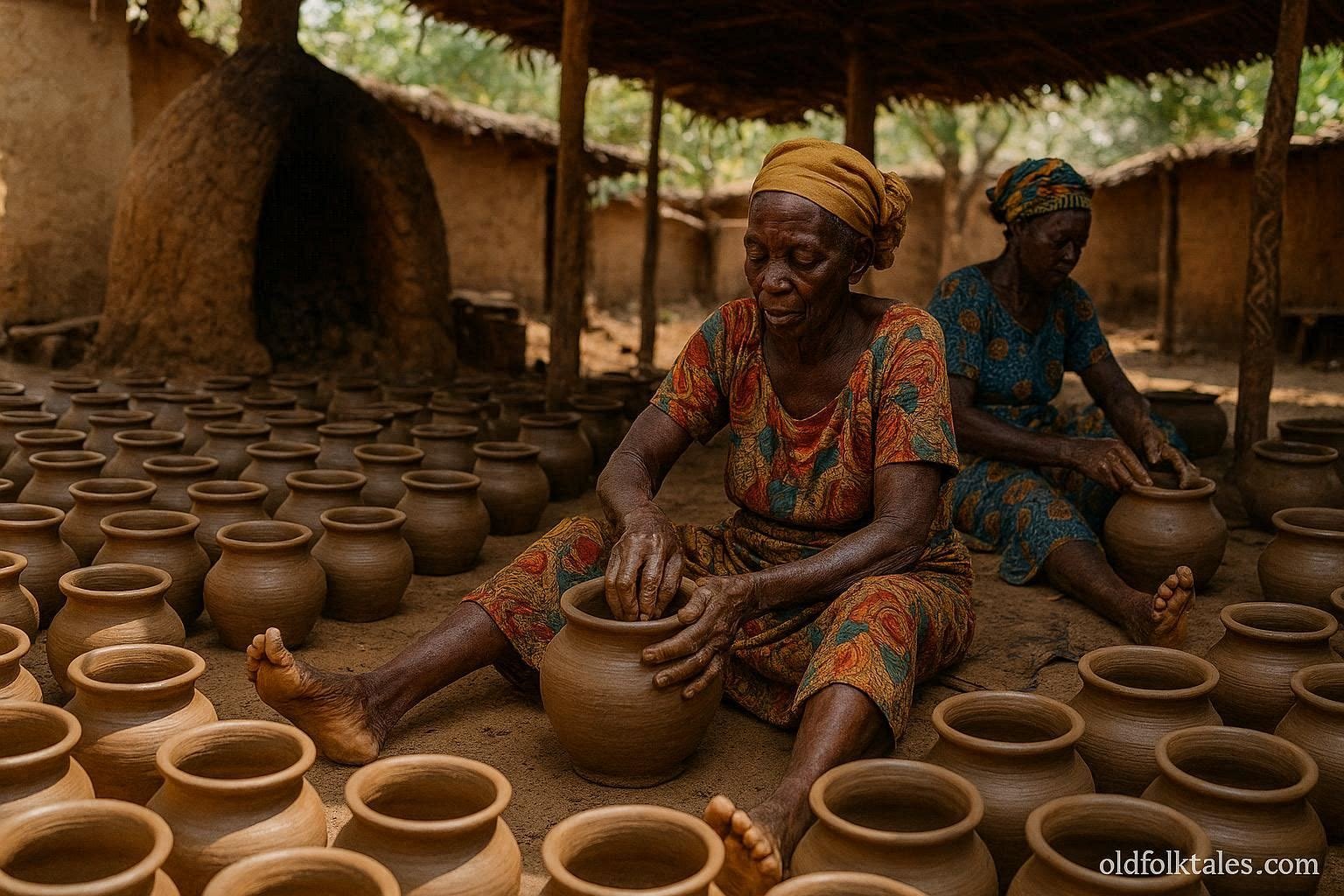
Nestled among the green hills of Togo, the communities of Kouma have long been known for their rich tradition of pottery making. For countless generations, families gathered fine clay from nearby streams and hillsides, carefully shaping it into cooking pots, water jars, storage vessels, serving bowls, and ceremonial containers. Every finished piece reflected not only the skill of the potter but also the knowledge that had been passed from one generation to another through patient observation and steady practice. Long before factories produced household containers, the people of Kouma depended upon these handmade vessels for nearly every part of daily life.
Pottery was never considered ordinary work. Within the community, a well made pot represented discipline, precision, and respect for tradition. Children grew up watching experienced potters knead clay, shape graceful curves with practiced hands, smooth rough surfaces, and carefully fire each vessel until it became strong enough for years of use. Elders often reminded young apprentices that clay could teach valuable lessons about life. It rewarded patience, punished carelessness, and reminded every artisan that lasting beauty could never be rushed.
Among the most respected potters in Kouma lived an elderly woman named Mama Akou. Her workshop stood beneath tall trees where cool shade protected freshly shaped clay from drying too quickly beneath the hot afternoon sun. Rows of finished pots lined wooden shelves while newly formed vessels rested quietly beneath woven mats as they slowly hardened before firing.
Every morning, villagers visited her workshop to purchase cooking pots, water jars, and ceremonial bowls. Many admired her work, but they admired her wisdom even more.
If you liked this story, see our Central African folktales collection
One season, a young girl named Esi asked to become her apprentice.
“I want to make pots as beautiful as yours,” Esi said eagerly.
Mama Akou smiled warmly.
“Then you must first learn to respect the clay.”
The following morning, before sunrise, they walked together toward a nearby stream where generations of potters had collected clay.
Esi expected to fill her basket quickly.
Instead, Mama Akou examined the earth carefully.
She picked up small handfuls, rubbed them between her fingers, and rejected several patches before finally choosing one.
Esi looked confused.
“Why not take the first clay we find?”
The old potter smiled.
“Every clay has its own character.”
“A wise potter learns to recognize the best.”
After gathering enough clay, they returned to the workshop.
The work had only begun.
The clay was cleaned carefully to remove tiny stones, roots, and leaves.
Water was added slowly.
The mixture was kneaded again and again until it became smooth and flexible.
Esi quickly grew tired.
She wiped the sweat from her forehead.
“I thought making pots meant shaping them.”
Mama Akou laughed softly.
“Good pots begin long before our hands shape them.”
Several days later, the clay was finally ready.
Mama Akou rolled a small ball before gently pressing it into a flat base.
Then she added long coils of clay one above another.
With slow movements, she blended each coil until the walls became smooth and strong.
Esi watched every movement with complete attention.
When it was her turn, she eagerly began building her own pot.
Everything seemed to go well until one side became much thicker than the other.
The vessel slowly leaned before collapsing.
Esi sighed.
“I have failed.”
Mama Akou carefully gathered the clay.
“No.”
“You have learned.”
She kneaded the clay once more.
“Clay is forgiving.”
“It allows us to begin again.”
Day after day, Esi practiced.
Some pots cracked while drying.
Others lost their shape.
Some became uneven during firing.
Each mistake became another lesson.
Gradually, her hands grew steadier.
Her movements became more confident.
She stopped rushing.
She began listening to the clay.
One afternoon, Mama Akou invited Esi to help prepare a large order for an upcoming community celebration.
The village needed dozens of cooking pots for the feast.
Families would prepare food together, and every household depended upon strong pottery.
Several experienced potters gathered inside the workshop.
Some shaped vessels.
Others polished surfaces with smooth stones.
Children carried water and stacked firewood for the kiln.
The entire community worked together.
As Esi looked around, she smiled.
“I thought each potter worked alone.”
Mama Akou gently shook her head.
“A craft survives because a community protects it.”
When every vessel had dried properly, the firing began.
The pots were arranged carefully inside a large outdoor kiln surrounded by firewood.
Mama Akou explained that too much heat could crack the pottery.
Too little heat would leave it weak.
The fire burned slowly throughout the day while experienced potters watched the flames with patient eyes.
Nobody hurried the process.
By evening, the kiln slowly cooled.
The following morning, the finished pottery emerged.
Strong.
Smooth.
Beautiful.
Esi proudly held one of the cooking pots she had shaped herself.
It was not perfect.
One side curved slightly more than the other.
Still, Mama Akou smiled with satisfaction.
“It will serve a family well.”
“That is what matters most.”
Years passed, and Esi became one of Kouma’s finest potters.
She learned how different clay mixtures created stronger vessels.
She mastered the careful timing required for drying and firing.
She also discovered that teaching others required as much patience as making pottery.
When young apprentices arrived at her workshop, eager to shape their first pots, they often became discouraged after making mistakes.
Esi would simply smile.
She handed them fresh clay and repeated the same words Mama Akou had once spoken.
“Clay is forgiving.”
“It allows us to begin again.”
Those simple words encouraged many young artisans to continue learning instead of giving up.
As time passed, visitors traveled to Kouma to admire the remarkable pottery created by local craftsmen and women.
Some purchased the vessels for cooking.
Others collected them as works of art.
Many left with a greater appreciation for the generations of knowledge hidden within every handmade piece.
Today, the pottery traditions of Kouma continue to preserve an important part of Togo’s cultural heritage. Skilled artisans still transform natural clay into practical and beautiful vessels while passing their knowledge to younger generations. Their work reflects patience, precision, and a deep respect for craftsmanship that continues to strengthen community life across the region.
The story of The Potters of Kouma reminds us that true mastery is shaped through patience, careful practice, and the willingness to learn from every mistake.
If you enjoyed this story, explore our full West African folktales collection
Moral Lesson
Patience, practice, and perseverance turn simple materials into lasting works of beauty and usefulness.
Knowledge Check
1. Why was pottery important in Kouma?
It provided vessels for cooking, storing food and water, and community ceremonies.
2. What was the first lesson Mama Akou taught Esi?
To respect the clay and choose the right material carefully.
3. Why did Esi’s first pot collapse?
Its walls were uneven because she rushed the shaping process.
4. What did Mama Akou mean when she said, “Clay is forgiving”?
Mistakes can become opportunities to learn and improve.
5. Why did the community help prepare the pottery for the celebration?
Because preserving the craft depended on cooperation and shared effort.
6. What is the main lesson of the story?
Patience, persistence, and careful learning lead to true craftsmanship.
Source
Adapted from the pottery traditions of the Kouma communities of Togo, with reference to Togolese craft heritage archives and ethnographic research on traditional pottery making.