In the heart of central Togo lies the vibrant town of Sokodé, a place long celebrated for its rich cultural traditions, lively markets, and skilled artisans. Among the Tem, also known as the Kotokoli people, craftsmanship has always been held in high regard. Every object created by hand reflected not only the ability of the maker but also the wisdom and patience passed down from parents to children. Whether weaving cloth, shaping leather, forging metal, or carving calabashes, artisans understood that true skill grew through years of careful practice rather than hurried effort.
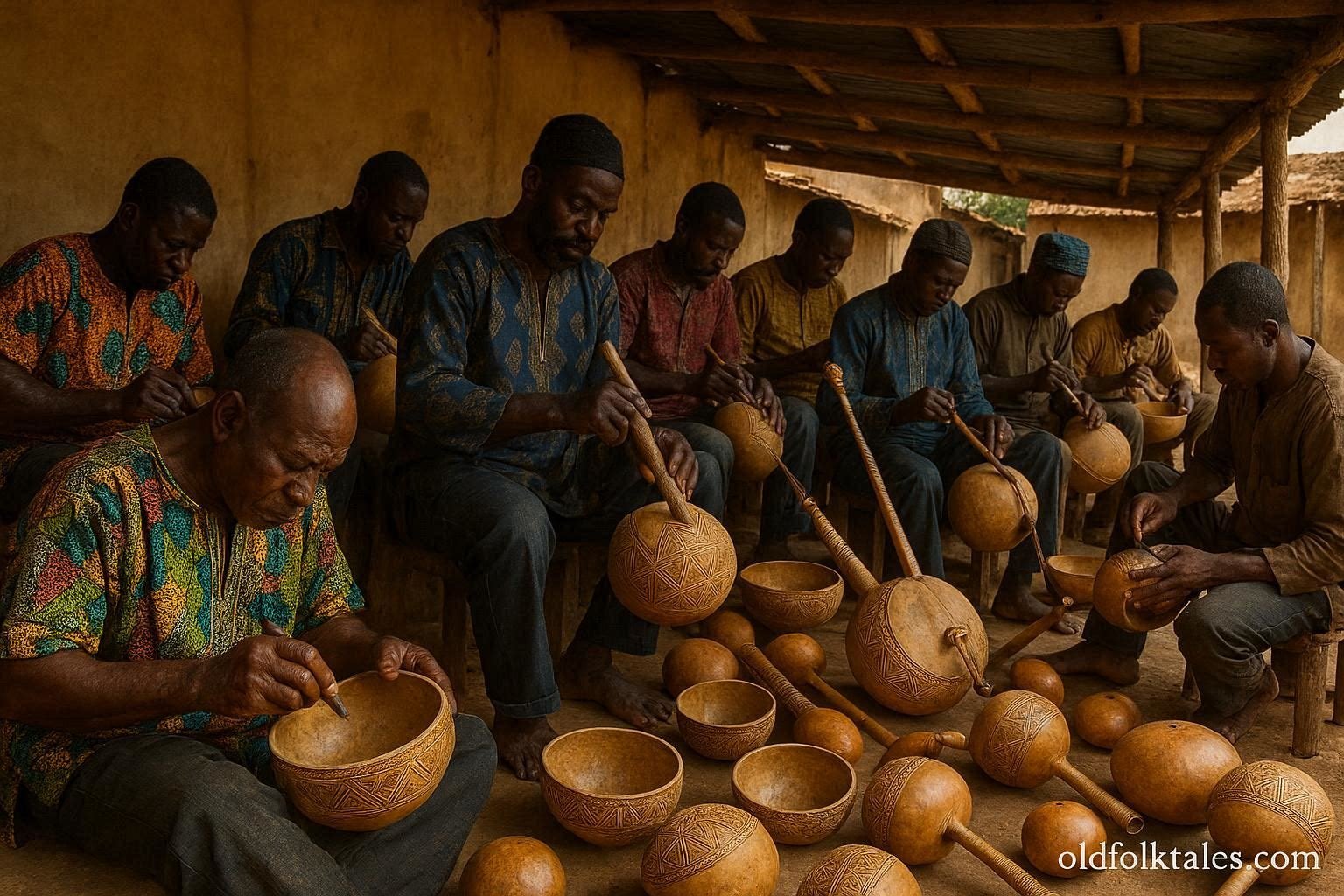
One of the most admired crafts in Sokodé was the art of decorating calabashes. After the gourds matured and dried beneath the warm West African sun, they became strong, lightweight vessels that served many purposes in daily life. Some were carefully shaped into bowls for serving food, while others became drinking cups, storage containers, or beautifully decorated gifts exchanged during family celebrations. Larger calabashes were transformed into musical instruments whose gentle rhythms accompanied songs, dances, and storytelling. Every carved design reflected the creativity of the artisan while preserving patterns that had been recognized within the community for generations.
Among the respected craftsmen of Sokodé lived an elderly carver named Baba Issa. His workshop stood beside the town’s busy marketplace, where the sounds of merchants, children, and travelers blended with the tapping of carving tools against smooth calabash shells. People often paused to admire the delicate patterns that slowly appeared beneath his careful hands.
His youngest apprentice was a curious boy named Farid.
Keep reading: Discover more Central African folktales
Every afternoon after helping his family, Farid hurried to the workshop, eager to learn the ancient craft.
On his first day, Baba Issa handed him a freshly dried calabash.
Farid examined its smooth surface with excitement.
“When do we begin carving?” he asked.
The old artisan smiled.
“We begin by learning to see.”
Farid looked puzzled.
“I can already see the calabash.”
“You see the shell,” Baba Issa replied.
“A craftsman must also see the story hidden inside it.”
The following morning, they visited nearby farms where calabashes had been harvested weeks earlier.
Baba Issa carefully inspected each one before selecting only those with thick, healthy shells.
Farid wondered why they did not simply take every calabash.
The old craftsman gently tapped one with his fingers.
“Each calabash has its own voice.”
“A good artisan listens before choosing.”
Back at the workshop, Baba Issa showed Farid how to clean the inside of each calabash until only the smooth outer shell remained.
The work required patience.
Nothing was rushed.
Every surface was polished carefully before any carving began.
When Farid finally reached for a carving knife, Baba Issa stopped him.
“First draw with your mind.”
The old craftsman slowly traced invisible lines across the shell with his fingertip.
“This pattern must remain balanced.”
“If one side is crowded, the beauty disappears.”
Farid spent the entire afternoon studying traditional designs instead of carving.
Although disappointed, he began noticing details he had never seen before.
Some patterns represented flowing rivers.
Others reflected growing plants.
Many were inspired by woven mats, family symbols, or geometric shapes passed down through generations.
Every design carried meaning.
The next day, Baba Issa finally allowed Farid to carve his first line.
His hand trembled slightly.
The cut wandered away from the pattern.
Farid sighed with frustration.
“I have ruined it.”
The old craftsman smiled kindly.
“No.”
“You have begun learning.”
Patiently, Baba Issa showed him how to guide the blade with slow, steady movements.
Little by little, Farid gained confidence.
Weeks turned into months.
Months became years.
The workshop filled with beautifully carved bowls, decorated drinking cups, storage containers, and musical rattles.
Each finished piece displayed remarkable attention to detail.
One market day, merchants from distant towns visited Sokodé.
They admired Baba Issa’s work and offered generous prices.
One trader pointed toward a beautifully carved serving bowl.
“I need twenty bowls like this before next week.”
Farid smiled excitedly.
“We can work day and night.”
Baba Issa shook his head gently.
“A hurried hand forgets what a patient hand remembers.”
The merchant understood.
He gladly agreed to wait.
Farid later asked why his teacher refused such an important opportunity.
The old artisan placed a finished bowl into the apprentice’s hands.
“Feel the surface.”
It was perfectly smooth.
Every carved line flowed naturally into the next.
“There are many bowls,” Baba Issa said.
“But only a few become treasures.”
One afternoon, the village musicians arrived carrying worn calabash rattles used during festivals.
Several had cracked after many years of use.
Baba Issa carefully repaired each instrument before replacing damaged parts with newly carved calabashes.
That evening, Farid attended the community celebration.
As dancers moved gracefully across the square, the gentle rhythm of the calabash instruments echoed beneath the stars.
Farid smiled with quiet pride.
He realized that the work of an artisan continued long after the carving was finished.
Their creations became part of family meals.
Community celebrations.
Traditional music.
Everyday life.
Several years later, Baba Issa grew too old to spend long hours carving.
Before retiring, he invited Farid into the workshop one final time.
He opened a small wooden chest containing his oldest carving knife.
The polished handle had grown smooth through decades of careful use.
“This belonged to my father,” Baba Issa said.
“He placed it in my hands when I became a master.”
Now he offered it to Farid.
The young artisan accepted it respectfully with both hands.
“I will protect our tradition.”
Baba Issa smiled.
“Do more than protect it.”
“Teach it.”
Farid fulfilled that promise faithfully.
Young apprentices soon gathered inside his workshop just as he once had beside his own teacher.
Whenever they eagerly asked when carving would begin, Farid always gave the same answer.
“We begin by learning to see.”
His students often laughed in confusion.
Only years later did they fully understand those words.
Today, the decorative calabash traditions of Sokodé continue to celebrate the creativity and craftsmanship of the Tem people. Skilled artisans preserve techniques passed down through generations, transforming natural materials into objects of beauty and practical value. Their work reflects a rich artistic heritage that continues to inspire visitors while strengthening cultural identity across central Togo.
The story of The Calabash Carvers of Sokodé reminds us that true craftsmanship begins with patience, careful observation, and a willingness to preserve the wisdom entrusted by those who came before us.
Want more? Read more West African folktales now
Moral Lesson
Great craftsmanship is built through patience, practice, and faithfully passing knowledge from one generation to the next.
Knowledge Check
1. Why were calabashes important in Sokodé?
They were transformed into bowls, cups, storage containers, and musical instruments used in everyday life.
2. What was the first lesson Baba Issa taught Farid?
That a craftsman must learn to see the story hidden inside every piece before beginning to carve.
3. Why did Baba Issa choose only certain calabashes?
Because strong, healthy shells produced the best quality finished work.
4. Why did Baba Issa refuse to rush the merchant’s order?
He believed beautiful craftsmanship could never be hurried.
5. What gift did Baba Issa give Farid before retiring?
His father’s old carving knife.
6. What is the main lesson of the story?
Patience, careful learning, and preserving tradition create lasting works of art.
Source
Adapted from the artistic traditions of the Tem (Kotokoli) communities of Sokodé, with reference to Sokodé cultural heritage archives, Togolese craft studies, and ethnographic research on traditional calabash carving.