In the northern reaches of Togo lies the extraordinary cultural landscape of Koutammakou, home of the Batammariba people. Rolling hills, rocky outcrops, fertile valleys, and scattered woodlands create a landscape unlike any other in West Africa. Rising from this land are distinctive earthen tower houses known as takienta, carefully built from clay, timber, and other natural materials gathered nearby. These remarkable homes have stood for generations as symbols of the Batammariba way of life, reflecting a deep understanding of architecture, family, security, and the surrounding environment.
Each earthen tower house was much more than a place to sleep. Every room, staircase, rooftop, and courtyard served a purpose shaped by centuries of experience. Families stored grain safely above the ground, sheltered livestock, prepared meals, welcomed guests, and performed important family ceremonies within these carefully designed homes. Elders taught that building a takienta was not simply construction. It was a responsibility that connected every generation to the land and to the wisdom of their ancestors. Children learned from an early age that caring for a home also meant caring for the family, the community, and the environment that provided every building material.
Among one Batammariba family lived a curious boy named Tando. Every evening he climbed onto the flat roof of his family’s tower house to watch the sun disappear behind the distant hills. From there he admired dozens of similar homes rising across the landscape like sturdy guardians watching over the valleys below.
One evening he asked his grandfather, Kpoti, a question that had long filled his mind.
Fascinated by this tale? Discover more North African folktales
“Who taught our people to build homes like these?”
His grandfather smiled as he rested his hand upon the smooth earthen wall.
“Our greatest teachers were the land itself.”
Tando looked around with curiosity.
“The land?”
Kpoti nodded.
“Our ancestors watched the hills.”
“They studied the wind.”
“They learned from the rain.”
“They understood that a home must live peacefully with nature rather than fight against it.”
The following morning, Kpoti invited Tando to help repair a neighboring family’s house before the arrival of the rainy season.
As they walked through the village, Tando noticed that many families were already working together.
Some collected clay from a nearby pit.
Others carried water from a stream.
Young people gathered bundles of grass and carefully selected strong wooden poles.
Everyone had a task.
When they reached the house, Kpoti explained that the walls needed fresh layers of carefully prepared earth to protect them from seasonal rains.
Tando eagerly filled a basket with dry soil.
His grandfather gently stopped him.
“Not every soil is the same.”
He knelt and picked up a handful of fine clay.
“This earth holds together.”
“It becomes stronger when mixed correctly.”
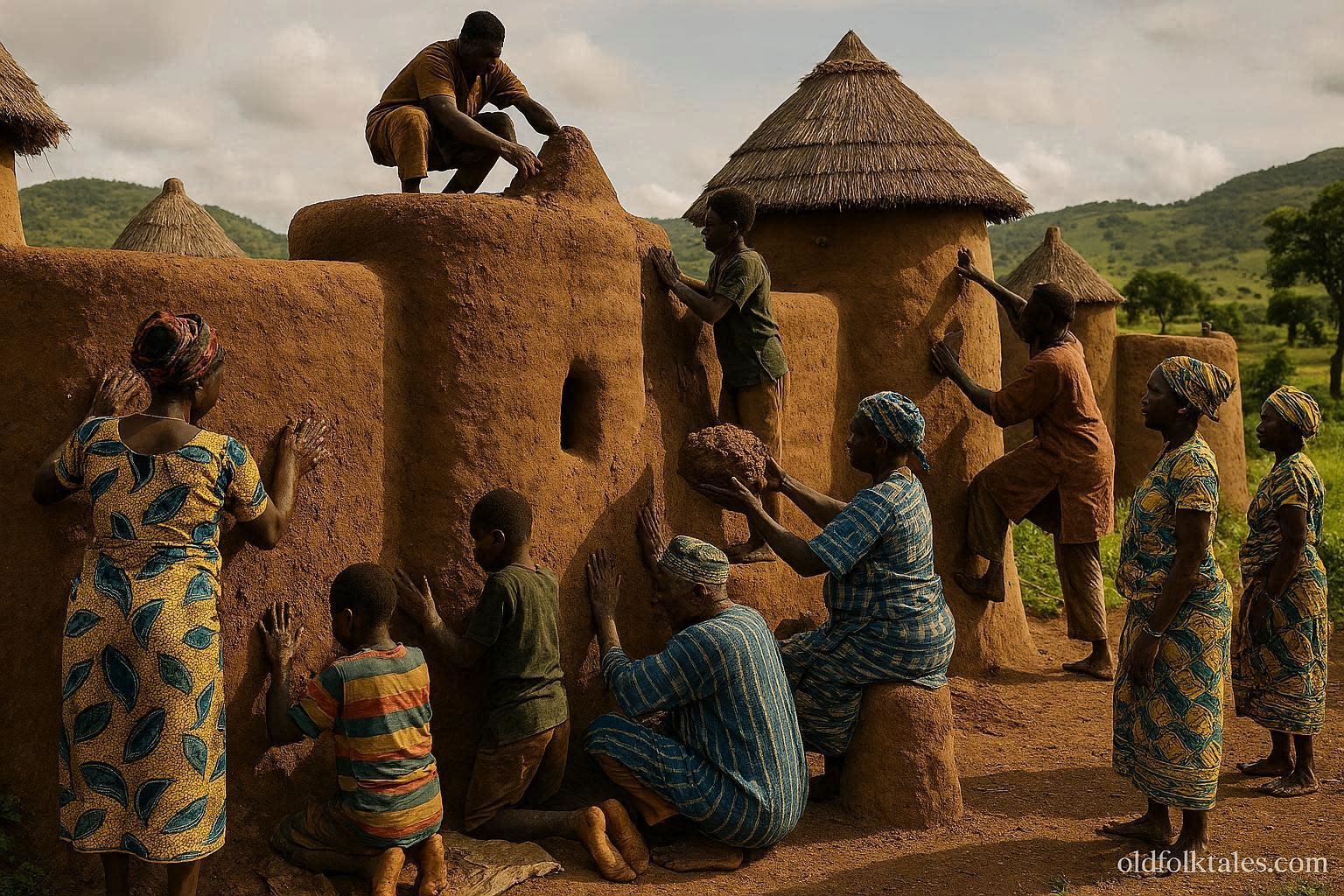
Nearby, experienced builders blended clay with water and natural fibers until the mixture became smooth and firm.
Children helped carry the prepared earth while older workers carefully pressed it onto the walls by hand.
No one rushed.
Every layer was shaped patiently.
Every surface was smoothed with careful attention.
As the work continued, Tando noticed that nobody worked for payment.
Families freely helped one another.
When one house required repairs, the entire community came together.
He quietly asked his grandfather why everyone worked so willingly.
Kpoti smiled.
“Today we build this house.”
“Tomorrow others may help repair ours.”
“A strong village begins with strong neighbors.”
Later that afternoon, an elderly woman invited everyone to rest beneath a large tree.
She served millet porridge and cool water while sharing stories about builders from long ago.
She explained how every takienta reflected the needs of the family who lived within it.
Some houses sheltered larger families.
Others included spaces for storing extra grain during plentiful harvests.
Every design respected both tradition and practical living.
The next day, Kpoti showed Tando the upper level of a newly completed tower house.
He pointed toward the flat rooftop.
“This is where grain dries safely beneath the sun.”
He then showed him the rounded storage rooms.
“They protect our harvest from moisture.”
Finally, he pointed toward narrow entrances and thick earthen walls.
“They help keep our families safe.”
Tando realized that every part of the building served an important purpose.
Nothing had been added simply for decoration.
Everything reflected thoughtful planning.
Several weeks later, powerful rains swept across the hills.
Streams overflowed.
Strong winds bent tall grasses.
Many modern structures in distant towns suffered damage from the storm.
When the rain finally ended, Tando walked through his village.
The sturdy earthen tower houses still stood proudly across the landscape.
Their thick walls had protected families through another rainy season just as they had done for generations.
His grandfather smiled when he saw Tando examining the buildings.
“Now you understand why we care for them every year.”
“They protect us because we protect them.”
As the seasons passed, Tando eagerly learned more about traditional building.
He discovered how builders selected timber without harming the surrounding forest.
He learned why repairs were completed before heavy rains arrived.
He understood that maintaining a house required the same patience as building one.
One afternoon, visitors from another country arrived to learn about the remarkable architecture of Koutammakou.
They admired the beauty of the tower houses and asked many questions about their construction.
One visitor asked Kpoti why the Batammariba continued using traditional methods when modern materials were available.
The old builder smiled kindly.
“Our homes belong to this land.”
“They breathe with the seasons.”
“They remind us who we are.”
His answer remained with Tando long after the visitors departed.
Years later, Tando became one of the village’s most respected builders.
Young apprentices followed him across the hills, eager to learn the ancient techniques.
He never began a lesson by discussing walls or roofs.
Instead, he always started with the same words his grandfather had once spoken.
“The land is our first teacher.”
He reminded every apprentice that a beautiful house could not be built through strength alone.
It required observation.
Patience.
Cooperation.
Respect for nature.
Respect for family.
Respect for tradition.
Today, the remarkable earthen tower houses of Koutammakou remain one of Africa’s most celebrated examples of traditional architecture. Recognized as a UNESCO World Heritage cultural landscape, they continue to demonstrate the Batammariba people’s deep understanding of sustainable building, environmental harmony, and community cooperation. Their homes stand as living symbols of resilience and cultural identity, inspiring admiration from visitors while continuing to shelter families just as they have for centuries.
The story of Koutammakou’s Earthen Castles reminds us that the strongest foundations are built not only with earth and timber but also with shared knowledge, mutual support, and respect for the environment.
If you enjoyed this story, explore our full West African folktales collection
Moral Lesson
Homes built with wisdom, cooperation, and respect for nature can serve generations with strength and dignity.
Knowledge Check
1. What are the traditional Batammariba tower houses called?
They are called takienta.
2. Why were the earthen houses important?
They protected families, stored food, and reflected generations of architectural knowledge.
3. What did Tando learn about building materials?
That choosing the right clay and preparing it carefully was essential.
4. Why did the whole community help repair houses?
Because cooperation strengthened every family and ensured everyone received help when needed.
5. What did Kpoti mean when he said the land was their first teacher?
The Batammariba learned to build by observing nature, the seasons, and the environment.
6. What is the main lesson of the story?
True strength comes from combining traditional wisdom, community cooperation, and respect for nature.
Source
Adapted from the cultural traditions of the Batammariba people of northern Togo, with reference to the UNESCO World Heritage Centre, Koutammakou cultural landscape documentation, and Batammariba ethnographic archives.