The Muchinga Mountains stretch across northeastern Zambia, their rocky slopes, forests, and valleys inspiring generations of stories among the Bisa people. Elders say that every mountain has a memory and every stone has witnessed the passing of countless generations. Among these stories, none is told with greater respect than the legend of the Sleeping Giant, a mighty guardian whose peaceful rest depends upon the kindness and wisdom of those who live upon the land. Through this tale, children learn that caring for nature is one of life’s greatest responsibilities.
Long ago, before roads crossed the mountains and before distant travelers knew the beauty of the Muchinga range, the Bisa people lived in small villages scattered along the valleys below the towering hills. Their lives depended upon the forests that provided medicine, the streams that carried fresh water, and the fertile soil where they planted their crops.
Every morning the mountains greeted the people with cool mist that slowly disappeared beneath the warm African sun.
The elders often reminded the children that the mountains were older than any living person.
“They watched our grandparents.”
“They watched their grandparents before them.”
“And they will still stand long after we are gone.”
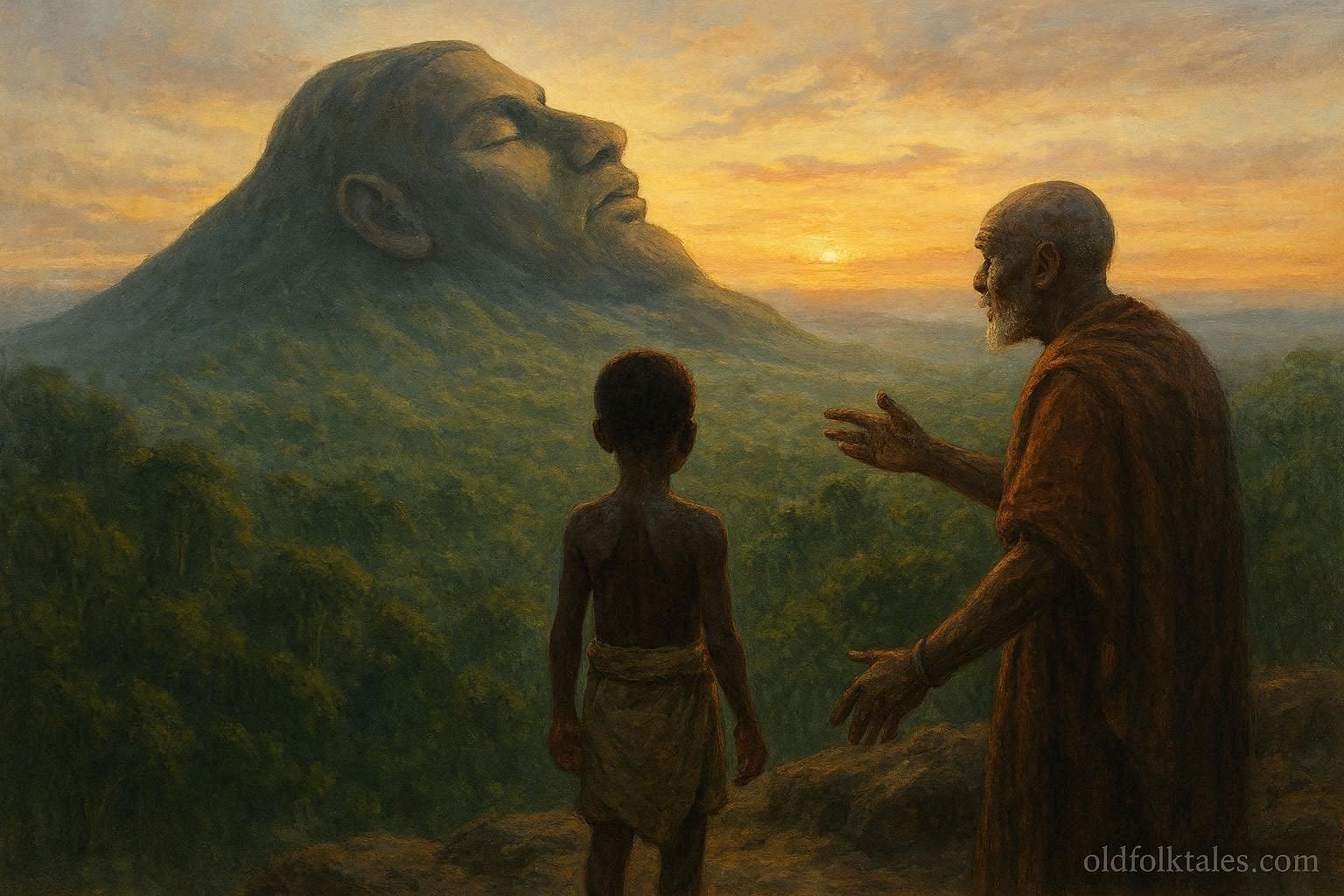
Among all the peaks stood one enormous rocky hill unlike the others.
From a distance its shape resembled the body of a giant lying peacefully upon the earth.
Its rounded summit looked like a great head resting upon folded arms.
Children often pointed toward it and laughed.
“It looks like a sleeping man.”
The elders would smile but quickly grow serious.
“That is because it is.”
The children always leaned closer.
They loved hearing the ancient legend.
Don’t stop yet! See our complete East African folktales collection
According to the oldest storytellers, a mighty giant spirit had once wandered across the mountains long before villages were built.
He protected the forests from careless hunters.
He guided rivers through the valleys.
He helped animals find safe places during long dry seasons.
When his work was complete, he asked the Creator for permission to rest forever among the mountains he loved.
The Creator granted his request.
The giant slowly lay down upon the highest hill.
His body became stone.
His breath became the cool mountain breeze.
His heartbeat became the steady rhythm of flowing streams.
Before falling into his endless sleep, he made one promise.
“As long as people honor this land, I shall sleep peacefully.”
“But if greed destroys what has been entrusted to them, I shall awaken.”
No one wished to test those words.
For generations the Bisa people cared for the mountain with great respect.
Hunters took only what their families needed.
Woodcutters never cleared more trees than necessary.
Young people were taught never to light careless fires near the forests.
Travelers thanked the mountain before beginning long journeys.
The land remained healthy.
Streams flowed clearly.
Animals continued returning each season.
In one nearby village lived a curious boy named Chanda.
Unlike many children, he loved climbing hills and exploring quiet places.
Whenever his chores were finished, he wandered among the rocky paths listening to birds sing through the trees.
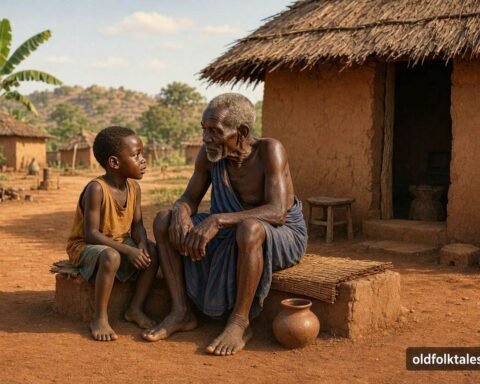
His grandfather often accompanied him.
One afternoon they stopped beneath a large fig tree overlooking the giant shaped hill.
Chanda studied the mountain carefully.
“Grandfather, do you truly believe a giant sleeps there?”
The old man smiled.
“Whether you believe the story or not is less important than understanding why it is told.”
“What do you mean?”
“The giant reminds us that the land is alive.”
“When we care for it, everyone benefits.”
“When we destroy it, everyone suffers.”
Chanda thought quietly about those words.
Several years passed.
The villages enjoyed many good harvests.
Then strangers arrived carrying sharp axes and speaking excitedly about the valuable timber growing along the mountain slopes.
Unlike the villagers, they saw only wealth.
They ignored the advice of the elders.
Each day more trees disappeared.
Small streams that once flowed throughout the year began drying earlier than usual.
Birdsong became quieter.
Animals moved deeper into the forest.
The villagers grew worried.
One evening the oldest elder called everyone together.
“The mountain is changing.”
“We must protect it before greater harm comes.”
Some listened carefully.
Others believed the forests would always recover on their own.
One morning Chanda climbed the familiar path toward the giant shaped hill.
Something felt different.
The cool breeze that usually greeted him had become strangely still.
The forest was unusually silent.
Even the insects seemed quieter.
As he reached the rocky summit, he noticed something remarkable.
A small crack had appeared across one enormous stone that formed what looked like the giant’s shoulder.
He gently touched the rock.
It felt unexpectedly warm.
Startled, he stepped back.
For a brief moment he thought he heard a slow, deep sound echoing beneath the mountain.
It resembled the steady beat of an enormous heart.
Chanda hurried back to the village.
His grandfather listened carefully without interrupting.
Finally the old man nodded.
“The legend is reminding us.”
“Not because a giant wishes to frighten us.”
“But because nature always warns those willing to listen.”
The following morning the elders visited the damaged forest themselves.
They saw fresh tree stumps stretching farther than ever before.
Dry streambeds crossed the valley.
Even the soil had begun washing away after recent rains.
The signs were impossible to ignore.
That evening every family gathered beneath the great meeting tree.
The village chief stood slowly before them.
“If the mountain truly carries a sleeping guardian, then we have already received its warning.”
“If the story is only a story, the land itself has still spoken.”
“Either way, we must change.”
The villagers agreed.
From that day forward they organized teams to restore the damaged woodland.
Young people planted native trees.
Hunters protected breeding areas for wildlife.
Families agreed upon rules that limited unnecessary cutting.
Children were taught why healthy forests protected rivers, animals, and future harvests.
Little by little, the mountain began to heal.
The cool breeze returned.
Birds built new nests among growing branches.
Clear water once again flowed through streams that had nearly disappeared.
One evening Chanda climbed the hill again.
The great stone remained peaceful beneath the golden light of sunset.
He placed one hand gently upon the warm rock.
This time he heard only the whisper of the wind moving through the trees.
He smiled.
Perhaps the giant had never truly stirred.
Or perhaps the mountain simply knew that its people had remembered their responsibility.
Either way, the lesson would never be forgotten.
The years that followed brought new generations of children to the villages beneath the Muchinga Mountains. Chanda eventually became one of the respected elders, and every season he led young people along the ancient mountain paths. Instead of beginning the journey with warnings, he began with a question.
“What do you hear?”
Some children answered,
“I hear birds.”
Others replied,
“I hear the wind.”
A few listened carefully and said,
“I hear the stream.”
Chanda smiled each time.
“As long as you can hear these voices, the mountain is healthy.”
He then told them the legend of the Sleeping Giant, not to make them fear the mountain, but to help them understand that every forest, river, and hill depended on the choices people made every day.
The children learned never to leave fires burning after camping.
They learned to protect young trees instead of cutting them down.
They learned to collect only what they needed from the forest and to leave enough for wildlife and future generations.
As they grew older, they passed these same lessons to their own children.
Visitors who traveled through the Muchinga Mountains often admired the healthy forests and clean streams. When they asked why the villages cared so deeply for the land, the elders simply smiled.
“We protect the mountain.”
“And the mountain protects us.”
Whether the giant truly slept beneath the rocks or lived only within the stories of the elders no longer mattered. The legend had achieved something far greater than proving itself true.
It had inspired generations of people to become faithful guardians of the land.
Today, the Muchinga Mountains remain one of Zambia’s remarkable natural landscapes, celebrated for their forests, rivers, wildlife, and cultural importance. Oral traditions among communities living in the region continue to remind people that the land should be treated with respect because the well being of future generations depends upon the choices made today.
The story of The Sleeping Giant of Muchinga teaches that the greatest guardian of nature is not a giant hidden beneath a mountain but the people who choose to care for the world around them. When communities protect the land with wisdom and humility, they ensure that both nature and tradition continue to thrive for generations yet to come.
Love this story? Discover our full Southern African folktales collection
Moral Lesson
Nature does not need a giant to defend it. It needs people who act with wisdom, humility, and responsibility. When we protect the environment today, we preserve life, heritage, and hope for tomorrow.
Knowledge Check
1. Why did the elders tell the story of the Sleeping Giant?
To teach younger generations the importance of respecting and protecting the land.
2. What promise did the giant make before falling asleep?
He promised to sleep peacefully as long as people honored and cared for the land.
3. What happened when strangers cut down too many trees?
Streams began drying up, wildlife moved away, and the forest started to deteriorate.
4. What lesson did Chanda learn from his grandfather?
He learned that the legend was meant to remind people that nature is alive and deserves respect.
5. How did the villagers restore the mountain?
They planted native trees, protected wildlife, cared for streams, and limited unnecessary tree cutting.
6. What is the central message of the story?
Communities become the true guardians of nature when they protect the environment with care and responsibility.
Source
Inspired by oral traditions associated with the Muchinga Mountains and the cultural heritage of the Bisa people, with reference to Muchinga oral traditions, Zambia heritage studies, and research on indigenous environmental knowledge in Zambia.