The forests of the Muchinga Hills have long inspired stories among the Bisa people of northeastern Zambia. Elders say that the hills remember every footprint left upon their paths and every promise made beneath their trees. Among the most respected legends is the tale of the Invisible Hunters, ancestral guardians who are believed to watch over the forest. Though unseen by ordinary eyes, their presence is said to guide those who hunt with respect and warn those whose greed threatens the balance of nature.
Every morning the Muchinga Hills awakened before the villages below.
Mist drifted slowly through the valleys.
Birds greeted the sunrise with cheerful songs.
Antelope quietly emerged from the woodland while streams carried clear water through the rocky landscape.
For generations, the Bisa people had depended upon these forests for food, medicine, shelter, and fresh water.
The elders taught that every tree deserved respect and every animal played an important role in the balance of the land.
Long ago, they said, there lived a group of remarkable hunters.
These men and women never hunted for pride.
Want to dive deeper? Read more North African folktales today
They never killed more than their families needed.
Before entering the forest, they always thanked the Creator for the gifts of nature.
Before returning home, they thanked the animals whose lives had sustained the community.
When these hunters finally departed from the world, the ancestors rewarded their wisdom.
Rather than allowing them to disappear completely, they became invisible guardians of the Muchinga forests.
From that day forward, they quietly watched over every path, every stream, and every animal.
No one could see them.
Yet many believed their footsteps could still be heard on quiet mornings.
Among the children who loved listening to these stories was a thoughtful boy named Chibesa.
Unlike his friends, he never laughed when the elders spoke about invisible hunters.
He enjoyed exploring the forests with his father and often wondered whether the unseen guardians truly walked among the trees.
One evening, while repairing hunting nets, Chibesa asked his grandfather,
“Have you ever seen the Invisible Hunters?”
The old man smiled.
“No.”
“Then how do you know they exist?”
His grandfather gently placed another knot into the net.
“Not everything important can be seen.”
“Sometimes we recognize a guardian by the good it protects.”
Chibesa thought carefully about those words.
Several weeks later, his father announced that Chibesa would accompany him on his first proper hunting journey.
The boy could hardly sleep.
Before sunrise they joined several experienced hunters at the edge of the forest.
The oldest hunter spoke quietly before anyone entered.
“We hunt with gratitude.”
“We hunt with restraint.”
“We hunt only what our families truly need.”
Everyone nodded.
They understood the rules their ancestors had followed for generations.
As they walked deeper into the forest, Chibesa noticed how carefully the hunters moved.
No one shouted.
No one frightened animals unnecessarily.
Broken branches were avoided whenever possible.
Even their footsteps seemed respectful.
His father whispered,
“The forest hears everything.”
Hours later they spotted a small antelope grazing peacefully.
The hunters watched patiently.
One experienced hunter quietly lowered his bow.
“It is too young.”
“We leave it.”
Chibesa smiled.
He had expected hunters to celebrate every opportunity.
Instead they showed remarkable patience.
As the sun climbed higher, they eventually found an older antelope suitable for the community’s needs.
Only one animal was taken.
No one suggested hunting another.
“This is enough,” his father said.
“Our families will eat.”
“The forest will remain healthy.”
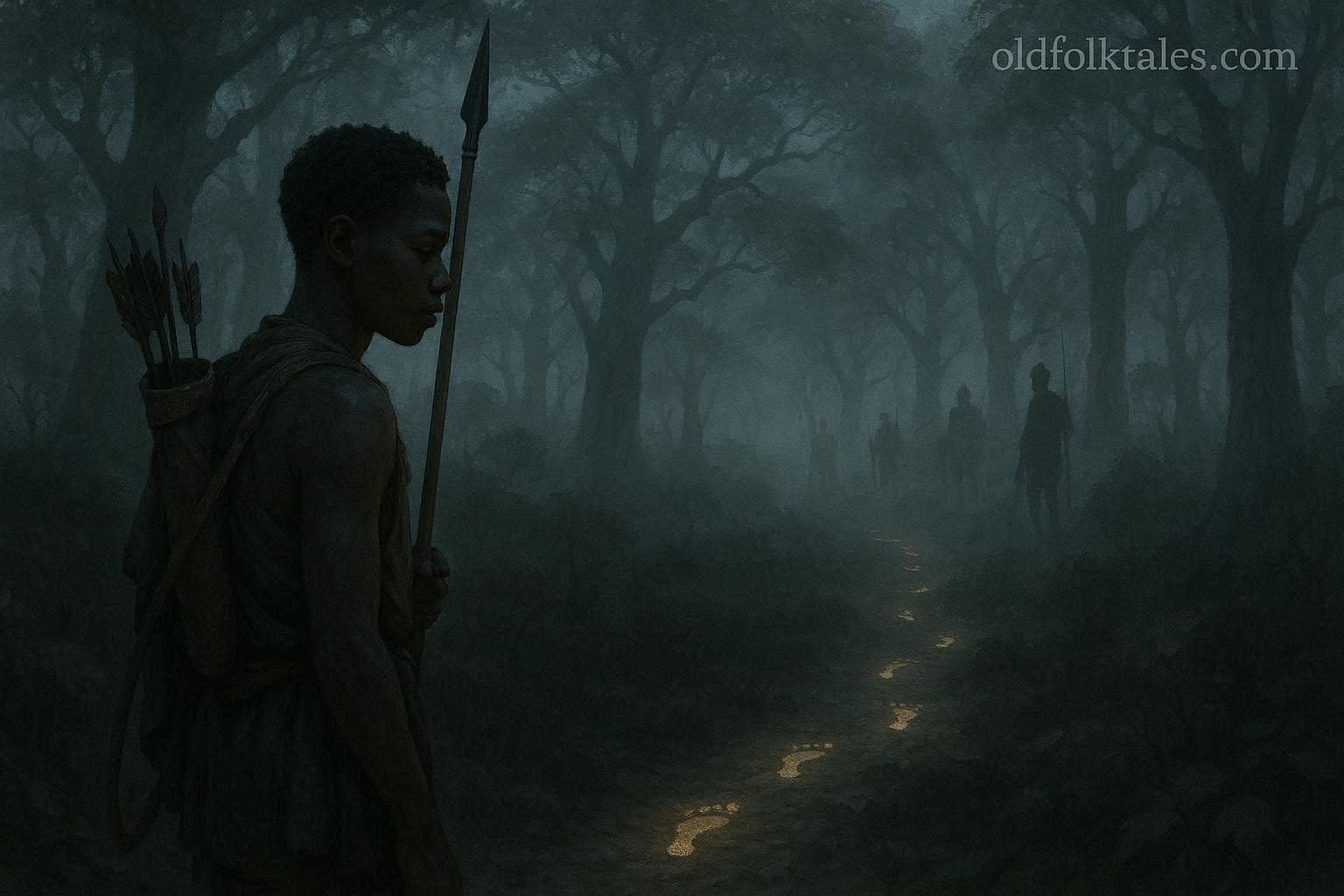
As they prepared to return home, Chibesa noticed something unusual.
Fresh footprints appeared along a narrow path ahead of them.
They resembled human footprints.
Yet none of the hunters had walked there.
He looked around.
The forest remained perfectly still.
“Father.”
His father stepped closer.
“What is it?”
“There are footprints.”
The older man studied them quietly.
Then he smiled.
“Sometimes the forest reminds us we are never alone.”
Chibesa looked carefully.
The footprints continued for a short distance before disappearing completely upon solid rock.
No broken branches surrounded them.
No other signs of travelers appeared.
The mystery remained.
Several months later, strangers entered the Muchinga forests.
Unlike the Bisa hunters, they cared little for balance.
They trapped more animals than necessary.
They ignored breeding seasons.
They left broken branches and abandoned camps behind them.
The elders became deeply concerned.
“Greed has entered the forest.”
One evening the strangers prepared another hunting expedition.
Confident in their skill, they laughed at the warnings about ancestral guardians.
“There are no invisible hunters.”
“There are only frightened old stories.”
The following morning they disappeared into the forest.
Hours passed.
Then an entire day.
Finally, exhausted and confused, they returned to the village.
They insisted that every familiar path had somehow vanished.
Each trail seemed to lead them back to the same enormous baobab tree.
No matter which direction they chose, they could not find fresh game.
Their traps remained empty.
One man quietly admitted,
“It felt as though someone was watching us.”
The village elders exchanged knowing glances but said nothing.
The strangers soon left the area, deciding to hunt elsewhere.
Peace gradually returned to the Muchinga forests.
One cool morning, Chibesa and his grandfather climbed a rocky hill overlooking the woodland.
The old man pointed toward the valleys below.
“Do you hear anything?”
Chibesa listened carefully.
“I hear birds.”
“I hear the stream.”
“I hear the wind.”
His grandfather nodded.
“That is because the forest is healthy.”
He paused before continuing.
“When people respect nature, the Invisible Hunters never need to reveal themselves.”
Chibesa smiled.
Perhaps the unseen guardians truly walked among the trees.
Or perhaps the elders had created the legend to teach every generation an important responsibility.
Either way, Chibesa understood that the lesson was real.
As the years passed, he became one of the most respected hunters in the Muchinga Hills. Before every hunting journey, he gathered the younger hunters beneath a large wild fig tree and reminded them of the ancient customs.
“We do not enter this forest as owners.”
“We enter as caretakers.”
He taught them to recognize animal tracks without disturbing nesting places.
He showed them how to leave waterholes undisturbed during the dry season so wildlife could survive.
He insisted that injured animals should never be left to suffer and that young animals should always be spared to allow future generations to thrive.
Some of the younger hunters asked him,
“Have you ever truly seen the Invisible Hunters?”
Chibesa smiled just as his grandfather once had.
“No.”
“But I have seen forests protected because people believed they were watching.”
The young hunters thought carefully about his answer.
One dry season, a wildfire broke out after careless travelers abandoned a cooking fire.
The flames spread quickly through the grasslands toward the forest.
The villagers rushed together carrying water, branches, and shovels.
Men, women, and children worked side by side until sunset, creating firebreaks and extinguishing the advancing flames.
When the fire was finally brought under control, much of the forest had been saved.
That evening, while everyone rested beneath the stars, one elderly woman quietly pointed toward the hills.
For a brief moment, several people thought they heard distant footsteps moving through the trees.
Slow.
Steady.
Confident.
No one could see anyone.
The sound faded as gently as it had come.
The oldest elder smiled.
“The guardians are satisfied.”
No one argued.
Some believed the footsteps belonged to the Invisible Hunters.
Others believed the sound came from the mountain itself.
Whatever the explanation, everyone understood the message.
The forest had been protected because people had worked together instead of waiting for someone else to act.
As Chibesa grew old, he often walked through the Muchinga Hills with his grandchildren.
Instead of teaching them only how to track animals, he taught them how to appreciate birdsong, recognize medicinal plants, protect young trees, and respect every stream flowing through the valleys.
“The greatest hunter,” he often said, “is not the one who brings home the most meat.”
“It is the one who leaves the forest healthy for those who come after him.”
His grandchildren never forgot those words.
Long after Chibesa had joined the ancestors, parents continued telling children about the Invisible Hunters.
Whether the guardians truly walked unseen among the trees or lived only within the wisdom of the elders no longer mattered.
The legend continued because it inspired people to protect what could never be replaced.
Today, the forests of the Muchinga region remain important for their wildlife, biodiversity, and cultural heritage. Oral traditions among the Bisa people continue to emphasize that humans are caretakers rather than owners of nature. Stories like The Invisible Hunters of the Muchinga Hills preserve indigenous environmental knowledge while encouraging future generations to respect wildlife and protect the forests that sustain life.
The legend reminds us that the strongest guardians are often those whose influence is felt rather than seen. Through wisdom, responsibility, and respect for nature, every person can become an invisible protector of the world around them.
Don’t miss out: Read more Southern African folktales
Moral Lesson
Nature thrives when people act with respect and restraint. True courage is shown not by taking more from the land but by protecting it for future generations.
Knowledge Check
1. Who were the Invisible Hunters according to the Bisa legend?
They were ancestral hunters believed to protect the forests after becoming unseen guardians.
2. Why did the ancient hunters earn the honor of becoming guardians?
They hunted responsibly, respected wildlife, and never took more than their communities needed.
3. What lesson did Chibesa learn during his first hunting journey?
He learned that hunting should be guided by gratitude, patience, and respect for nature.
4. What happened to the careless strangers who ignored the elders’ warnings?
They became confused in the forest, found no game, and eventually left the area.
5. How did the villagers protect the forest during the wildfire?
They worked together to stop the flames and save much of the woodland.
6. What is the central lesson of the story?
People become the true guardians of nature when they care for the environment with wisdom, humility, and responsibility.
Source
Inspired by Bisa oral traditions associated with the Muchinga Hills and indigenous conservation beliefs, with reference to Muchinga oral traditions, Zambia ethnographic research, and studies on traditional ecological knowledge in Zambia.