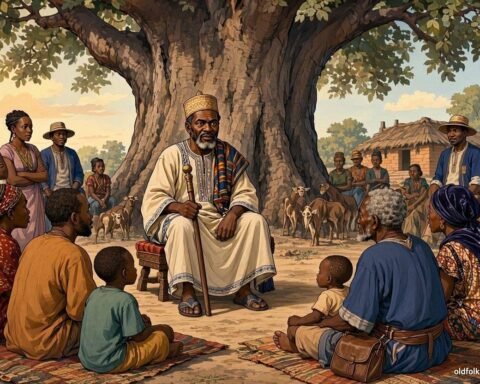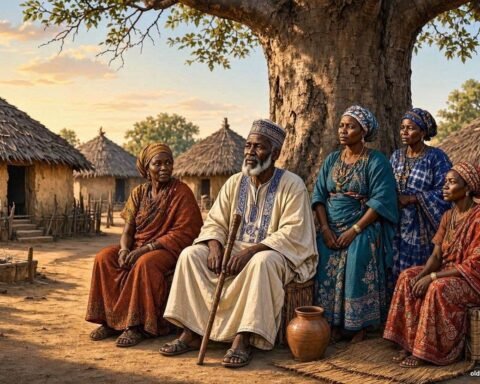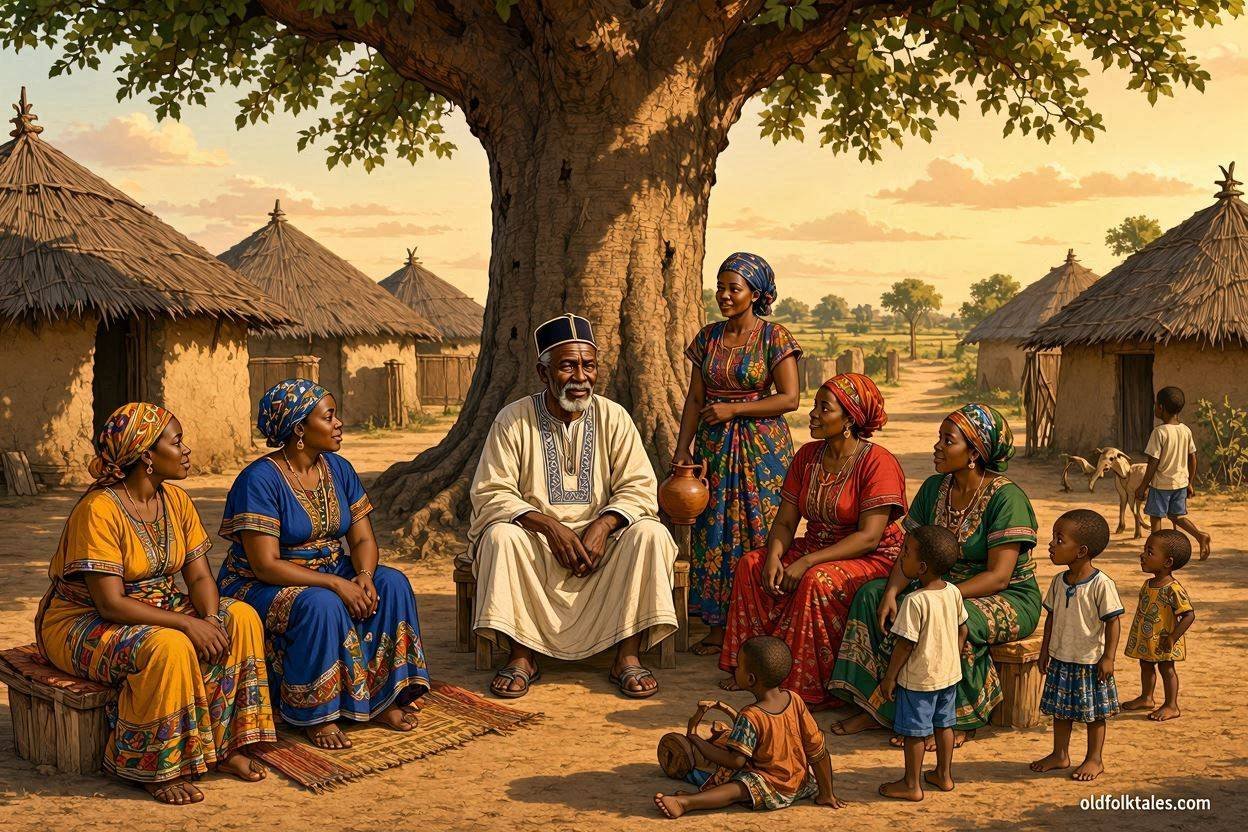
In the fertile lands of the Wolof people, where millet fields stretched toward the horizon and the evening breeze carried songs from village courtyards, there lived an elderly man named Burr Njai. He was respected by everyone who knew him. Years of honest labor had filled his granaries, and his wisdom had settled many disputes among neighbors.
Burr Njai had three wives who had shared his home for many years. Though they often disagreed, they had learned to live together with patience. Each wife managed her own cooking fire, cared for her own children, and contributed to the welfare of the family. The compound was rarely silent, for children laughed beneath the shade of the baobab tree while women pounded millet and elders exchanged stories beneath the evening sky.
As Burr Njai grew older, many expected him to spend the rest of his days enjoying the peace he had built. Instead, he surprised the entire village.
One market day he returned with a young woman named Ndey, whom he introduced as his fourth wife.
The compound fell silent.
His older wives greeted the newcomer politely, but behind their smiles lived uncertainty. Some wondered why an old man who already had a large family desired another wife. Others feared that affection and resources would no longer be shared fairly.
At first Burr Njai noticed none of these worries. He believed kindness alone would keep everyone united.
Looking for more? Explore the magic of East African folktales here
“I have enough for all,” he often declared. “No one will lack food or clothing in this household.”
But fairness is more difficult than generosity.
The youngest wife naturally received more attention. Burr Njai often asked about her comfort before speaking with the others. When he visited the market, he returned with colorful cloth for Ndey while forgetting that the older wives had also requested simple household items.
The differences were small at first.
Small differences became quiet complaints.
Quiet complaints became hidden resentment.
Soon every ordinary task became a competition.
One wife woke before dawn to prepare breakfast, hoping Burr Njai would praise her diligence.
Another planted the largest vegetable garden.
The youngest decorated her hut with beautiful woven mats.
Instead of working together, they began trying to outshine one another.
The children noticed the growing tension. They stopped eating together and played in separate groups according to their mothers.
The peaceful compound slowly became divided.
One evening Burr Njai returned from visiting neighboring villages and found every cooking fire burning separately.
No one greeted him.
No one shared the evening meal.
Each wife remained inside her own hut.
The old man sat alone beneath the baobab tree until darkness covered the village.
The following morning he visited the oldest elder in the community.
The elder listened quietly before speaking.
“You have filled your granary,” he said.
“Yes.”
“You have enlarged your family.”
“Yes.”
“But have you enlarged your wisdom?”
Burr Njai lowered his head.
The elder handed him four identical calabashes.
“Fill each with millet tomorrow.”
Burr Njai obeyed.
The elder then invited all four wives to the village square.
Before everyone, he asked Burr Njai to distribute the grain.
The old man filled the first calabash generously.
The second received a little less.
The third received only half.
The fourth barely held any grain.
Immediately the wives protested.
“That is unfair!”
“We all belong to the same family!”
“Why should one receive more?”
The elder smiled gently.
“Exactly.”
He emptied every calabash and asked Burr Njai to fill them again.
This time the old man carefully measured the millet until every vessel contained exactly the same amount.
The wives nodded in approval.
The elder looked toward Burr Njai.
“Grain is easy to measure,” he said.
“But kindness.”
He paused.
“Attention.”
Another pause.
“Respect.”
A final pause.
“Those are far more difficult.”
The words settled heavily upon Burr Njai’s heart.
For the first time, he understood that his household had not been divided by wealth but by unequal affection.
He returned home with his wives and gathered the entire family beneath the baobab tree.
“I believed that providing food was enough,” he confessed.
“I now understand that justice begins long before the evening meal.”
He apologized to each wife individually.
He listened to every grievance without interruption.
When one finished speaking, another began.
Some cried.
Some remained silent for a long time before finding their voices.
By sunset, every hurt had been spoken aloud.
The next morning Burr Njai changed the way his household was managed.
Household responsibilities were discussed together.
Market purchases were planned openly.
Celebrations included every family equally.
If one wife received a gift, the others were not forgotten.
More importantly, Burr Njai spent time speaking with each member of the household, not only the youngest.
The children gradually returned to playing together.
Shared meals became common again.
Songs returned to the compound.
The laughter that had once disappeared slowly found its way back.
Years later, travelers passing through the village often asked why Burr Njai’s large household lived in such remarkable harmony.
The villagers would smile and point toward the old baobab.
“There was a time when that family almost fell apart.”
“What saved them?”
“An old man finally learned that justice begins at home.”
And whenever Burr Njai heard those words, he smiled quietly, knowing that the greatest lesson of his long life had not come from wealth, age, or authority.
It had come from learning that love must be shared with fairness if a family is to remain united.
If you enjoyed this story, explore our full West African folktales collection
Moral Lesson
True leadership within a family is not measured by wealth or authority but by fairness, respect, and equal care for every member. Favoritism, even when unintentional, can divide a household, while justice and humility restore peace.
Knowledge Check
1. Why did Burr Njai’s household become divided?
Because unequal attention and favoritism created jealousy and resentment among his wives.
2. What lesson did the four calabashes teach Burr Njai?
That fairness must extend beyond material possessions to kindness, respect, and affection.
3. Why is this story important in Wolof tradition?
It emphasizes harmony, responsible leadership, and justice within the extended family.
4. What values does the story promote?
Fairness, humility, responsibility, reconciliation, and family unity.
5. Is Burr Njai Takes Another Wife a traditional Gambian folktale?
Yes. It is based on a documented Wolof folktale preserved in a published Gambian folklore collection and presented here as an original adaptation.
6. What is the central message of the story?
A family remains strong when every member is treated with fairness, dignity, and equal respect.
Source
Adapted from: Folk Tales and Fables from The Gambia, Volume 1 by Dembo Fanta Bojang & Sukai Mbye Bojang. This is an original retelling inspired by the documented traditional Wolof folktale.