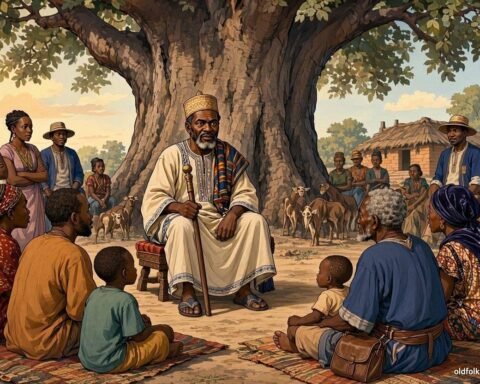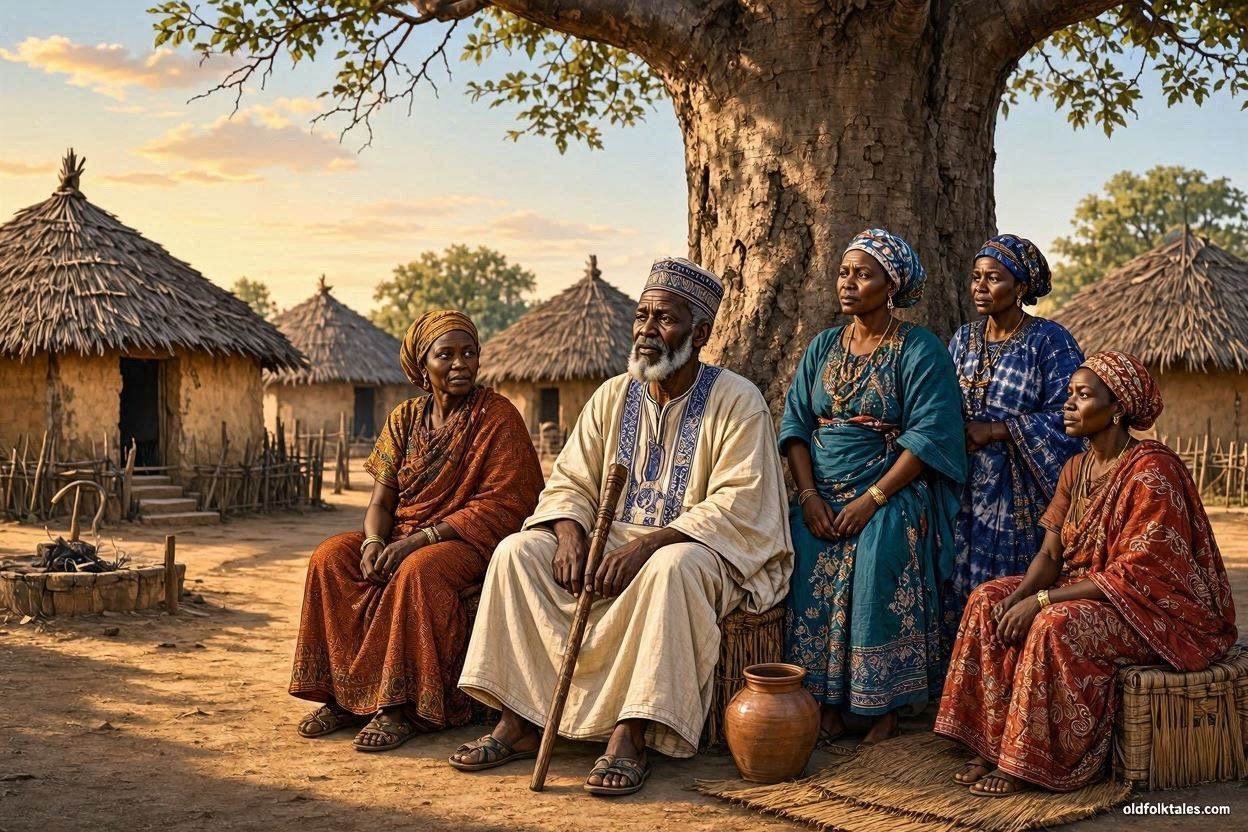
In a prosperous Wolof village where the baobab trees cast wide shadows over bustling family compounds, there lived a respected elder known simply as Gorgui. Age had silvered his beard, but it had never weakened his reputation for honesty, generosity, and sound judgment. Whenever disputes arose between neighbors, they sought Gorgui’s counsel, trusting that his wisdom would restore harmony.
Yet there was one place where peace had quietly disappeared.
It was his own home.
Gorgui had four wives. Each was hardworking, intelligent, and deeply devoted to the family. For many years, they had shared responsibilities with remarkable cooperation. One cared for the granaries, another tended the gardens, the third oversaw the livestock, while the youngest managed the household’s weaving and trading.
Together they had built one of the happiest homes in the village.
But as time passed, small misunderstandings began to grow.
One wife believed Gorgui spent too much time visiting another’s courtyard.
Another felt her hard work was never praised.
Fascinated by this tale? Discover more North African folktales
The youngest worried that her opinions were dismissed because of her age.
The eldest believed everyone expected her to carry the greatest burdens simply because she had been in the family the longest.
None of them spoke openly.
Instead, hurt feelings settled quietly inside their hearts.
Simple disagreements soon became frequent arguments.
Cooking was no longer done together.
Shared meals became rare.
Even the children noticed the growing distance between their mothers.
One evening, after another day filled with silence and resentment, Gorgui sat alone beneath the village baobab.
The imam passed by and greeted him.
“You solve many problems for others,” he observed.
“Who solves yours?”
Gorgui smiled sadly.
“That is the question keeping me awake.”
The imam sat beside him.
“You cannot command peace.”
“You must cultivate it.”
Those words remained with Gorgui throughout the night.
The following morning, he announced that no one would work in the fields that day.
Instead, he invited his wives and children to gather beneath the largest baobab tree outside the compound.
Curious villagers watched from a distance.
Gorgui placed four empty baskets before his wives.
“I have one task for each of you,” he said.
“Fill these baskets with whatever you believe makes a family strong.”
The first wife returned carrying bundles of millet.
“A family survives because everyone has food.”
The second filled her basket with cooking utensils.
“A family needs people willing to work.”
The third gathered clothing, blankets, and water pots.
“A family must be cared for.”
The youngest wife returned with flowers and children’s handmade toys.
“A family also needs joy.”
Gorgui thanked them all.
Then he quietly emptied every basket onto the ground.
The women stared at him in confusion.
“Which basket contained everything a family needs?” he asked.
None answered.
“Can millet alone build a home?”
“No.”
“Can work alone create happiness?”
“No.”
“What about comfort?”
They shook their heads.
“Or laughter?”
Again, no.
Gorgui smiled gently.
“A family survives because every gift is needed.”
He looked at each wife in turn.
“I have spent too much time comparing your strengths instead of celebrating them.”
He turned toward the children.
“And you have watched us forget that we belong to one household.”
The eldest wife lowered her eyes.
“I have been jealous.”
The second spoke next.
“I have been impatient.”
The third sighed.
“I allowed small disappointments to become great resentments.”
The youngest wiped away tears.
“I feared my voice had no value.”
For the first time in many months, everyone spoke honestly.
No accusations.
No shouting.
Only truth.
The conversation lasted until sunset.
By the end of the day, every misunderstanding had been shared and every apology offered.
But Gorgui knew that words alone would not restore lasting peace.
So he changed the way the household functioned.
Important decisions were discussed together.
Household responsibilities rotated whenever possible.
Special celebrations honored everyone’s contributions equally.
Most importantly, every week the family gathered beneath the baobab simply to talk, laugh, and share a meal.
Gradually the compound changed.
The wives once again cooked together.
The children played without choosing sides.
Neighbors noticed laughter returning to Gorgui’s courtyard.
Months later, visitors asked the elder how he had restored harmony to such a large household.
Gorgui pointed toward four woven baskets hanging from the roof of his veranda.
“They remind me that no single basket can carry everything.”
“Neither can one person.”
Years passed.
When Gorgui eventually became one of the honored ancestors remembered by the village, people spoke not only of his wisdom as a leader but also of the lesson he learned inside his own home.
Parents repeated his story to newly married couples.
Village elders shared it whenever family disagreements threatened community peace.
For everyone remembered that leadership begins with listening, fairness grows through patience, and a home remains strong only when every voice is valued.
And so the story of Gorgui and his four wives continued to teach generations that the greatest victories are often won not on battlefields, but around the family hearth.
Want more? Read more West African folktales now
Moral Lesson
A peaceful family is built on fairness, patience, honest communication, and mutual respect. True leadership begins by listening to every voice and valuing every contribution.
Knowledge Check
1. Why did Gorgui’s household lose its harmony?
Because small misunderstandings, jealousy, and unspoken feelings gradually divided the family.
2. What lesson did the four baskets teach?
That every family member contributes something valuable, and no one person can provide everything a household needs.
3. What values does this Wolof folktale promote?
Fairness, patience, leadership, communication, and family unity.
4. How did Gorgui restore peace?
By encouraging honest conversation, treating everyone fairly, and ensuring every family member felt valued.
5. Is Gorgui and His Four Wives based on a traditional Gambian folktale?
Yes. It is an original adaptation inspired by a documented Wolof folktale preserved in a published Gambian folklore collection.
6. What is the central message of the story?
Strong families thrive when leaders practice fairness, patience, and respect for every member.
Source
Adapted from: Folk Tales and Fables from The Gambia, Volume 1 by Dembo Fanta Bojang and Sukai Mbye Bojang. This is an original retelling inspired by the documented traditional Wolof folktale.