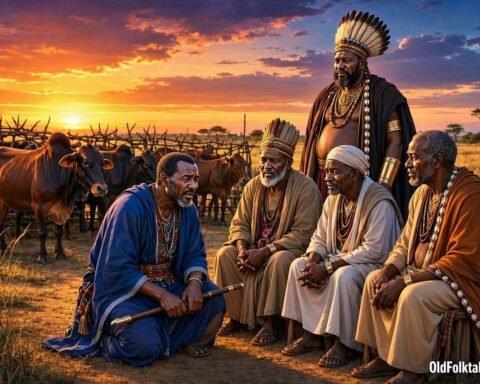
Long ago, when cattle were the greatest measure of wealth and honor among the Dinka people of South Sudan, neighboring communities sometimes allowed anger and pride to grow into bitter conflict. What began as small disagreements over grazing lands, water, or stolen cattle could quickly become violent. Elders often worked to restore peace, but there were times when their voices were ignored, and warriors chose their spears instead of wise counsel.
One such conflict became so fierce that people would remember it for generations.
The fighting lasted until the sun disappeared behind the distant plains. Spears clashed against shields, cries echoed across the grasslands, and the earth itself seemed to tremble beneath the feet of determined warriors. Families waited anxiously in their villages, praying that their sons, brothers, and fathers would return safely.
When silence finally settled over the battlefield, it was not the silence of victory.
It was the silence of loss.
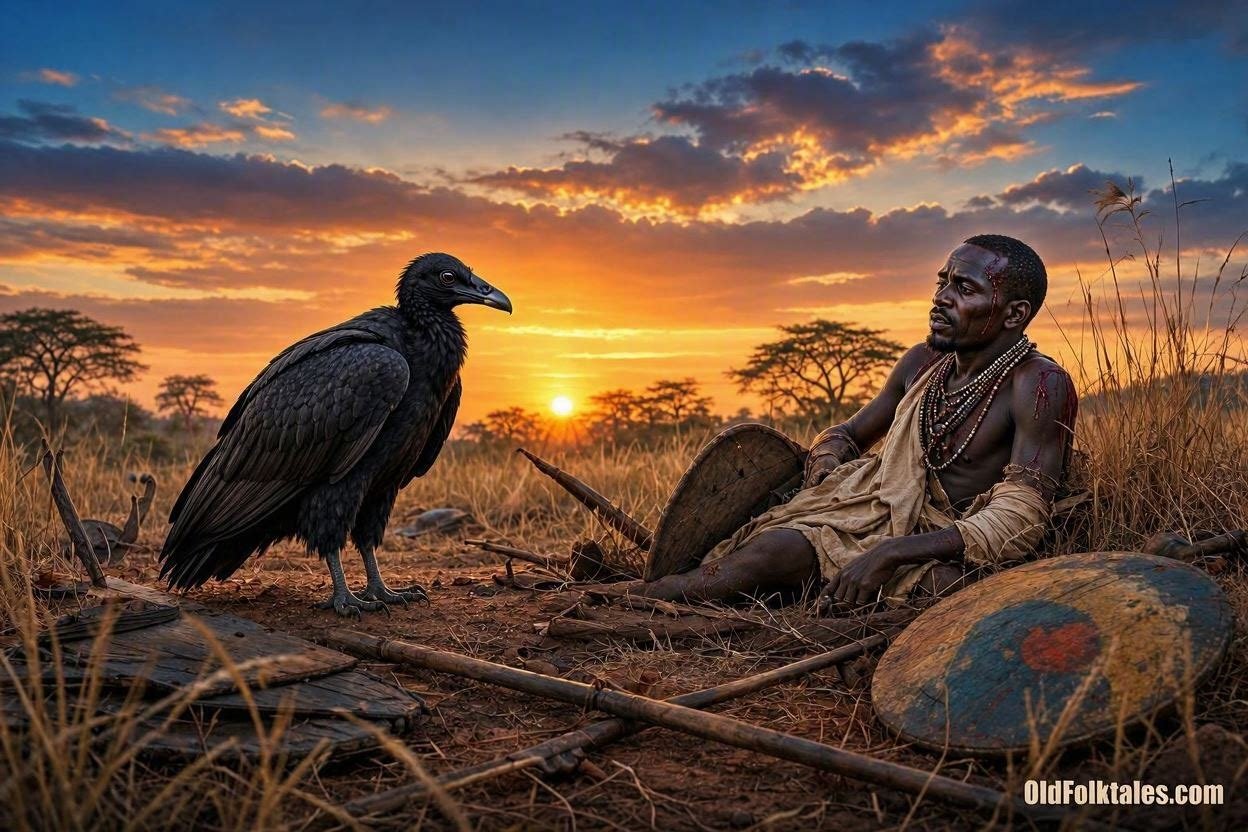
The wide plain was scattered with broken shields, abandoned weapons, and the bodies of men who would never again return to their homes. Smoke drifted slowly through the evening air while the wind carried away the last echoes of the battle.
No songs of celebration were heard.
No family truly won.
Only sorrow remained.
Fascinated by this tale? Discover more North African folktales
As darkness covered the land, wild creatures cautiously approached the battlefield. Among them was a large black vulture that circled slowly above the fallen warriors before descending to the ground.
The bird looked around carefully.
Everywhere it turned, it saw the terrible results of human anger.
The vulture moved from one place to another, pausing often as though it were studying the scene before it. Unlike the warriors, it had not taken sides. It saw only the terrible price that had been paid.
After a long silence, the bird spoke aloud.
“Kääc Kë.”
“You! Stop! Hold on!”
Its voice seemed to disappear into the empty plain.
Again the vulture looked across the battlefield.
“So many lives have been lost,” it murmured.
“So many families will mourn before the next sunrise.”
It lowered its head and continued,
“If only they had stopped.”
“If only someone had listened before anger became bloodshed.”
Unknown to the bird, one wounded warrior was still alive.
Unable to stand, he lay quietly among the tall grass, listening with fading strength.
At first he thought the words were part of a dream brought on by pain and exhaustion.
But then he heard the vulture speak again.
“Kääc Kë.”
“You! Stop! Hold on!”
The wounded man slowly opened his eyes.
Never before had he imagined that wisdom could come from a creature feeding upon the dead.
Yet the bird’s simple words pierced his heart more deeply than any spear.
For the first time since the fighting had begun, he asked himself a question he had never considered.
Why had no one stopped?
Why had pride become more important than life?
Why had neighbours who once shared water and grazing land chosen destruction instead of peace?
As dawn approached, the surviving warrior gathered the little strength he had left and slowly made his way back toward his village.
Every painful step reminded him of the countless friends who would never walk beside him again.
When he finally arrived, the villagers rushed to help him.
The elders listened carefully as he described everything that had happened.
Then he told them about the black vulture.
Some people looked at one another in surprise.
Others remained silent.
The warrior repeated the bird’s unforgettable words.
“Kääc Kë.”
“You! Stop! Hold on!”
“The bird asked why no one had spoken these words before the battle destroyed so many lives,” he said quietly.
“The battlefield taught me that victory means nothing when both sides are left grieving.”
The oldest elder slowly rose to his feet.
He looked across the gathering and spoke with deep sadness.
“The Creator sometimes teaches human beings through voices they never expect.”
“We ignored the wisdom of our elders.”
“We ignored opportunities for peace.”
“And now even a bird has reminded us what we should already have known.”
From that day onward, whenever anger threatened to divide families or villages, people remembered the story of the battlefield and the vulture’s cry.
Before quarrels could grow into violence, someone would raise a hand and call out,
“Kääc Kë!”
“You! Stop! Hold on!”
Those simple words became more than a warning.
They became a plea for patience.
A reminder that every conflict has a moment when peace is still possible.
And among the Dinka people, the story lived on but not to celebrate war, but to remind every generation that true courage is often found in the wisdom to stop before it is too late.
Looking for more? Explore the magic of East African folktales here
Moral Lesson
The Vulture’s Cry for Peace reminds us that the greatest victories are not won on the battlefield but in the moments when people choose peace over pride. Anger, revenge, and stubbornness often lead to suffering that affects entire families and communities, while patience and dialogue can prevent irreversible loss.
The story teaches that wisdom can come from the most unexpected places. The vulture’s simple cry, “Kääc Kë” (“You! Stop! Hold On!”), became a lasting reminder that every conflict presents an opportunity to pause, reflect, and choose a better path.
Ultimately, the folktale encourages us to value compassion above violence, reconciliation above revenge, and human life above personal pride.
Knowledge Check
1. What caused the conflict in the story?
Answer: A dispute between neighbouring communities grew into a violent battle because people ignored opportunities to make peace.
2. Which animal spoke the words “Kääc Kë”?
Answer: A black vulture.
3. What does “Kääc Kë” mean?
Answer: It means “You! Stop! Hold On!”
4. Who heard the vulture’s message?
Answer: A wounded warrior who survived the battle.
5. Why did the elders preserve the phrase?
Answer: They wanted future generations to remember the importance of stopping conflict before it turned into violence.
6. What is the central lesson of the story?
Answer: Peace, patience, and wise counsel are more valuable than victory achieved through violence.
Source
Adapted from: The Story of the Phrase “Kääc Kë” (“You! Stop! Hold On!”), in Folktales and Contemporary Stories from South Sudan, South Sudanese Folktales Archive (Na’eesh Mabadh – Living Together Project).