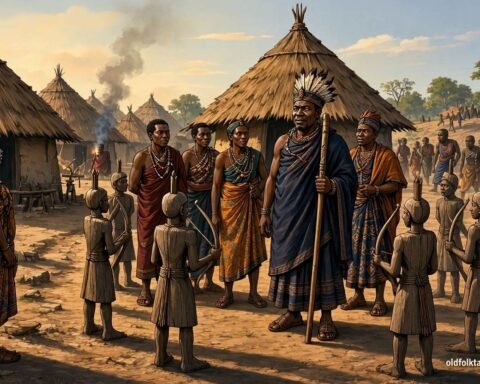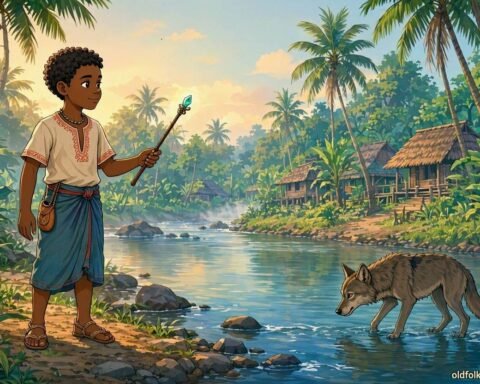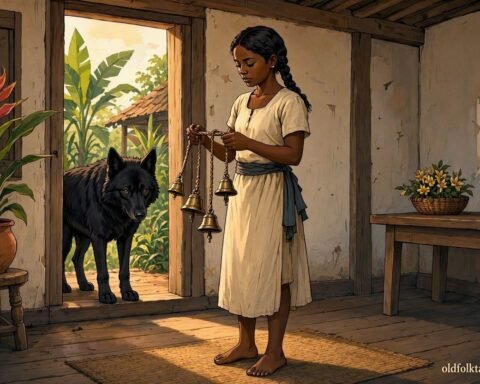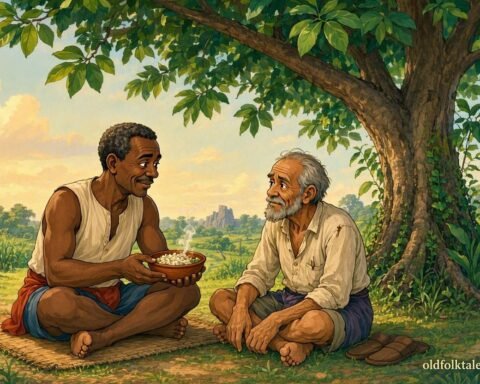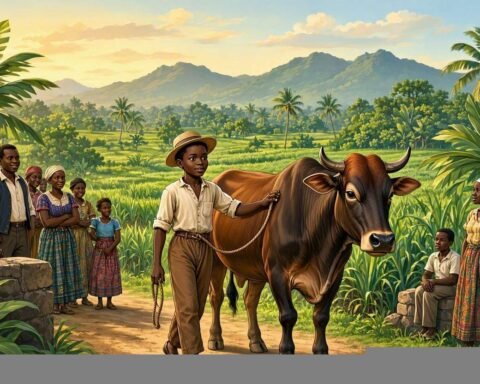
In a country where people lived according to the customs of their community, there was a young woman named Rose.
Rose was the daughter of a hunter.
One day, she went into the bush with her father. They travelled deeper and deeper into the wilderness, walking for a long time through the unfamiliar surroundings.
As they continued their journey, something unexpected happened.
Rose became pregnant.
In time, she gave birth to twins.
One was a boy.
The other was a girl.
The twins grew up together, raised within their family and surrounded by the traditions of their community.
As the years passed, the children became adults.
Then, one day, the young man announced something that surprised his parents.
“Father, Mother, I want to marry.”
His parents looked at him.
“Where will you find a wife?” they asked.
“I know,” he replied.
“You know?”
“Yes.”
The young man then went into the house and shut the door behind him.
His father wondered where he had gone.
His sister explained that he had closed himself inside and appeared to be sleeping.
His parents called him.
“Come and eat ubwali.”
But the young man refused.
“I do not want to.”
His mother prepared the meal anyway.
She carried the ubwali to him and approached the closed door.
When she entered, the young man looked at her and asked:
“Who are you?”
“I am your mother,” she answered.
Then the young man began to sing.
He sang about Rose.
If you enjoyed this story, explore our full West African folktales collection
He sang about Rose of the crocodile clan.
He sang about the woman he desired.
He repeated that she was the one he wanted.
His parents were confused.
The young man refused every woman who was brought to him.
No matter who came, he rejected her.
He wanted Rose.
Only Rose.
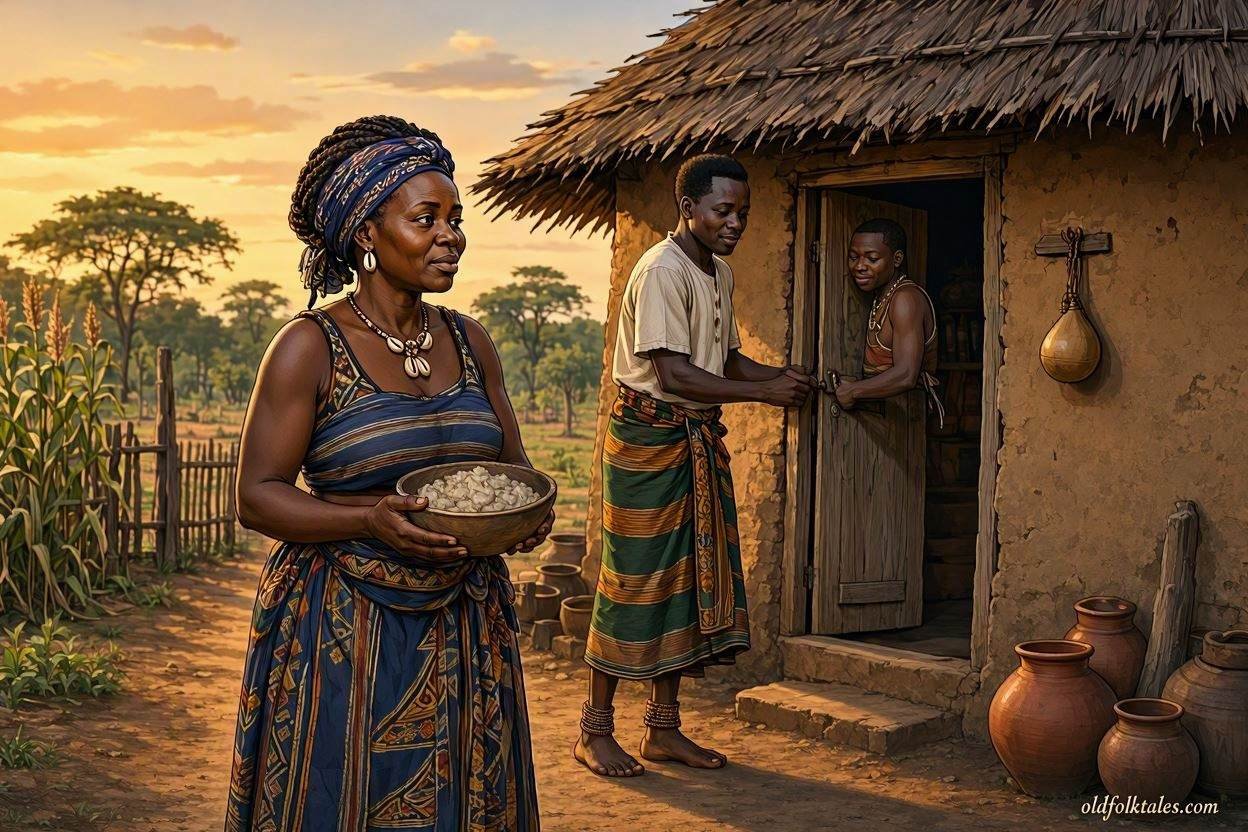
Eventually, Rose herself arrived carrying ubwali.
She knocked on the door.
Knock.
Knock.
The young man called out:
“Who are you?”
“I am Rose,” she replied.
He opened the door.
Rose entered.
The young man ate the ubwali she had brought.
And that is where the storyteller ended the tale.
There was no long explanation.
There was no final battle.
There was no wedding ceremony described.
There was simply the strange choice of the young man, his repeated desire for Rose, and the mysterious conclusion.
The meaning of the story was left hanging in the air.
Who exactly was Rose?
Was she the young man’s mother?
Was Rose another woman who happened to have the same name?
Why did the young man insist that he wanted Rose?
And what did his song about the crocodile clan truly mean?
The storyteller did not explain.
The mystery remained.
The performance itself was also important.
Emeliya Muleya sang part of the young man’s song during her telling. She paused briefly to ask whether her voice was acceptable before continuing. When Rose finally arrived with the food, the story did not develop into another adventure. The storyteller simply stated that the young man ate the ubwali and that things continued in that manner.
Robert Cancel, who recorded the performance, also recognised the unusual nature of the narrative. He observed that the story seemed to leave important information unstated. The opening account of Rose becoming pregnant after travelling into the bush and the later insistence of the young man on marrying Rose create a possible connection that is never directly explained.
This uncertainty is part of what makes the story memorable.
Traditional oral storytelling does not always provide every answer.
Sometimes a storyteller leaves a question for the listeners.
Sometimes the audience is expected to think about what has been said and what has deliberately been left unsaid.
In this Lunda narrative, the mystery is never resolved for us.
We are left with Rose, her two children, the young man’s strange determination, and a song that repeatedly names the woman he desires.
Perhaps the story was intended as a riddle.
Perhaps the listeners already understood a cultural reference that is difficult for an outsider to recognise.
Perhaps the mystery itself was the point.
Whatever its original intention, the tale reminds us that oral traditions do not always work like modern stories.
A folktale does not necessarily need to explain everything.
Sometimes a few carefully chosen events can create a question that survives long after the storyteller has stopped speaking.
And so the story of Rose and her twins ends where the mystery begins.
The young man has found the woman he wants.
Rose has arrived at his door.
He has accepted the food she brought.
And the storyteller simply says that it went on that way.
The rest is left to the imagination of the listener.
Don’t miss out: Read more Southern African folktales
Moral Lesson
This narrative does not provide a clear conventional moral, and its original collector also noted that its theme was difficult to determine. Rather than forcing a lesson onto the story, it is better understood as a mysterious oral narrative that encourages listeners to question what they hear and consider what the storyteller has deliberately left unexplained.
It also demonstrates an important feature of African oral storytelling: not every tale exists simply to teach a straightforward lesson. Some stories entertain, puzzle, provoke discussion, preserve cultural references, or challenge listeners to interpret events for themselves.
Knowledge Check
1. Who was Rose?
Answer: Rose was introduced as the daughter of a hunter.
2. What happened to Rose while she was travelling with her father?
Answer: She became pregnant and later gave birth to twins, a boy and a girl.
3. What did Rose’s son tell his parents when he became an adult?
Answer: He told them that he wanted to marry.
4. Which woman did the young man repeatedly say he wanted?
Answer: He repeatedly said that he wanted Rose.
5. What did Rose bring when she finally came to the young man’s door?
Answer: She brought ubwali, a traditional staple food.
6. Does the original storyteller explain the mystery completely?
Answer: No. The narrative ends without fully explaining the young man’s unusual desire for Rose, leaving the meaning open to interpretation.
Source
Adapted from Lunda Storytelling 8, performed by Emeliya Muleya and recorded by Robert Cancel in Storytelling in Northern Zambia: Theory, Method, Practice and Other Necessary Fictions (Open Book Publishers, 2013).