The people who became known as the Babwile once lived at Kasongo wa Kumwimba, where they were known as the Baluba Kati. Their chief was Kasongo wa Kumwimba. As they travelled, they eventually reached Kaansa, a small river and tributary where they settled and established their community.
On the other side of the river lived their Lunda neighbours. At first, the two communities lived near each other, but relations eventually became hostile. The Lunda began attacking the settlement, approaching from behind, burning houses and taking livestock. The repeated attacks created fear among the Babwile, who knew they needed to find a way to protect themselves.
The people gathered to discuss their situation. Their enemies appeared stronger and more numerous, and fighting them directly would be difficult. They therefore needed a strategy that could make the Babwile appear stronger than they really were.
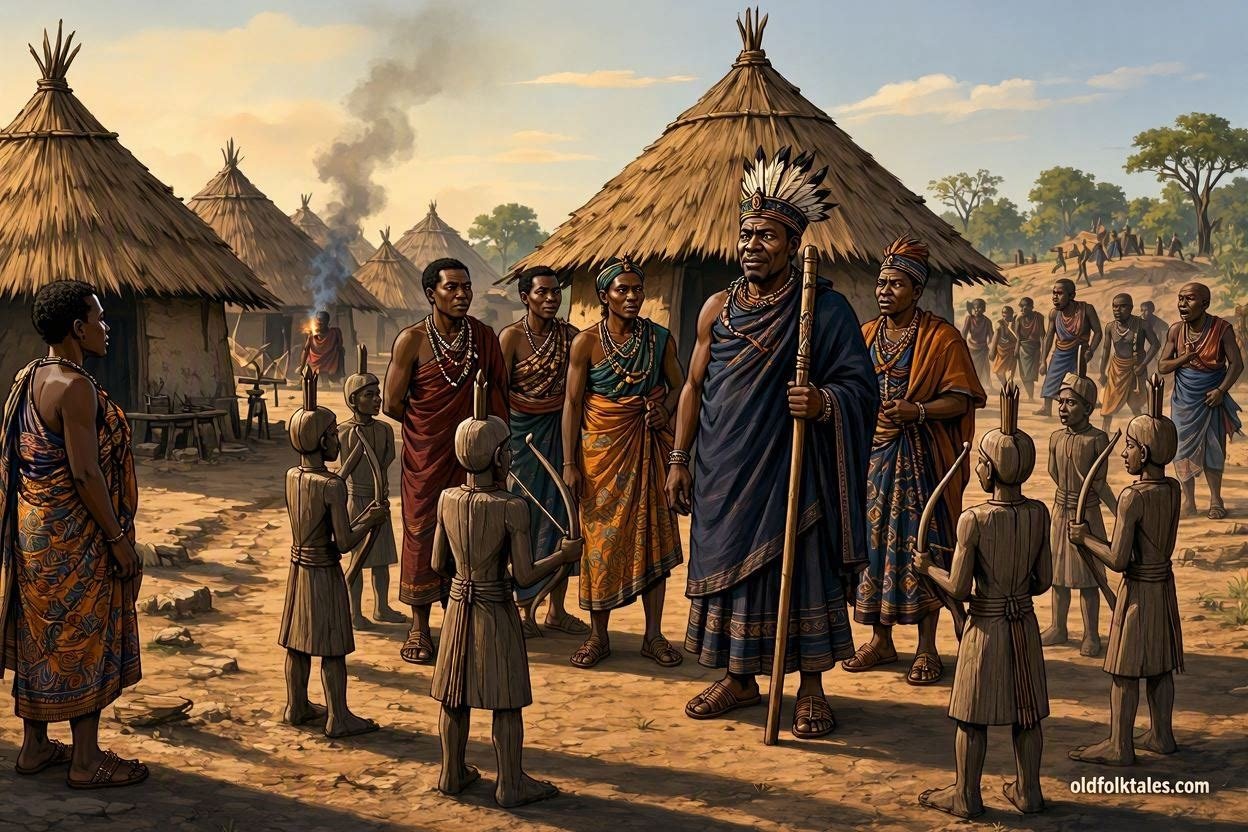
Their leader, Mpweto, devised an ingenious plan. Instead of trying to gather a large army, the people began carving wooden figures in the form of soldiers. The figures were made to resemble warriors, with some appearing to carry bows and arrows. They then positioned the wooden soldiers around the settlement so that anyone approaching from a distance would see what appeared to be a large force guarding the community.
Continue your journey: Read more East African folktales
The plan depended on one simple idea. The Babwile did not need to have a huge army if their enemies believed that they did.
When the Lunda returned to attack, they approached the settlement expecting to find the same vulnerable community they had attacked before. Instead, they saw what appeared to be soldiers standing throughout the area. From a distance, the wooden figures looked like a large group of armed warriors prepared to defend the settlement.
The Lunda were alarmed by what they saw. They believed that the Babwile had greatly increased their military strength. Faced with what appeared to be a much larger force, they became afraid that they would be defeated if they continued with the attack.
The Lunda therefore turned back and fled.
The plan had succeeded. The Babwile had protected their settlement without needing to fight a much larger army. Their wooden figures had created an illusion strong enough to make their enemies retreat.
Later, the Lunda returned to the area. They wanted to see the place where they believed the large army had been gathered. When they looked closely, they discovered that there were no soldiers waiting for them. The figures they had feared were only wooden carvings.
The Lunda realised that they had been deceived. The Babwile had made them believe that the settlement was protected by a large army when, in reality, the apparent soldiers were simply carefully positioned wooden figures.
The story became part of the remembered history of the Babwile. Their victory had not depended on having more weapons or more warriors than their neighbours. Instead, their leader had recognised the situation and found a creative way to protect his people.
Mpweto’s strategy demonstrated that leadership is not always about physical strength. A good leader must also know how to think during difficult circumstances, understand the fears of an opponent and use the resources available to protect the community.
The Babwile had limited numbers, but they had something equally valuable: cooperation and ingenuity. The people worked together to create the wooden soldiers and position them around their settlement. Their combined effort made the deception convincing.
The wooden soldiers could not move, speak or fight. Yet they played an important role in protecting the people who had made them. Their presence created the appearance of strength and convinced the enemy to retreat.
The story of Mpweto and the wooden soldiers therefore became a powerful example of how intelligence can overcome a disadvantage in numbers. When a community faces a stronger opponent, courage does not always require rushing into battle. Sometimes the wisest response is to think carefully, work together and find another way to overcome the danger.
Explore more Southern African folktales here
Moral Lesson
The story teaches that wisdom and strategy can be as powerful as physical strength. Mpweto understood that his people could not compete with their enemies through numbers, so he found another way to protect them.
It also highlights the importance of cooperation. The plan worked because the community worked together to create and position the wooden soldiers.
Most importantly, the story shows that limited resources do not necessarily mean limited possibilities. Creative thinking can turn ordinary materials into an unexpected solution to a serious problem.
Knowledge Check
1. Who was Mpweto?
Answer: Mpweto was the leader who devised the strategy of using wooden figures to protect the Babwile from their enemies.
2. Why were the Babwile afraid of the Lunda?
Answer: The Lunda had repeatedly attacked their settlement, burned houses and taken livestock.
3. What did the Babwile make?
Answer: They made wooden figures that looked like soldiers, including figures that appeared to carry bows and arrows.
4. Why did the Lunda retreat?
Answer: They believed the wooden figures were real soldiers and thought the Babwile had a much larger army.
5. What did the Lunda discover when they returned?
Answer: They discovered that the supposed soldiers were actually wooden carvings.
6. What is the main lesson of the story?
Answer: The story shows that intelligence, cooperation and creative strategy can help people overcome challenges even when they are weaker in numbers.
Source
This adaptation is based on Bwile Storytelling 7, told by T. D. Koti and recorded by Robert Cancel in Storytelling in Northern Zambia: Theory, Method, Practice and Other Necessary Fictions.