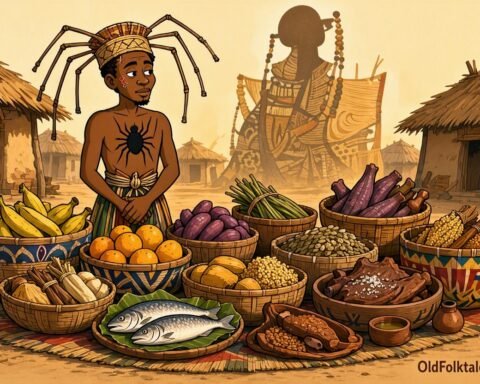
There was once a terrible famine in the village, the kind of famine that made every day a struggle for survival. For three years, the rains had failed to arrive. The clouds that usually gathered in the sky had disappeared, and the sun seemed determined to burn whatever remained alive. The grasses stopped growing, the earth cracked open under the heat, and the trees stood bare and helpless. The rivers and streams gradually withdrew into smaller pools, leaving behind stretches of dry, pale sand.
The suffering was everywhere. People became weak from hunger, and death followed closely behind the famine. Even the animals were affected. There was hardly anyone who could claim to be untouched by the disaster.
Kacou Ananzè, the Spider, was no exception.
He was usually known for his cleverness and ability to escape difficult situations. He had always trusted his intelligence and his talent for finding a way out of trouble. But hunger was different. It could weaken even the cleverest creature.
The famine began taking a terrible toll on him. His stomach cramped, his head became dizzy, his joints ached, and his vision sometimes became blurred. There were evenings when he wondered whether he would even have the strength to get up the following morning.
Kacou Ananzè knew he needed to find another way to survive.
So he became a fisherman.
Continue your journey: Read more East African folktales
He spent his days beside the shrinking waters, throwing his line again and again. He became remarkably skilled at fishing, but the creatures in the water seemed determined to frustrate him. Sometimes his float would disappear beneath the surface just when he was preparing to pull the line, only to rise again without a catch.
Still, Ananzè refused to become angry.
The famine had taught him patience.
He continued fishing even when the waters became little more than shallow pools. Sometimes he spent the entire night beside the river, waiting for his luck to change.
But his luck seemed to have abandoned him.
For an entire week, his float hardly moved.
Ananzè began to fear that even fishing would no longer save him. His hunger became so severe that he began experiencing strange visions and hearing voices. He talked to himself and sometimes behaved as though other people were sitting beside him.
Then, suddenly, the float moved.
At first, Ananzè could hardly believe his eyes.
It dipped beneath the water.
He grabbed his line and pulled.
At the end of it was a tiny silure, a freshwater catfish no bigger than the little finger of a newborn baby.
Ananzè was delighted.
At last, he had caught something.
He seized the fish, ready to turn it into a meal, but before he could do so, the little silure spoke.
“Spare me.”
Ananzè stared at it.
The fish pleaded with him to return it to the water. In exchange, it promised that he would become happy.
Ananzè was suspicious.
He had heard promises like that before. As a trickster himself, he knew very well that creatures sometimes said whatever was necessary to escape danger.
The little fish continued to insist.
It told Ananzè to climb a particular fromager tree and reach its twelfth branch. From there, he was to let himself fall.
The instruction sounded ridiculous and dangerous.
Ananzè immediately objected. Why should he climb a thorny tree and deliberately throw himself from such a height merely because a tiny fish had told him to?
He reminded the silure that he was Kacou Ananzè, a creature famous for intelligence, experience and cleverness. Surely he was not going to risk breaking his neck because of a tiny fish.
But the silure continued pleading.
Eventually, something in its voice convinced him.
Ananzè decided to take the risk.
He climbed the fromager tree. The journey upward was difficult, but strangely, the tree seemed easier to climb than he expected. He continued until he reached the twelfth branch.
He closed his eyes and jumped.
Instead of crashing to the ground, Ananzè suddenly found himself in the most magnificent city he had ever seen.
It was a city overflowing with wealth and activity. People moved everywhere, buying, selling, trading and negotiating. The city was filled with magnificent buildings and brilliant lights. Everywhere he looked, there was evidence of prosperity.
It was completely different from the famine-stricken village he had left behind.
Ananzè realised that the little silure had not deceived him.
He had truly been taken to a place of extraordinary abundance.
There was food everywhere.
Ananzè ate and ate.
After having suffered so terribly from hunger, he could hardly believe that he was now surrounded by more food than he could possibly consume. His body recovered, and he gradually became healthier and larger.
He became so comfortable in the city that he lost track of time.
Eventually, he was brought before the Queen.
Ananzè behaved so well that the Queen appointed him Prime Minister of the kingdom.
The starving fisherman had become one of the most powerful people in a magnificent kingdom.
His fortune seemed complete.
But there was one condition.
The Queen allowed Ananzè to do almost anything he wished throughout the kingdom and its palaces. However, she gave him one strict instruction.
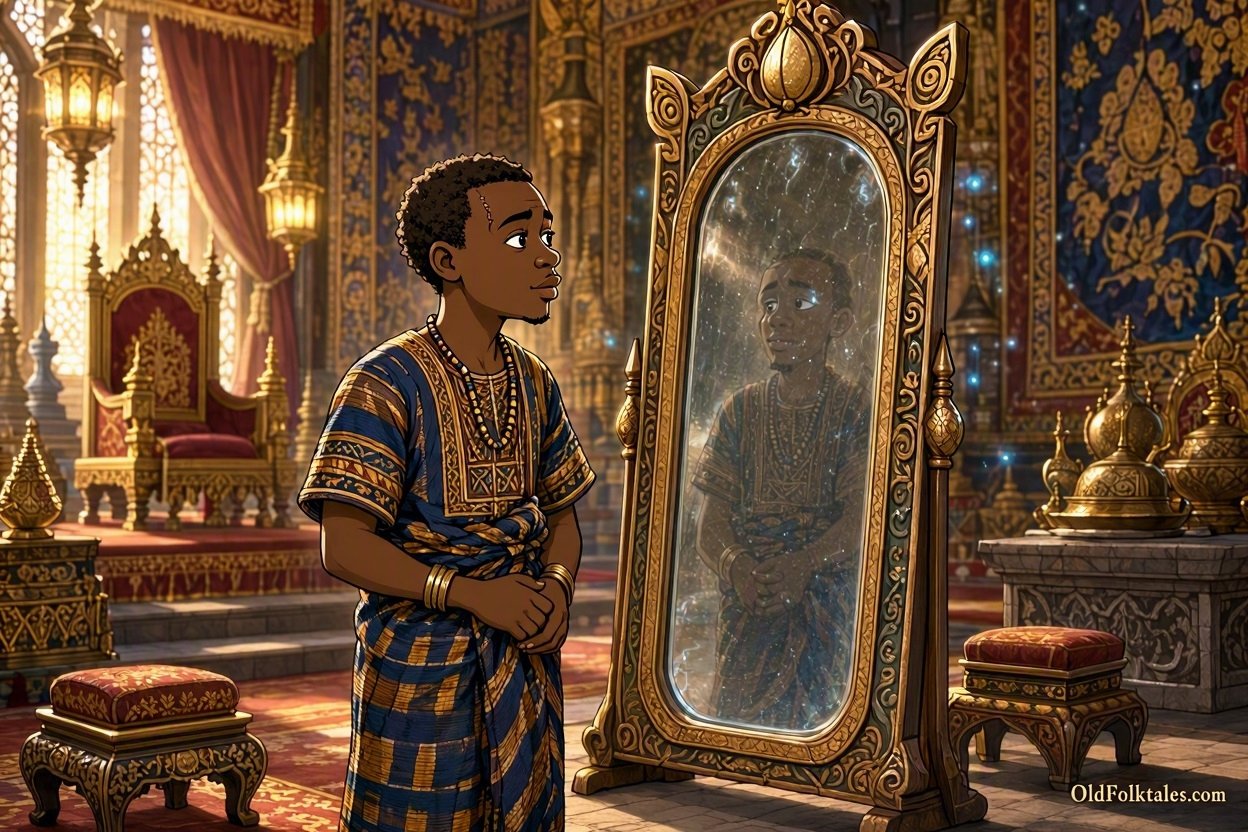
There was a particular mirror in the palace.
He must never look into it.
Ananzè agreed.
At first, he had no reason to question the order.
After all, he had been given everything.
But the forbidden mirror soon began occupying his thoughts.
Why was he forbidden from looking at it?
The mirror itself appeared completely ordinary.
That made the mystery even more tempting.
Ananzè began to suspect that the Queen was hiding something from him.
Perhaps the mirror was magical.
Perhaps it contained some great secret.
Perhaps the Queen believed she was clever enough to keep him away from it.
The more he thought about the mirror, the stronger his curiosity became.
Ananzè had always loved difficult situations. Obstacles challenged his intelligence and encouraged him to find ways around them. But this time, his cleverness began working against him.
The Queen had given him wealth.
She had given him power.
She had given him a place in her kingdom.
Yet the one thing she told him not to do became the one thing he desperately wanted to do.
Eventually, Ananzè gave in.
He went to the mirror.
He looked into it.
And in that instant, everything disappeared.
The magnificent city was gone.
The palace was gone.
His position was gone.
His wealth was gone.
The abundance surrounding him vanished as suddenly as it had appeared.
Ananzè found himself back where his extraordinary journey had begun, beside the river, with his fishing line in his hand.
The float was motionless.
The riverbank was hot.
And he was hungry again.
He looked around and realised that the magnificent kingdom had been nothing he could hold on to once he broke the condition placed upon him.
Then the float moved.
Ananzè pulled the line.
Another tiny silure was hanging from the hook.
The fish was the same size as the one he had caught before.
Ananzè recognised it immediately.
His extraordinary fortune had disappeared, but the little fish had returned.
This time, Ananzè treated it differently.
He carefully removed it from the hook and returned it to the water.
The fish did not need to explain everything.
Ananzè already understood what had happened.
He had been given an extraordinary opportunity.
He had escaped famine.
He had entered a prosperous kingdom.
He had become Prime Minister.
He had been given wealth, comfort and influence.
But he had allowed curiosity to overcome obedience.
The very fortune that had rescued him from hunger had been lost because he could not resist a forbidden mirror.
Ananzè had survived famine because he was clever and patient enough to find another way to live. But his downfall came when he allowed curiosity to become stronger than wisdom.
The mirror therefore became more than an ordinary object.
It represented temptation.
It represented the desire to discover what had been deliberately kept hidden.
Most importantly, it represented the danger of believing that intelligence alone can protect us from our own weaknesses.
Kacou Ananzè had always been confident in his ability to escape difficult situations. But sometimes the greatest danger does not come from an enemy.
Sometimes it comes from within.
The famine had tested his body.
The fishing had tested his patience.
The journey to the magical city had tested his courage.
But the mirror tested his self-control.
And that was the test he failed.
His story reminds us that receiving a blessing also comes with the responsibility to protect it. Wealth, comfort and success can disappear quickly when temptation takes control.
Kacou Ananzè escaped hunger, but he could not escape his own curiosity.
And so the forbidden mirror became the object that ended his fortune.
If you enjoyed this story, explore our full West African folktales collection
Moral Lesson
Not every secret needs to be uncovered. Curiosity without self-control can destroy the very blessings that have brought us happiness.
Knowledge Check
1. What caused the terrible famine in Kacou Ananzè’s village?
The rains failed for three consecutive years, leaving the land dry and the people without enough food.
2. What did Kacou Ananzè do when hunger became unbearable?
He became a fisherman and spent his days trying to catch food from the shrinking waters.
3. How did the little silure change Ananzè’s life?
After Ananzè spared its life, the silure directed him to a magical journey that took him to a magnificent and prosperous city.
4. What position did Ananzè eventually receive in the magical kingdom?
He became the Prime Minister of the kingdom.
5. What warning did the Queen give Ananzè?
She allowed him to do almost anything but strictly warned him never to look into a particular mirror.
6. What happened after Ananzè looked into the forbidden mirror?
His magical fortune disappeared, and he was returned to the riverbank where he had begun his journey.
Source
Adapted from Bernard Binlin Dadié, Le Pagne noir, “Le Miroir de la Disette.”