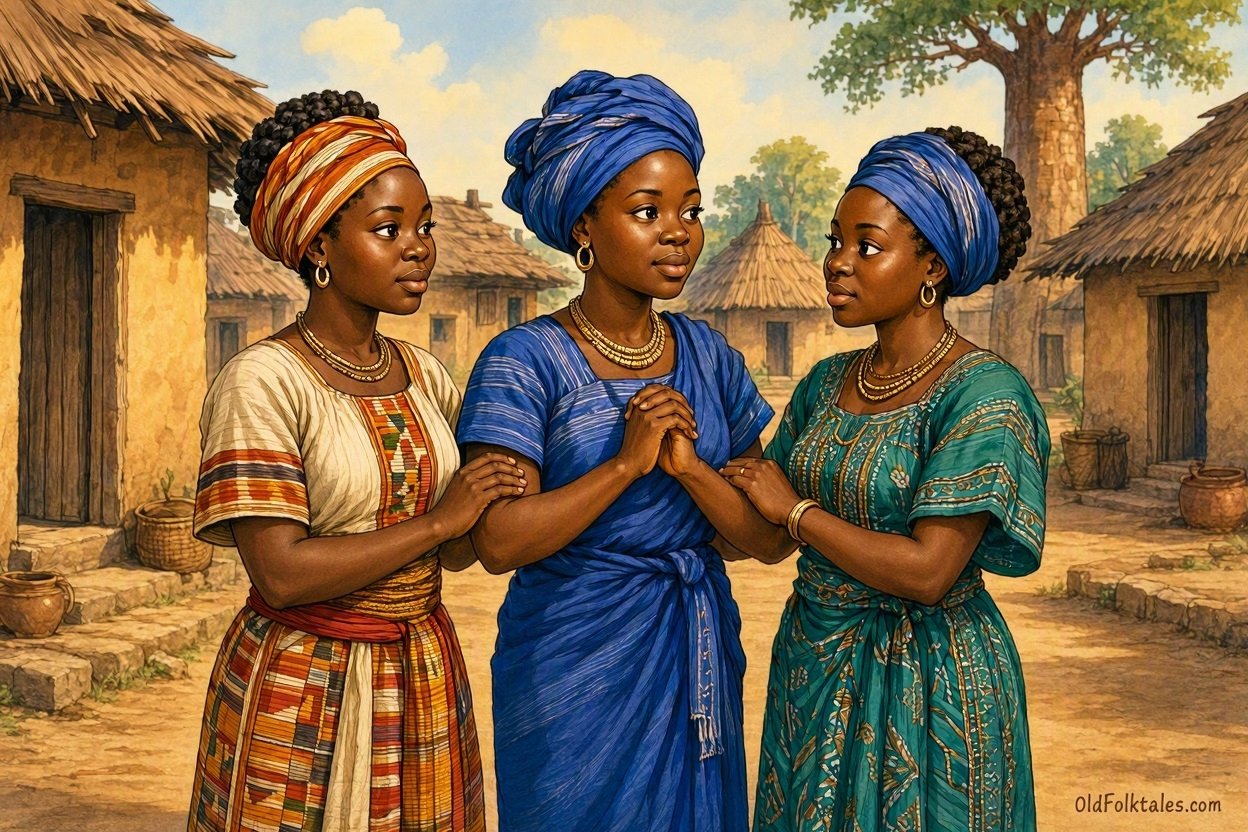
In the village of Amenvi lived three young women named Ama, Allua and Bomo. They were close companions, and wherever one went, the other two were usually nearby. Their friendship had become so strong that the people of the village often saw them together.
The three young women were admired for their beauty. As they grew older, their beauty became even more remarkable, and before long, young men began showing interest in them. Suitors came from different places, hoping to win their affection and eventually marry them.
But marriage was not something the three friends wanted.
They had spoken about it many times among themselves. They had watched people marry, build families and take on responsibilities, but they had decided that they wanted a different future.
One day, they made a solemn promise.
They swore that none of them would ever marry.
It was not merely a casual statement made between friends. They treated their words as a serious oath. They called upon Allouko, the witness of their promise, and repeated their determination that marriage would never separate them.
Love this story? Discover our full Southern African folktales collection
They sang together as they made their vow, declaring that they would never marry.
The promise brought them even closer.
Years passed, and the three friends continued living according to the decision they had made. Their beauty did not diminish, and their suitors became even more numerous. Yet whenever marriage was mentioned, they remembered the promise they had made.
They were determined to keep their word.
Life, however, does not always follow the plans people make when they are young.
One day, tragedy came to Amenvi.
Allua died.
Her death devastated Ama and Bomo. They had grown up together, shared their dreams and made their solemn promise side by side. Losing one of them felt like losing part of themselves.
The village mourned with them.
Ama was especially affected by the loss. She remembered the promise they had made and the song they had sung together. Now only two of the three voices remained.
But before the village had completely recovered from Allua’s death, another tragedy struck.
Bomo also died.
Ama was now alone.
The three friends who had once moved through life together had been reduced to one.
Ama cried for her friends. She mourned them deeply, and the young women of Amenvi mourned with her. For a long time, the memories of Allua and Bomo remained painfully fresh.
Yet life continued.
As the months and years passed, Ama gradually began to recover from her grief. Her family and the people around her tried to comfort her in different ways.
Her father tried to create an atmosphere that would help her forget her sorrow. Her mother and the young women of the village began speaking to her about the qualities of various young men. Children composed songs praising her beauty.
Slowly, the sadness that had surrounded Ama began to weaken.
Then a young prince entered her life.
Her parents encouraged the relationship.
At first, Ama remembered the promise she had made with Allua and Bomo. She had sworn never to marry, and that promise still mattered to her.
But her parents continued to pressure her.
They believed that she had mourned long enough. They wanted her to marry, settle down and begin a new chapter of her life.
The pressure became difficult to resist.
Eventually, Ama gave in.
She married the young prince.
She left her former life behind and was taken to the royal palace, accompanied by many devoted attendants.
The palace was magnificent.
It was protected by several doors, and anyone wishing to reach Ama’s private apartment had to pass through six guarded entrances.
Ama had entered a world of royalty and privilege.
But despite her new surroundings, she carried something with her that could not be left behind.
Her old promise.
The vow she had made with Allua and Bomo had not disappeared simply because she had married.
For a while, everything seemed peaceful.
Then signs appeared that Ama was pregnant.
The news filled the palace with happiness.
The royal household looked forward to the birth of the child. The people of Amenvi also anticipated the arrival of the royal baby.
But just as the palace was preparing to celebrate, tragedy returned.
Ama suddenly became ill.
A fever came upon her and refused to leave.
At first, the people around her were frightened but hopeful. They believed she would recover.
Her condition, however, became increasingly serious.
One night, Ama fainted three times.
The king became alarmed and immediately summoned Assem-Kora, a powerful traditional healer.
Assem-Kora hurried to the palace.
But reaching Ama’s room was not simple.
He had to pass through the palace’s guarded entrances one after another. At each door, he stopped and invoked his spirits before continuing.
The atmosphere inside the palace became tense.
Everyone hoped that the healer would save the pregnant woman and the unborn royal child.
At last, Assem-Kora reached the final door.
He opened it and entered Ama’s private room.
Then he began to sing.
Something strange happened.
Ama, who had been gravely ill, heard the song and joined in.
The people surrounding her were astonished.
For a moment, hope returned to the palace.
They believed that the singing meant that Ama was recovering.
Perhaps, they thought, the healer had succeeded.
Perhaps a miracle had occurred.
But they were mistaken.
Ama was not recovering.
The song was not a sign that she was returning to health.
It was her farewell.
When the song ended, Ama’s voice fell silent.
She died.
The palace was left in shock.
The people could not understand what had happened. Only moments earlier, they had believed that the healer’s arrival might bring a cure.
Now Ama was gone.
The mystery was eventually explained by Assem-Kora.
According to the healer, Ama had been summoned back to the kingdom of the dead because she had broken the oath she had made with her two friends.
Years earlier, Ama, Allua and Bomo had promised that none of them would marry.
Ama had eventually broken that promise under pressure from her parents.
The two women who had made the oath with her were already dead.
Yet the vow had not been forgotten.
The tragedy therefore became a warning to the people of Amenvi.
Ama’s parents had wanted what they believed was best for her. They wanted her to marry and move forward with her life. But in their determination, they had pressured her into doing something she had solemnly promised never to do.
The story places responsibility not only on Ama but also on those who refused to respect her decision.
Her parents had continued insisting until she finally surrendered.
Her marriage brought happiness for a time, but the promise she had made remained part of her story.
The tale therefore gives great importance to the power of a spoken oath.
A promise may appear simple when it is made.
Words can be spoken in a moment of happiness, friendship or confidence.
But once those words become a solemn vow, breaking them can have consequences that are difficult to predict.
Ama’s story also raises an important question about personal choice.
Should someone be pressured into marriage simply because family members believe it is the right thing to do?
The tale’s traditional moral warns against forcing a young woman into marriage when she has clearly expressed that she does not wish to marry.
Ama had made her decision.
Her parents did not respect it.
The consequences were devastating.
The story has therefore survived not merely as a supernatural tale about an oath, but also as a warning about family pressure, marriage and the importance of respecting another person’s wishes.
The promise Ama made with Allua and Bomo began as a declaration of friendship.
It became a solemn commitment.
And eventually, it became the force that shaped the final chapter of Ama’s life.
The three friends had once promised that marriage would never separate them.
Death separated them first.
Marriage then became the act that broke the promise.
And in the traditional understanding preserved by the tale, the broken oath ultimately brought Ama back to the world of the dead.
Her story reminds listeners that words have weight.
A promise should not be made carelessly.
And when someone makes a serious decision about their own life, those around them should think carefully before attempting to force them to change it.
If you enjoyed this story, explore our full West African folktales collection
Moral Lesson
Promises should be made with care and respected once given, but people should also be free to make important decisions about their own lives without being forced by others.
Knowledge Check
1. Who were the three young women at the centre of the story?
Ama, Allua and Bomo.
2. What promise did the three friends make?
They promised that none of them would ever marry.
3. What happened to Allua and Bomo?
Both women died, leaving Ama as the only surviving member of the group.
4. Why did Ama eventually marry the young prince?
Her parents repeatedly pressured her to accept marriage after she had gradually recovered from her grief.
5. What happened to Ama after she became pregnant?
She developed a severe fever, became seriously ill and eventually died despite the arrival of the traditional healer.
6. Why did the healer say Ama had died?
He explained that she had been called back to the kingdom of the dead because she had broken the solemn promise she had made never to marry.
Source
Adapted from F. J. Amon d’Aby, La mare aux crocodiles: contes et légendes populaires de Côte d’Ivoire, “La force du serment.”