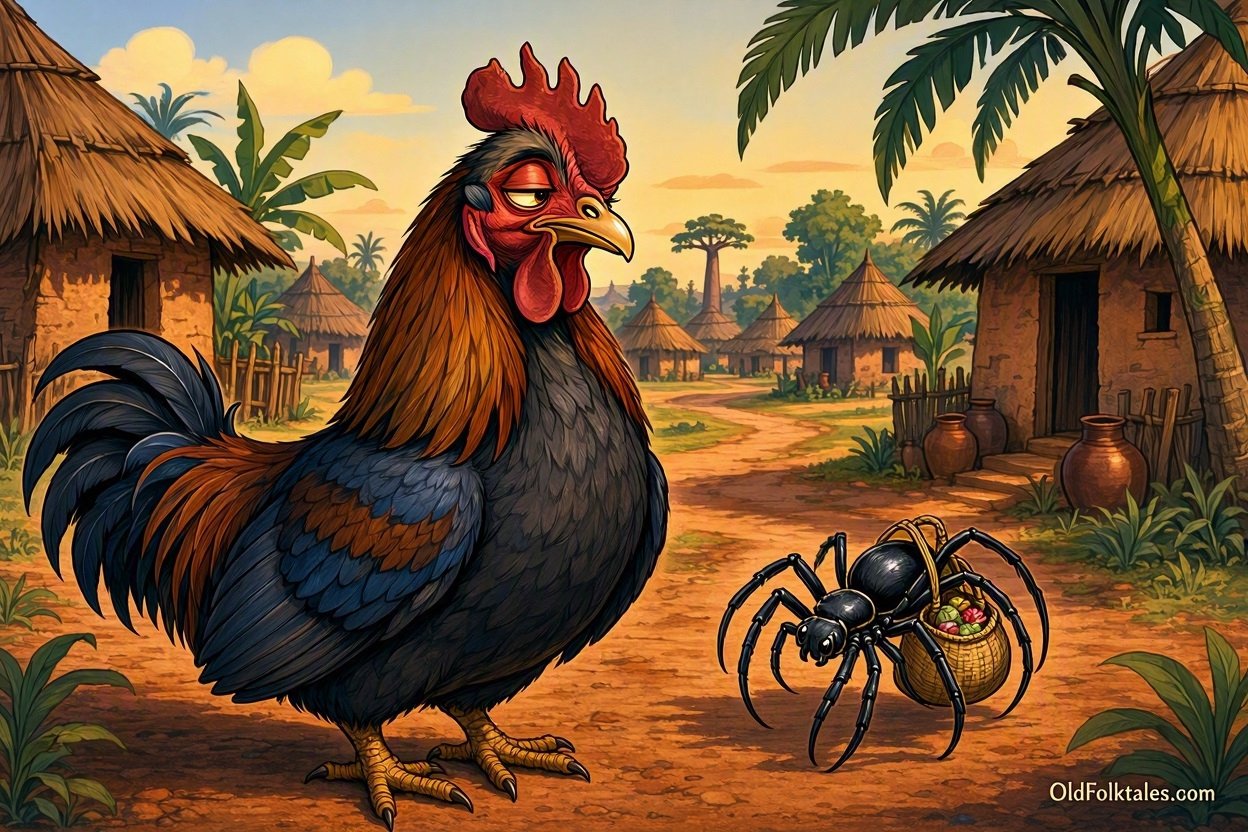
In a village where animals lived close to one another, Akogni the Rooster was known for his confidence and lively spirit. He was proud of his appearance, proud of his voice and, above all, proud of the friendships he had made among the other animals.
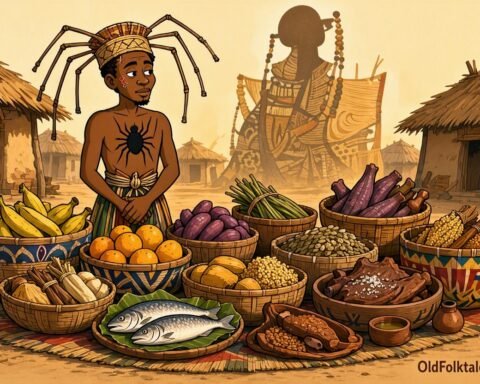
Among those friends was Ekèndèba the Spider.
The Spider was clever and persuasive. He always seemed to have a plan, and he knew how to make even the simplest journey sound exciting. Akogni trusted him, and because of their friendship, he rarely questioned the Spider’s intentions.
One day, Ekèndèba came to Akogni with an invitation.
He had a fiancée who lived in a distant village, and he wanted to visit her. The journey was long, however, and he did not want to travel alone.
“Come with me,” Ekèndèba told the Rooster. “We will travel together, and you will enjoy the journey.”
Akogni was pleased by the invitation.
He had no reason to suspect that the journey would become one of the most difficult experiences of his life.
The two friends set out.
Continue your journey: Read more East African folktales
At first, everything seemed peaceful. They walked along the familiar paths, talking and enjoying one another’s company. Akogni believed that the journey would be an adventure shared between two friends.
But before long, Ekèndèba began behaving strangely.
Whenever they stopped to rest, the Spider somehow managed to find food for himself while Akogni was left with little or nothing.
At first, Akogni did not complain.
Perhaps, he thought, the Spider simply had better luck finding food.
They continued travelling.
Then the same thing happened again.
Whenever food appeared, Ekèndèba found a way to eat while Akogni went hungry.
The Rooster began noticing the pattern.
Yet friendship made him reluctant to accuse his companion.
He continued walking.
As the days passed, however, his hunger became unbearable.
Akogni was accustomed to eating regularly. He was not prepared for a journey in which food would constantly appear just beyond his reach.
Ekèndèba seemed to have a strange ability to arrange things so that he was always satisfied while the Rooster remained hungry.
Whenever Akogni asked about food, the Spider had an explanation.
Sometimes he said they would find something further ahead.
Sometimes he claimed that they should wait until they reached the next village.
Sometimes he simply changed the subject.
Akogni listened, hoping that his friend knew what he was doing.
But hunger has a way of making people question even those they trust.
The Rooster began to wonder whether Ekèndèba was deliberately keeping food away from him.
Still, he remained silent.
He did not want to destroy their friendship because of suspicion.
The journey continued.
The road became longer.
The villages became farther apart.
The food became scarcer.
And Akogni became weaker.
Ekèndèba, however, continued to appear perfectly comfortable.
He walked ahead with confidence, as though nothing was wrong.
Eventually, Akogni could no longer hide his frustration.
He confronted the Spider.
“Why do you always find something to eat while I remain hungry?”
Ekèndèba laughed.
He dismissed the complaint and told Akogni not to worry.
According to him, everything would be fine when they reached the village where his fiancée lived.
Akogni reluctantly continued.
He had already travelled too far to turn back.
Besides, he still believed that his friend might eventually explain everything.
At last, the travellers reached the distant village.
Akogni expected the journey to become easier.
Instead, the situation became even more troubling.
Ekèndèba was welcomed warmly.
The Spider was treated like an honoured guest, and people gathered around him.
Akogni expected to receive the same welcome.
After all, he had travelled the entire distance with Ekèndèba.
But something was wrong.
The Spider had arranged matters in such a way that Akogni was again left without the comfort and food he expected.
The Rooster watched carefully.
For the first time, he began to understand that his hunger was not simply the result of bad luck.
Ekèndèba had been deceiving him.
The Spider had deliberately invited him on the journey while making sure that he would remain hungry.
Akogni was deeply hurt.
The problem was no longer hunger.
It was betrayal.
He had trusted Ekèndèba.
He had travelled with him.
He had endured hunger because he believed they were friends.
Now he realised that the Spider had been using his trust against him.
Akogni decided that he would not allow the deception to continue.
He began observing Ekèndèba more carefully.
Instead of reacting immediately, he waited.
He watched where the Spider went.
He watched how he behaved around other animals.
He listened to the conversations taking place around him.
Little by little, the truth became clearer.
Ekèndèba had indeed been acting deliberately.
His friendliness had been a disguise.
His invitation had not been an act of genuine friendship.
He had wanted Akogni to accompany him, but he had no intention of treating the Rooster fairly.
The discovery changed Akogni.
The hungry and trusting traveller who had begun the journey was no longer the same.
He had learned an important lesson.
Not everyone who calls themselves a friend behaves like one.
Sometimes deception hides behind laughter.
Sometimes betrayal comes from someone who walks beside you.
And sometimes the person who invites you on a journey may have a completely different destination in mind.
Akogni returned home determined to make sure that the truth was known.
When he finally had the opportunity to speak openly, the Spider’s behaviour was exposed.
The truth spread among the animals.
Those who had once admired Ekèndèba’s cleverness began to see another side of him.
His cleverness had not been used to help his friend.
It had been used to exploit him.
Akogni had suffered because he trusted the wrong companion.
But he did not remain helpless.
He found a way to reclaim his dignity.
The Rooster’s revenge did not come from strength alone.
It came from patience.
He had watched.
He had listened.
He had waited until he understood what had really happened.
Then he acted.
Ekèndèba discovered that the friend he had treated as an easy victim was not as helpless as he had imagined.
The Spider had relied on deception.
The Rooster responded with determination.
And in the end, the one who had used cunning to make another suffer was forced to face the consequences of his own actions.
Akogni’s journey therefore became more than a trip to a distant village.
It became a lesson in friendship.
At the beginning of the journey, Akogni believed that friendship meant trusting someone without question.
By the end, he had learned that genuine friendship must include fairness, honesty and consideration.
A friend should not deliberately leave another person hungry while enjoying abundance.
A friend should not use another person’s trust for selfish advantage.
And cleverness should never become an excuse for cruelty.
Ekèndèba had believed that because he was clever, he could manipulate Akogni without consequences.
He was wrong.
His actions eventually became known, and the Rooster found a way to answer the treatment he had received.
The journey also taught Akogni something about himself.
He had survived hunger.
He had endured disappointment.
He had travelled far from home.
Most importantly, he had learned to recognize deception.
The experience made him more careful, but it did not destroy his ability to trust.
He understood that one dishonest friend should not make every friendship meaningless.
Instead, he learned to judge friendship by actions rather than words.
Ekèndèba had called himself a friend.
But his actions had told a different story.
Akogni had learned that the difference between a true friend and a false one is revealed most clearly when circumstances become difficult.
When everything is comfortable, almost anyone can appear friendly.
But when food is scarce, when the road is long and when one person has an opportunity to take advantage of another, character becomes visible.
The Rooster’s difficult journey exposed that character.
It also showed that deception may succeed for a while, but it cannot remain hidden forever.
The Spider managed to fool his companion for a time.
He managed to keep Akogni hungry.
He managed to disguise his intentions.
But eventually, the truth came out.
And when it did, the Rooster was ready.
His journey ended with a valuable lesson that the animals would remember.
A friendship built on deception cannot last.
The cleverest person is not always the wisest.
And someone who uses intelligence to harm others may eventually discover that the same cleverness can be turned against them.
Akogni began the journey as a trusting friend.
He returned from it wiser.
He had lost his innocence about friendship, but he had gained something more valuable: the ability to recognize betrayal and stand up for himself.
And Ekèndèba learned that the hunger he had deliberately caused in another could eventually return as a hunger for justice.
Want more? Read more West African folktales now
Moral Lesson
True friendship requires honesty and fairness. Deception may succeed temporarily, but harmful actions eventually bring consequences.
Knowledge Check
1. Why did Ekèndèba invite Akogni on the journey?
He wanted Akogni to accompany him to visit his fiancée in a distant village.
2. What problem did Akogni repeatedly experience during the journey?
He was continually left hungry while Ekèndèba found ways to eat and satisfy himself.
3. Why did Akogni initially refuse to accuse Ekèndèba?
He trusted him as a friend and did not want to destroy their friendship based only on suspicion.
4. What did Akogni eventually discover?
He discovered that Ekèndèba had deliberately deceived him and had arranged the journey in a way that kept him hungry.
5. How did Akogni respond after discovering the truth?
He observed the Spider carefully, exposed the deception and eventually found a way to reclaim his dignity.
6. What is the main lesson of the story?
True friendship requires honesty and fairness, while deception and selfishness eventually bring consequences.
Source
Adapted from F. J. Amon d’Aby, Les Aventures du coq.