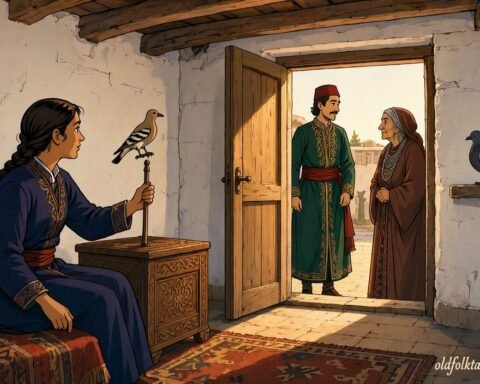
A powerful king once lived with his many wives in a large royal household. Among them was his first wife, TányinO. She had been married to the king for many years, but she had never given birth to a child. As the years passed, the king married more women, and eventually one of his younger wives became pregnant. The news brought excitement to the palace, but TányinO did not share in the happiness. She became increasingly jealous of the young woman, knowing that the birth of a child would bring her new attention and affection from the king.
When the younger wife’s time came to give birth, TányinO was present to assist her. She was an experienced older woman and was trusted to help during childbirth. However, she had secretly prepared a terrible plan. Before going to the young woman, she obtained a small puppy and wrapped it carefully in cloth. When the young wife gave birth to a baby girl, TányinO secretly took the newborn child and replaced her with the puppy. She then made it appear as though the young woman had given birth to a dog.
TányinO did not stop there. She carried the real baby away from the palace and abandoned her in a bush. The helpless child was left alone while TányinO returned to the royal household as though nothing had happened. She believed that the truth would remain hidden and that the young mother would never know what had happened to her child.
Fascinated by this tale? Discover more North African folktales
But the baby was not left to die. An old woman named Nagbo happened to be nearby and saw what TányinO had done. After TányinO left, Nagbo went into the bush and found the abandoned child. She took the baby home and cared for her. She raised the girl with love and patience, and as the years passed, the child grew into a beautiful young woman.
The girl grew up knowing Nagbo as the woman who had cared for her, but the truth about her birth remained hidden. Eventually, Nagbo cultivated a farm close to the king’s farmland. When the maize began to ripen, birds frequently came to eat the crops. The young woman helped protect the farm by sitting on a raised platform and chasing the birds away with a sling. The king’s servants were also trying to protect the king’s maize from the birds.
One day, some of the king’s servants complained to the young woman that she was not doing enough to prevent the birds from disturbing the king’s crops. Instead of arguing with them, the young woman began to sing. Her song told of a woman who had given birth to a daughter, a first wife who had taken the newborn child and thrown her into the bush, and an old woman who had found and raised the abandoned baby. She then questioned why she should worry about the king’s maize when the birds could eat the maize belonging to the woman who had raised her.
The servants were surprised by what they heard. They returned to the palace and told the king about the strange song. The king wanted to know who the young woman was and why she was making such a serious claim. He ordered that she be brought before him, and he also called his wives and other members of the household together so that the matter could be examined.
When the young woman stood before the king, he asked her about the song. She repeated the story and made it clear that she was not singing about someone else. The events described in the song were about her own life. The king listened carefully and then asked her to identify her mother among the women who had gathered before him.
The young woman looked at the women and then walked toward the king’s youngest wife. She identified her as her mother. The revelation shocked everyone. The king now understood that the baby his youngest wife had given birth to had not been a puppy and had not disappeared at birth. A real human child had been born, and someone had secretly taken her away.
The king wanted to discover who had committed the crime. He ordered a deep pit to be dug and filled with dry branches. The branches were then set on fire, and the flames rose from the pit. The king instructed his wives to jump over the burning pit one after another. According to his judgment, the woman who fell into the fire would be the one responsible for stealing the baby and abandoning her in the bush.
One after another, the women approached the pit and jumped over the flames. When TányinO’s turn came, she stepped forward and attempted to cross the burning pit. However, she stumbled and fell into the fire. The truth was now exposed before the king and everyone who had gathered. TányinO had been responsible for taking the newborn baby from the youngest wife and abandoning her in the bush.
The child she had tried to remove from the royal household had survived because Nagbo found her and raised her. Years later, that same child had returned to the palace without knowing exactly how her story would unfold. Through her song, she revealed the secret that had been hidden for years, and the king finally learned what had happened to his daughter.
TányinO’s jealousy had led her to commit a terrible act against another woman and her newborn child. She had believed that the truth could be buried with the baby she abandoned, but the truth survived along with the child. The kindness of Nagbo gave the girl a chance to live, and eventually the girl’s own words brought the hidden crime back into the open.
The story therefore shows how jealousy can become destructive when it is allowed to control a person’s actions. TányinO could not accept another woman giving birth to the king’s child, and her jealousy pushed her into a crime that eventually brought about her own downfall. The child she tried to destroy survived, while the secret she tried to protect was finally revealed before the entire royal household.
If you enjoyed this story, explore our full West African folktales collection
Moral Lesson
Jealousy can lead a person to make terrible choices and create consequences that cannot be escaped. The story also reminds us that kindness can change a life. Nagbo’s decision to rescue and raise an abandoned child gave her a future, while the truth eventually exposed the wrongdoing that had been hidden for years.
Knowledge Check
1. Why was TányinO jealous of the king’s youngest wife?
TányinO was jealous because she had never had a child, while the youngest wife was expecting the king’s baby.
2. What did TányinO use to replace the newborn baby?
She secretly replaced the newborn baby with a puppy.
3. What happened to the king’s newborn daughter?
TányinO carried her away from the palace and abandoned her in the bush.
4. Who rescued and raised the abandoned baby?
An old woman named Nagbo found the baby and raised her.
5. How did the young woman reveal the truth about her birth?
She sang a song describing how the king’s first wife had taken the baby and abandoned her in the bush.
6. How was TányinO exposed?
The king ordered his wives to jump over a burning pit, and TányinO fell into it, revealing that she was responsible.
Source
Adapted from “Warum ein König seine erste Frau umbringen ließ,” Story 9, in Mensah Wekenon Tokponto’s doctoral dissertation, Deutsch beninische Märchenforschung am Beispiel von Märchen in der Fon Sprache, University of Bielefeld, 2002.