In the rolling highlands of ancient Ethiopia, where red earth stretched beneath endless blue skies and small towns dotted the landscape like scattered jewels, there lived two men whose names had become synonymous with cunning and deceit. Hirsi lived in one bustling market town, while Kabaalaf made his home in another village just a day’s journey away. Though they had never met face to face, their reputations as clever thieves and master swindlers had spread far beyond their own communities.
Both men were legends in their own right. In the crowded bazaars and coffee houses, people would whisper stories of their elaborate schemes and daring cons. Merchants would clutch their purses tighter when either name was mentioned, and mothers would warn their children about the dangers of trusting smooth-talking strangers. Yet for all their infamy, there was an almost grudging admiration for their cleverness after all, it took considerable skill to consistently outwit others without getting caught.
One bright morning, as the sun painted the mountains gold and the air carried the scent of wild jasmine, both Hirsi and Kabaalaf awoke with similar schemes brewing in their cunning minds. Each had decided that the time had come to expand his territory and test his skills in a new market, where his reputation had not yet preceded him.
Also read: The Three Tests of a Bride
Hirsi carefully filled a large hemp sack with fine ash, sifted until it resembled the precious flour that sold for good money in the markets. He loaded this deceptive cargo onto his sturdy horse, already imagining the coins he would collect from unsuspecting buyers who thought they were purchasing grain for their bread.
Meanwhile, Kabaalaf was engaged in his own preparation. He had collected goat droppings, dried them thoroughly in the sun, and ground them until they bore a striking resemblance to roasted coffee beans one of the most valuable commodities in Ethiopian trade. His sack bulged with the false treasure as he secured it to his own mount, dreaming of the profit he would make selling his counterfeit coffee to eager customers.
The dusty road between their towns wound through valleys dotted with acacia trees and past small streams that sparkled in the morning light. It was here, at the halfway point of their respective journeys, that fate arranged their first encounter. As their paths converged at a well-worn crossroads, both men reined in their horses and studied each other with the sharp eyes of professional swindlers.
“Oh, how are you, my friend?” called out Hirsi, his voice warm with false friendliness as he recognized a kindred spirit.
“Are you well, brother?” replied Kabaalaf, equally charming in his greeting. “Are you on your way to market?”
“Yes, indeed,” Hirsi nodded, patting his sack with pride. “Business calls, as always.”
“And what treasure do you carry in that fine sack?” Kabaalaf inquired, his eyes gleaming with interest.
“A sack of the finest flour,” Hirsi replied smoothly, “ground fresh and white as morning clouds.”
Kabaalaf’s face lit up with what appeared to be genuine delight. “That’s remarkable! A sack of flour is exactly what I’ve been seeking. I have here a sack of premium coffee beans, roasted to perfection.”
Now it was Hirsi’s turn to express amazement. “Coffee is precisely what I want! How extraordinary that we should meet like this on the road.”
Both thieves marveled at their incredible luck. Here they were, each carrying exactly what the other claimed to need, meeting by pure chance in the middle of nowhere. Why continue the long, dusty journey to market when they could complete their business right here?
“We don’t need to travel all the way to town,” Kabaalaf suggested with apparent enthusiasm. “Aren’t we fortunate? Let’s simply exchange our goods here and now.”
The swap was made with elaborate courtesy and mutual congratulations on their good fortune. Each man rode away convinced that he had just pulled off the perfect con, completely unaware that he had been equally deceived.
When Hirsi reached his destination and eagerly took his newly acquired “coffee” to market, the harsh reality struck him like a physical blow. The disgusted expressions on potential buyers’ faces and their angry words made it clear that he had been sold nothing but dried goat dung.
Similarly, when Kabaalaf proudly displayed his “flour” to interested customers, their outrage and threats revealed that his precious cargo was merely worthless ash. Both master thieves had been thoroughly outmaneuvered by an opponent of equal skill.
The Second Encounter
Days later, nursing their wounded pride and empty purses, Hirsi and Kabaalaf encountered each other again. This time, instead of anger, they felt a grudging respect for their mutual cleverness. After sharing their stories and laughing at the irony of their situation, they decided that two such skilled con artists could accomplish far more working together than competing against each other.
Their opportunity came when they spotted a woman walking along the market road, clearly heading to town to sell her goods. She balanced a large clay pot of fresh butter on her head with practiced grace, while her free hand held a rope that led a fine, fat ram. The sight of her valuable cargo and her obviously occupied hands sparked an idea in their criminal minds.
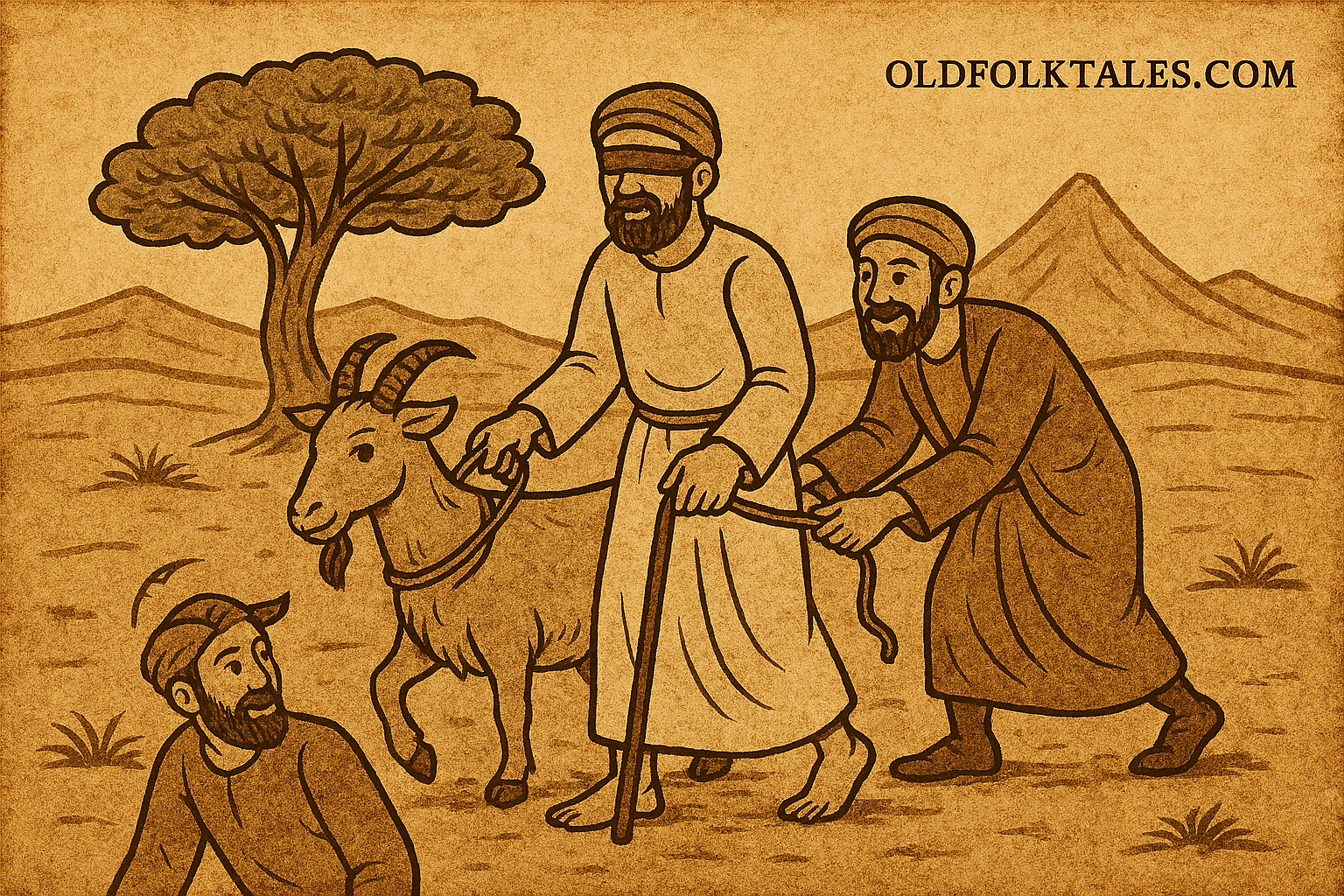
Hirsi hurried ahead and positioned himself by the roadside, assuming the pitiful posture of a helpless blind man. He began to call out in a voice filled with desperation and need: “Is there anyone here with a kind heart who can guide a poor blind man where he needs to go? I am lost and alone!”
The woman’s heart immediately filled with compassion when she heard his pleas. Despite her burdens and her own pressing business, she could not simply walk past someone in such obvious distress.
“Oh, you poor soul,” she said, approaching him with genuine concern. “I truly wish I could help you, but as you can see, both my hands are completely occupied. One holds the rope that controls my ram, and the other steadies this heavy pot of butter on my head. I simply don’t have a free hand to guide you.”
Hirsi’s voice took on a tone of humble gratitude mixed with practical wisdom. “Dear lady, your kindness touches my heart, and I believe there is a way you can help without too much inconvenience. If you would give me the ram’s rope, I can pull the animal along behind me that way you’ll have one hand free to take my walking stick and guide me in the right direction.”
The woman considered this arrangement and found it quite reasonable. “That’s actually a very good solution,” she agreed, handing him the rope and accepting his walking stick in return. “Where do you need to go?”
As they began walking together, with Hirsi carefully playing his role as a grateful blind man and the woman kindly directing their path, Kabaalaf crept silently behind them. With the stealth of a practiced thief, he carefully untied the rope from around the ram’s neck and led the valuable animal away into the surrounding brush.
After several minutes, Hirsi noticed that the rope in his hand had become suspiciously light. “Strange,” he commented with feigned confusion, “the rope seems much lighter now. What could have happened?”
The woman turned around to check on her ram and gasped in horror. The animal had completely vanished, leaving only an empty rope dangling from Hirsi’s hand.
“My ram is gone!” she cried in distress. “How could this have happened? I didn’t feel anything unusual just that the rope gradually became lighter as we walked.”
Hirsi maintained his helpful demeanor even in the face of this apparent tragedy. “What shall we do now?” the woman asked, her voice filled with worry about her loss.
“Perhaps the best plan would be for you to retrace our steps and search for your ram,” Hirsi suggested with apparent concern. “These animals sometimes wander off on their own. Meanwhile, I’ll stay right here and guard your pot of butter so it remains safe while you’re gone.”
The desperate woman, seeing no better alternative and trusting in the apparent kindness of this helpful blind man, agreed to the plan. She carefully lowered the heavy pot from her head and placed it beside Hirsi, then hurried back along the path to search for her missing ram.
The moment she disappeared from sight, Hirsi abandoned his pretense of blindness, snatched up the valuable butter, and ran swiftly into the wilderness where Kabaalaf waited with the stolen ram.
Divine Justice
The two thieves met in a secluded grove, congratulating themselves on the success of their elaborate scheme. They slaughtered the ram and prepared a feast, sharing the rich butter with their meal. Never had stolen goods tasted so sweet, and they ate with the satisfaction of men who believed they had perfectly executed their plan.
But their celebration was short-lived. Within hours of finishing their ill-gotten feast, both men became violently ill. Their stomachs cramped with excruciating pain, fever burned through their bodies, and weakness overtook them like a heavy blanket. As their condition worsened, they began to fear for their very lives.
Word of their illness spread quickly through both their communities. Friends, neighbors, and even former victims came to visit, curious about what had befallen the two notorious thieves.
“What has happened to you?” the visitors asked, seeing the men writhing in obvious agony.
With death seemingly approaching and their consciences finally awakened, both Hirsi and Kabaalaf confessed their crimes. “We have done a terrible thing,” they admitted through their pain. “We stole a ram and a pot of butter from an innocent woman who was simply trying to earn an honest living at the market. Perhaps she has children at home who are hungry and depend on her small trade for survival. We are deeply sorry for our wickedness, and now we fear we are about to die for our sins.”
Their illness served as a stark reminder that while they might escape human justice through cleverness and deception, divine justice sees all and judges with perfect accuracy.
Moral Lesson
This Ethiopian folktale teaches us that dishonesty and theft ultimately bring their own punishment. The story demonstrates how “cheats will be cheated in their turn” when Hirsi and Kabaalaf swindle each other, and shows that even when human law fails to catch wrongdoers, divine justice ensures that evil deeds do not go unpunished. The tale warns that temporary material gain through deception comes at the cost of spiritual and physical well-being.
Knowledge Check
Q1: What were Hirsi and Kabaalaf’s false goods in this Ethiopian folktale? A1: Hirsi carried a sack of ash that he claimed was flour, while Kabaalaf carried dried goat dung that he pretended was coffee beans, both intending to deceive buyers in unfamiliar markets.
Q2: How did the two thieves first encounter each other in the story? A2: They met at a crossroads while both were traveling to each other’s towns to commit fraud, and ended up trading their fake goods with each other, each believing they were cheating the other.
Q3: What elaborate scheme did Hirsi and Kabaalaf use to steal from the woman? A3: Hirsi pretended to be blind and asked for help, getting the woman to give him the ram’s rope. While she guided him with his stick, Kabaalaf secretly stole the ram, and then Hirsi ran off with her butter.
Q4: What happened to the thieves after they ate their stolen goods? A4: Both men became violently ill with stomach pain, fever, and weakness, fearing they would die as divine punishment for their theft from the innocent woman.
Q5: What does the phrase “cheats will be cheated in their turn” mean in this Ethiopian tale? A5: This phrase illustrates the concept of poetic justice that those who deceive others will eventually become victims of deception themselves, as shown when the two master thieves swindled each other.
Q6: What moral lesson about divine justice does this Ethiopian folktale teach? A6: The story teaches that even when human law cannot catch wrongdoers, divine justice sees all actions and ensures that evil deeds receive appropriate punishment, often through natural consequences of the wrongdoing itself.