Long before Lake Ichkeul became recognized as one of the world’s most important wetlands and earned its place as a UNESCO World Heritage Site, the people of northern Tunisia understood its value through generations of observation and experience. They did not need maps, scientific studies, or official designations to appreciate its importance. Every season, they watched the waters change with the rains, listened to the calls of birds arriving from distant lands, and saw how every living thing depended upon the health of the lake.
To them, Ichkeul was far more than a beautiful landscape.
It was a place where nature, livelihood, and tradition existed in harmony.
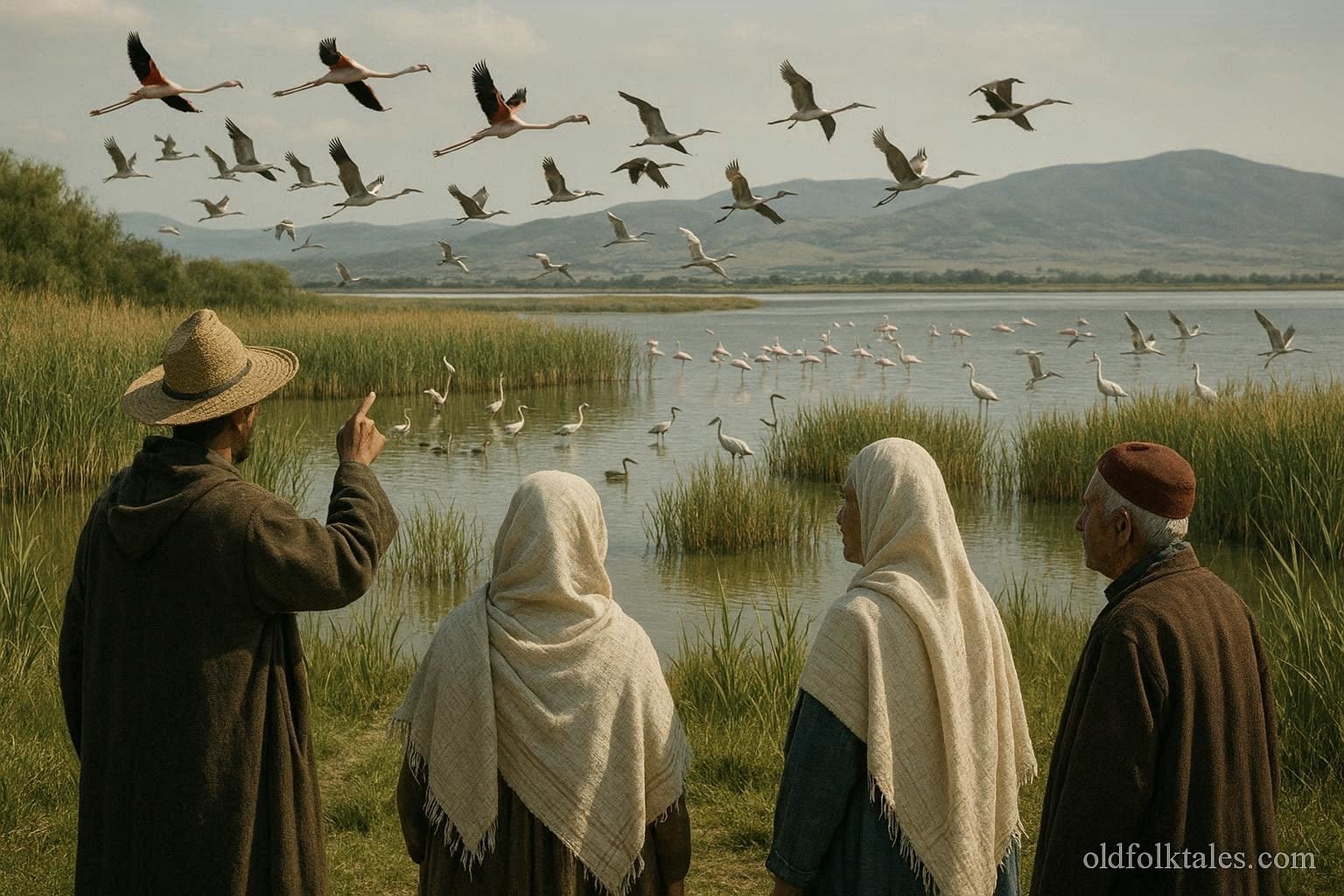
Nestled between rolling hills and fertile plains, the lake formed part of a remarkable ecosystem of open water, marshes, reed beds, and grasslands. Every autumn and winter, countless migratory birds traveled thousands of kilometers from Europe to find food and shelter there before continuing their journeys across Africa. Flamingos painted the shallow waters with soft shades of pink. Ducks and geese gathered in great numbers upon the lake, while herons, egrets, and storks searched patiently among the reeds.
For generations, the surrounding communities understood that these visitors returned only because the wetlands remained healthy.
Their elders often reminded them that every reed, every stream, every patch of marsh, and every bird formed part of a delicate balance that could not be taken for granted.
If you enjoyed this story, explore our full West African folktales collection
These lessons were never confined to written books.
They lived within stories shared around evening fires, conversations during fishing trips, and quiet walks through the wetlands with parents and grandparents. Children learned to recognize birds by their calls long before they could read their names. They learned which plants could be gathered responsibly, which nesting areas should never be disturbed, and why every generation carried the responsibility of leaving the lake healthier than they had found it.
Among those children was a thoughtful boy named Karim.
Unlike many of his friends, Karim was happiest when sitting quietly beside the reeds. While others raced through the meadows or played games near the village, he preferred watching birds arrive and depart with the changing seasons.
His father often laughed.
“You listen to birds as though they are telling stories.”
Karim would simply smile.
“Maybe they are.”
His grandfather, Youssef, was one of the oldest fishermen in the village. His face bore the marks of many years spent beneath the North African sun, and few people knew the wetlands better than he did.
He understood the rhythms of the lake.
He knew when fish moved into the shallows.
He recognized approaching weather by watching the behavior of birds.
Most importantly, he respected the unwritten customs that protected the wetlands.
One crisp autumn morning, Youssef invited Karim to accompany him before sunrise.
As darkness slowly gave way to dawn, the two walked quietly along narrow paths winding through tall reeds.
The air was cool.
Mist floated gently above the calm water.
For several moments, the world seemed almost silent.
Then the sky awakened.
Hundreds of birds appeared overhead.
Their wings caught the first rays of sunlight as they descended toward the lake.
Soon hundreds became thousands.
Flamingos landed gracefully in the shallows.
Geese called to one another from above.
Ducks skimmed across the water before settling into peaceful groups.
Karim stood speechless.
“I’ve never seen so many,” he whispered.
Youssef nodded.
“They have trusted this place for longer than any of us have lived.”
As they continued walking, Youssef pointed toward the wetlands.
“The birds need these reeds.”
“The reeds protect the fish.”
“The fish feed both wildlife and people.”
“The streams keep the lake alive.”
He paused before saying,
“When one part suffers, every part feels the loss.”
Those simple words stayed with Karim.
Over the following weeks, the olive harvest filled the nearby countryside with activity, while fishermen continued their daily work along the lake.
Even during busy seasons, villagers remained careful.
Families harvested reeds only from areas approved by the elders.
They avoided disturbing nesting grounds.
Fishing followed long-established customs designed to protect future stocks.
No one considered these practices burdens.
They were acts of gratitude toward the land that had sustained their ancestors.
One afternoon, visitors arrived from distant towns hoping to witness the famous bird migrations.
Some carried sketchbooks.
Others brought cameras and binoculars.
Karim eagerly volunteered to guide them through the safest walking trails.
Before beginning, he reminded everyone to speak softly.
“The birds have traveled farther than we can imagine,” he explained.
“They deserve a peaceful place to rest.”
The visitors admired not only the beauty of the lake but also the respect shown by the local people.
An elderly traveler remarked,
“You protect this place as though it belongs to your family.”
Karim smiled.
“It does.”
The following summer tested the community’s resolve.
Rainfall was scarce.
Water levels gradually dropped.
Some marshes became smaller than usual.
Concern spread throughout the villages.
Rather than waiting for others to solve the problem, community leaders gathered farmers, shepherds, fishermen, and teachers beneath a large fig tree.
Together they discussed practical solutions.
They organized clean-up efforts along streams flowing into the lake.
Young volunteers removed litter from footpaths.
Families agreed to reduce activities that could damage fragile wetland habitats.
Children planted native vegetation where erosion had weakened the shoreline.
Although no one could control the weather, everyone could contribute to protecting the ecosystem.
Karim worked beside neighbors twice his age.
He realized that stewardship required action, not merely good intentions.
Months later, autumn returned.
The villagers waited with hopeful anticipation.
One cool morning, familiar sounds echoed across the sky.
Flocks of migratory birds appeared once again.
Wave after wave descended toward Lake Ichkeul.
The wetlands came alive with movement.
Laughter spread throughout the village.
The children celebrated.
The elders smiled quietly, grateful that the ancient cycle had continued.
Years passed.
Karim grew into adulthood and became one of the community’s most respected nature guides.
School groups visited the wetlands regularly.
Instead of simply identifying bird species, Karim taught children to observe relationships.
He asked questions rather than giving immediate answers.
“Why do birds choose this lake?”
“What would happen if the reeds disappeared?”
“Why must clean streams continue flowing into the wetlands?”
The children discovered that every answer connected to another.
Nature worked not as separate pieces but as one living system.
Visitors from many countries also came to Lake Ichkeul.
They admired its extraordinary biodiversity and learned about the traditions preserved by local communities.
Karim always reminded them that conservation was not a modern invention.
Long before protected areas were established, families living beside the lake had already developed customs that encouraged responsible fishing, careful harvesting, and respect for wildlife.
Their traditions helped preserve the wetland for generations.
As Karim grew older, he often returned to the very place where his grandfather had first shown him the great migration.
Standing beside the reeds, he watched another generation of children gaze upward as thousands of birds filled the autumn sky.
One little boy asked,
“Will they always come back?”
Karim looked across the shimmering lake before answering.
“They will…”
“…if we never forget that this place belongs to more than ourselves.”
The child nodded thoughtfully.
At that moment, Karim realized the true guardians of Ichkeul were not individuals.
They were every generation willing to pass forward the values of respect, responsibility, and harmony with nature.
Today, Lake Ichkeul National Park remains one of the most important wetlands in the Mediterranean region and a UNESCO World Heritage Site. Its marshes, reed beds, and freshwater lake continue to provide essential habitat for hundreds of thousands of migratory birds each year. The traditions of the surrounding communities reflect a long history of environmental stewardship, reminding the world that cultural heritage and natural heritage are deeply connected.
The story of Guardians of Ichkeul teaches that protecting nature is not simply about preserving beautiful places. It is about honoring the delicate relationships that sustain life and ensuring that future generations inherit a world where both people and wildlife can continue to flourish together.
Want to dive deeper? Read more North African folktales today
Moral Lesson
Communities that respect nature and work together to protect it leave a lasting legacy for both people and wildlife.
Knowledge Check
1. Why is Lake Ichkeul important to migratory birds?
It provides food, shelter, and a resting place for birds traveling between Europe and Africa.
2. What did Karim learn from his grandfather?
That every part of the wetland is connected and must be protected to keep the ecosystem healthy.
3. How did the villagers care for the wetlands?
They harvested reeds responsibly, protected nesting areas, kept streams clean, and followed sustainable fishing practices.
4. What challenge did the community face during the dry summer?
Lower water levels threatened the wetlands, so villagers worked together to protect the ecosystem.
5. How did Karim teach children as an adult?
He encouraged them to observe nature, ask questions, and understand the connections within the wetland.
6. What is the main lesson of the story?
Protecting nature requires cooperation, responsibility, and respect across generations.
Source
Adapted from the oral traditions of communities surrounding Lake Ichkeul, together with documentation from UNESCO World Heritage Centre, Ichkeul National Park, and Tunisian environmental and cultural heritage studies.