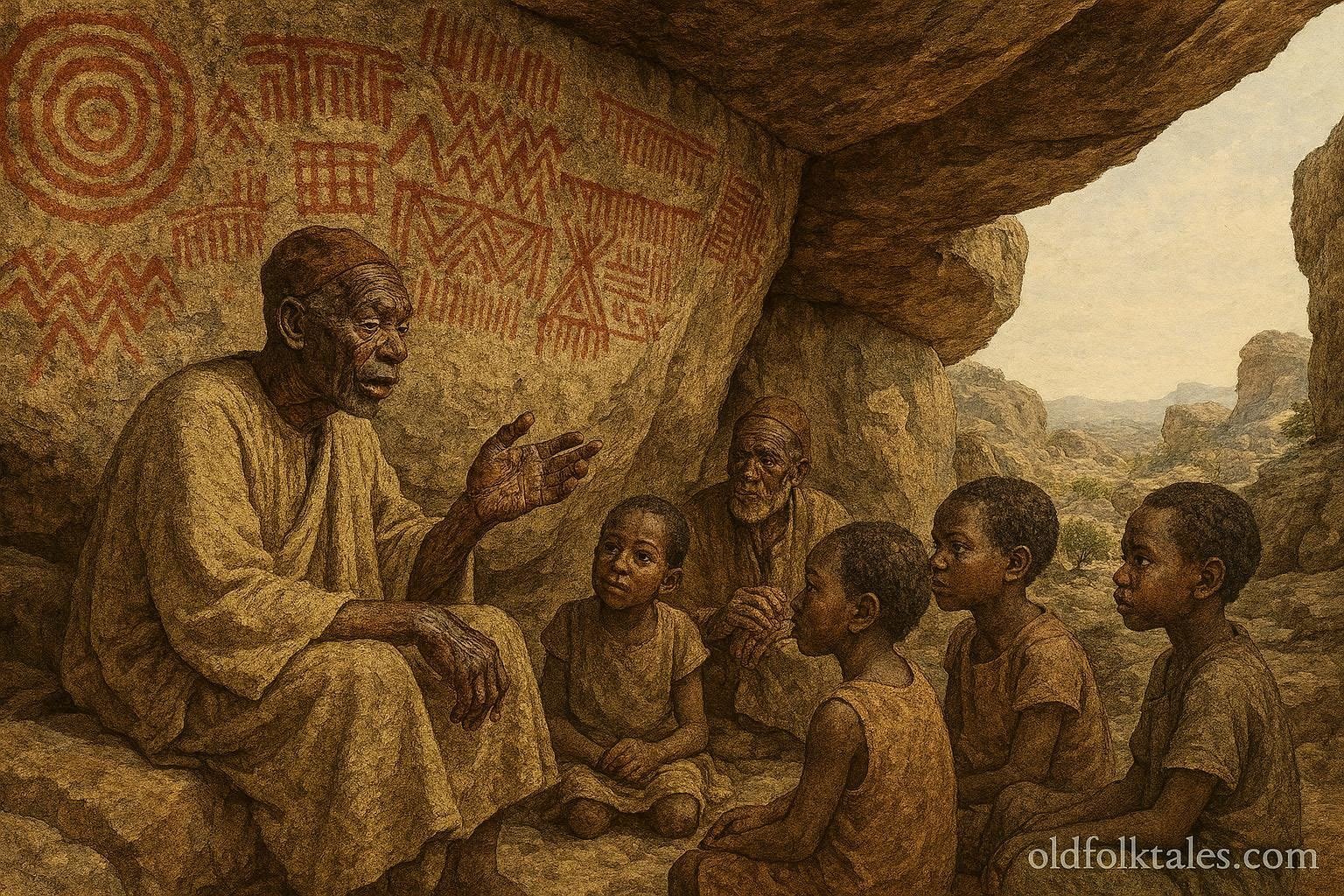
Across the rolling landscapes of eastern Uganda, where rocky outcrops rise above the surrounding plains, there stands a remarkable place known as Nyero Rock. For centuries, people have visited the site and gazed upon the ancient paintings that decorate its sheltered surfaces. The images, painted in red pigments, have survived through changing seasons, passing generations, and the rise and fall of communities. Although no one knows with certainty who created them, stories about the ancient painters have been preserved within the cultural memory of the region.
Long before written records became common, communities relied upon storytelling to preserve knowledge. Elders passed important information to younger generations through songs, legends, and oral histories. Among the stories shared in the Teso region were accounts of the mysterious artists responsible for the paintings at Nyero Rock.
According to tradition, the paintings were already ancient when the grandparents of the oldest elders first heard stories about them. The images appeared on sheltered rock surfaces protected from wind and rain. Some resembled circles, lines, and geometric shapes. Others seemed to contain patterns whose meanings were no longer fully understood.
Want to dive deeper? Read more North African folktales today
Because their creators remained unknown, people developed many explanations.
Some elders believed the paintings were created by highly skilled ancestors who wished to leave messages for future generations. Others suggested that travelers from distant lands may have passed through the region long ago and recorded important events using symbols and designs. Still others believed the paintings reflected ceremonies, beliefs, or traditions that had faded from memory over time.
One village near Nyero was home to a curious boy named Ocen. He often accompanied his grandfather on walks through the countryside. Whenever they passed near the rock shelter, Ocen stopped to study the ancient images.
The more he looked at them, the more questions he had.
Who painted them?
Why were they created?
What stories did they tell?
One afternoon, after spending hours examining the artwork, Ocen finally asked his grandfather whether anyone knew the answers.
The old man smiled.
He explained that many generations had asked the same questions. The mystery itself was part of what made Nyero special. While the exact identities of the painters had been lost to time, their work remained as evidence that people long ago possessed creativity, knowledge, and a desire to communicate.
His grandfather encouraged him to think beyond the question of who created the paintings.
Instead, he suggested considering why communities continued preserving stories about them.
That evening, Ocen reflected on the advice.
He realized that although the names of the artists had disappeared, their work still influenced people centuries later. Travelers visited the site. Elders shared stories inspired by the paintings. Children learned about the importance of protecting historical places.
In a way, the painters had achieved something extraordinary.
They had created a connection between generations separated by vast stretches of time.
Motivated by this realization, Ocen began speaking with elders throughout the community. Each person offered a slightly different interpretation of the paintings.
One elder believed the circular designs represented gatherings of people united by common traditions.
Another suggested they symbolized the sun and the passage of seasons.
A respected storyteller proposed that some images might have been connected to rituals intended to strengthen relationships between communities and the natural world.
Although opinions differed, everyone agreed on one point.
The paintings deserved respect.
As Ocen continued learning, he discovered that stories about Nyero Rock were not limited to a single village. Communities throughout the region preserved traditions connected to the site. Some narratives emphasized its spiritual significance. Others highlighted its historical importance. Together, these stories formed a rich tapestry of cultural memory.
Years later, a severe storm struck the region.
Strong winds damaged homes and uprooted trees. After the storm passed, villagers gathered to repair what had been destroyed. During these efforts, some people worried that natural forces might eventually damage the ancient paintings as well.
The concern inspired an important discussion.
Community leaders, elders, and teachers met to consider how future generations could continue protecting Nyero Rock. They understood that once historical treasures are lost, they cannot easily be replaced.
The gathering resulted in a shared commitment to preservation.
Families encouraged children to learn about the site’s history. Elders continued sharing stories connected to the paintings. Visitors were taught to treat the area with care and respect.
Ocen, now a young man, became deeply involved in these efforts.
He believed that protecting Nyero Rock meant more than preserving physical images on stone. It also required preserving the stories, questions, and lessons associated with them.
Whenever visitors arrived, he shared what he had learned.
He explained that mystery does not diminish the value of history. In many ways, it increases it. The unknown encourages curiosity, investigation, and reflection. It reminds people that the past still contains discoveries waiting to be understood.
As years passed, scholars, researchers, and historians also became interested in the site. They studied the paintings and attempted to learn more about their origins. Their work contributed valuable knowledge, yet many questions remained unanswered.
For the local communities, this uncertainty was not a problem.
The mystery had become part of the site’s identity.
People understood that not every historical question would receive a complete answer. Sometimes the most important lesson lies not in certainty but in the desire to keep learning.
The story of Nyero Rock continued to inspire generations because it celebrated the enduring power of memory. The painters may have vanished from history, but their work survived. Through those images, they continued communicating across centuries.
Children who visited the site learned that human creativity can outlast individual lifetimes.
Adults were reminded that heritage deserves protection.
Elders recognized the importance of passing knowledge forward.
Over time, Nyero Rock became more than an archaeological site.
It became a symbol of continuity.
The paintings connected present communities to people who lived long before them. They demonstrated that every generation leaves traces of its existence, whether through art, stories, traditions, or acts of preservation.
Today, the ancient images remain among Uganda’s most remarkable cultural treasures. Visitors continue to marvel at their beauty and mystery. Communities continue telling stories about their creators. Researchers continue searching for answers.
Yet perhaps the greatest achievement of the ancient painters is that they succeeded in preserving a conversation across time.
Through their work, they encouraged future generations to ask questions, value heritage, and remember that the past still has much to teach.
The mystery endures, but so does the wisdom contained within it.
Looking for more? Explore the magic of East African folktales here
Moral Lesson
Preserving heritage allows future generations to learn from the creativity, knowledge, and experiences of the past.
Knowledge Check
1. What makes Nyero Rock famous?
Its ancient rock paintings that have survived for centuries.
2. Do historians know exactly who created the paintings?
No, the identity of the painters remains uncertain.
3. Why did elders continue telling stories about the paintings?
To preserve cultural memory and teach younger generations about their heritage.
4. What did Ocen learn from studying the paintings?
That history remains valuable even when some mysteries remain unsolved.
5. Why did the community decide to protect Nyero Rock?
Because it is an important cultural and historical treasure.
6. What is the main lesson of the story?
Heritage should be preserved so future generations can learn from the past.
Source
Adapted from oral traditions associated with Nyero Rock paintings, Teso regional heritage narratives, Uganda Museum heritage archives, and cultural memory traditions preserved in eastern Uganda.