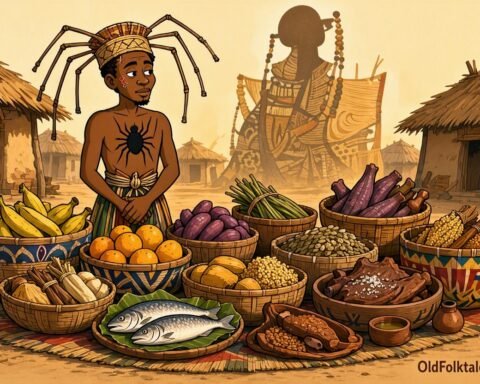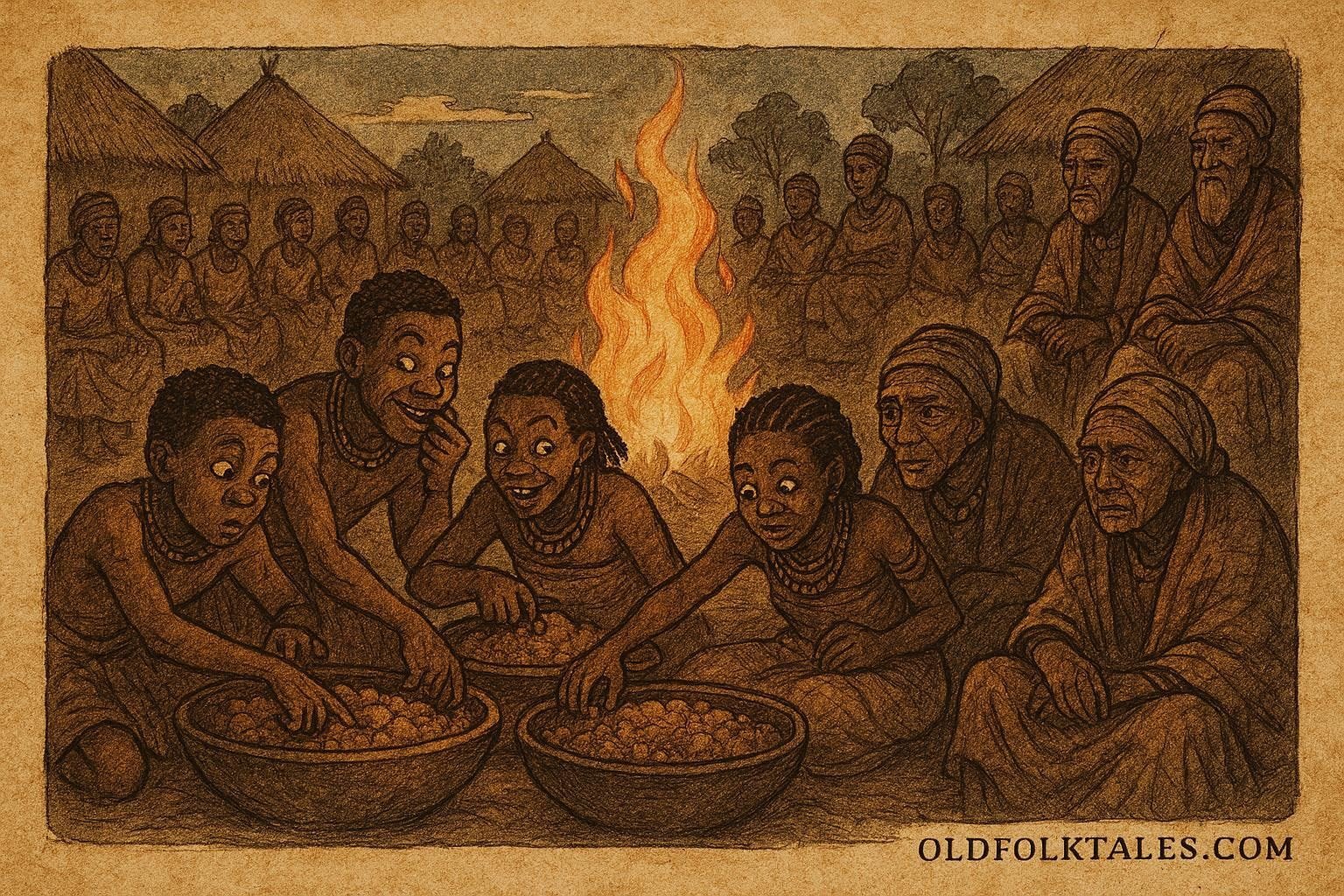
On a day chosen with care, when the season had been kind and the people had enough to share, the village prepared for a great feast that would bring everyone together. It was not merely a time for eating, but a moment of unity, where families gathered, laughter filled the air, and the bonds of the community were strengthened. Large pots were set over steady fires, the aroma of cooking food spread across the village, and every household contributed something, no matter how small. In such gatherings, fairness and respect were not spoken of loudly, yet they guided every action, for everyone understood that a feast was only meaningful when it was shared equally.
As the preparations continued, people moved with purpose and excitement. Some fetched water, others gathered firewood, while the elders oversaw the arrangement of the space where everyone would sit. Children watched eagerly, drawn by the promise of abundance, while the adults ensured that everything was done properly. The food was placed in large serving bowls, meant to be shared among all, with the understanding that each person would take only what they needed.
Among the villagers were a few individuals whose thoughts did not fully align with the spirit of the gathering. Outwardly, they participated like everyone else, offering help and speaking kindly, but inwardly, they carried a quiet desire to take more than their fair share. They told themselves that no one would notice, that in the abundance of the feast, a little extra taken in secret would make no difference.
Fascinated by this tale? Discover more North African folktales
When the time came, everyone gathered and took their places. The elders spoke briefly, reminding the people of the importance of unity and fairness, not as a warning, but as a reflection of what the feast represented. Then the eating began, and the joyful sounds of conversation filled the air as people reached for food and shared what was before them.
At first, everything appeared as it should. People took moderate portions, passing bowls from one person to another, ensuring that all were included. Laughter and stories flowed easily, and the feast seemed to embody the harmony the village valued.
But slowly, something began to change.
Some bowls that had been full began to empty faster than expected. Portions that should have been enough for many seemed to disappear before reaching everyone. A few people noticed, but they said nothing at first, assuming it was simply the natural flow of a large gathering.
Yet the pattern continued.
Those who sat closer to certain dishes found that they were able to take more, often returning for extra before others had received any. Some quietly hid portions beside them, planning to eat later, while others reached more frequently than necessary, careful not to draw attention to themselves.
The imbalance grew, though it remained subtle.
Not everyone was aware of it, but those who observed carefully began to understand that something was wrong. The spirit of sharing that defined the feast was slowly being replaced by quiet selfishness.
The elders watched.
They said nothing at first, choosing instead to observe the behavior unfolding before them. They understood that sometimes, it was not words that revealed truth, but actions allowed to continue without interruption.
After some time, one of the elders rose.
The conversations softened as attention turned toward him.
He spoke calmly, his voice steady and clear, carrying across the gathering without force. He did not accuse anyone directly, nor did he raise his tone. Instead, he spoke about the meaning of the feast, about how it reflected the character of the people, and how true abundance was measured not by how much one could take, but by how much one allowed others to receive.
As he spoke, a quiet realization began to settle over the gathering.
Those who had taken more than their share felt the weight of his words, though their actions had not been publicly named. The truth had revealed itself without needing to be pointed out directly.
The elder then asked that the remaining food be gathered and redistributed.
People moved slowly, some with hesitation, others with a renewed sense of awareness. The bowls were brought together again, and it became clear how unevenly the food had been taken.
What had been hidden was now visible.
Those who had acted with fairness saw the difference clearly, while those who had taken more could no longer pretend that their actions had gone unnoticed.
There was no shouting, no punishment declared.
Instead, there was silence.
It was a silence filled with understanding, one that carried more weight than anger ever could.
The food was shared again, this time with greater care.
People took only what they needed, ensuring that others received their portion before returning for more. The balance that had been lost was slowly restored, not through force, but through awareness.
As the feast continued, the atmosphere changed.
The laughter returned, but it carried a different tone, one shaped by reflection as much as joy. People spoke more thoughtfully, their actions guided by a renewed understanding of what it meant to share.
When the gathering came to an end, the lesson remained.
It was not spoken loudly, nor repeated in long speeches.
But it was understood by all.
Those who had taken more than their share carried the memory of that moment with them, not as a mark of shame, but as a reminder of the importance of fairness.
The elders knew that no further action was needed.
The truth had already done its work.
From that day forward, the story of that feast was told as a lesson within the village.
Not as a tale of wrongdoing alone, but as a reminder that character is revealed not in what people say, but in what they do when they believe no one is watching.
And so, the feast that began as a celebration became something more.
It became a moment of truth.
Love this story? Discover our full Southern African folktales collection
Moral Lesson
True character is revealed in how we act when we think no one is watching.
Knowledge Check
- What was the purpose of the feast?
To bring the community together and share food equally. - What problem arose during the feast?
Some people secretly took more than their fair share. - How was the greed revealed?
The food ran out unevenly, and the elders observed the behavior. - Did the elders punish anyone directly?
No, they allowed the truth to reveal itself through actions. - What happened after the realization?
The food was redistributed more fairly. - What lesson did the villagers learn?
That fairness and honesty matter even when no one is watching.
Source
Angolan folktale. Collected by Heli Chatelain in Folk-Tales of Angola (1894).