For the BaAka people of the Congo Basin, the forest is far more than a place to hunt or gather food. It is a living home that provides shelter, nourishment, music, and spiritual guidance. Among the most respected traditions is the ceremony of Dzengi, the revered forest spirit whose appearance symbolizes the deep bond between the people and the rainforest. Passed down through generations, the legend of The Coming of Dzengi teaches that communities prosper only when they honor the forest with gratitude, unity, and respect.
There was a time when the great rainforest sang every morning.
Birds welcomed the sunrise.
Streams flowed clearly through the trees.
Children laughed as they gathered wild fruits beside their parents.
The forest gave generously because its people never took more than they needed.
Among those people lived a young BaAka boy named Suma.
He had grown up listening to stories about Dzengi.
The elders spoke of the sacred forest spirit with great respect.
No one described Dzengi as something to fear.
Instead, they spoke of Dzengi as the voice of the forest itself.
Whenever the community forgot gratitude or allowed pride to grow, the elders prepared the sacred ceremony.
During songs, dancing, and prayer, Dzengi would come to remind the people that they belonged to the forest just as much as the forest belonged to them.
Fascinated by this tale? Discover more North African folktales
Suma dreamed of witnessing the ceremony one day.
But he was still too young.
“The time will come,” his grandfather always told him.
“When your heart is ready.”
One year the rains arrived much later than expected.
Forest streams became shallow.
Wild fruits grew scarce.
Hunters walked farther each day before finding animals.
Even the birds seemed quieter than before.
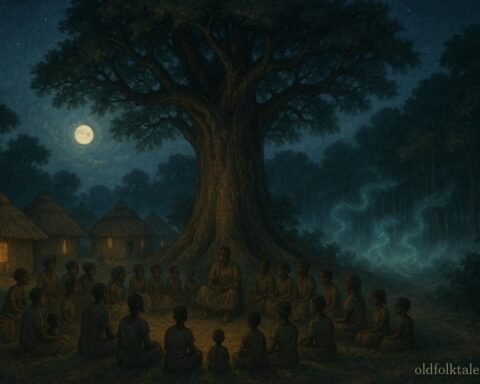
The elders gathered beneath a towering tree.
No one blamed the forest.
Instead, they examined themselves.
“Have we forgotten our promises?”
One elder asked.
Another replied,
“Perhaps we have become careless.”
An old woman spoke softly.
“Some families have taken more than they need.”
Another elder nodded.
“Young hunters have ignored the resting places where animals raise their young.”
The gathering became silent.
Finally, the oldest elder stood.
“It is time.”
“We must call upon Dzengi.”
News spread quickly throughout the camp.
Every family began preparing.
The women cleaned the gathering place.
The men repaired traditional drums.
Children collected fresh leaves and flowers from the forest floor.
No one shouted.
No one hurried.
Every task was completed with care and respect.
Suma watched everything with wide eyes.
His grandfather smiled.
“Today you will learn that ceremonies begin long before the songs.”
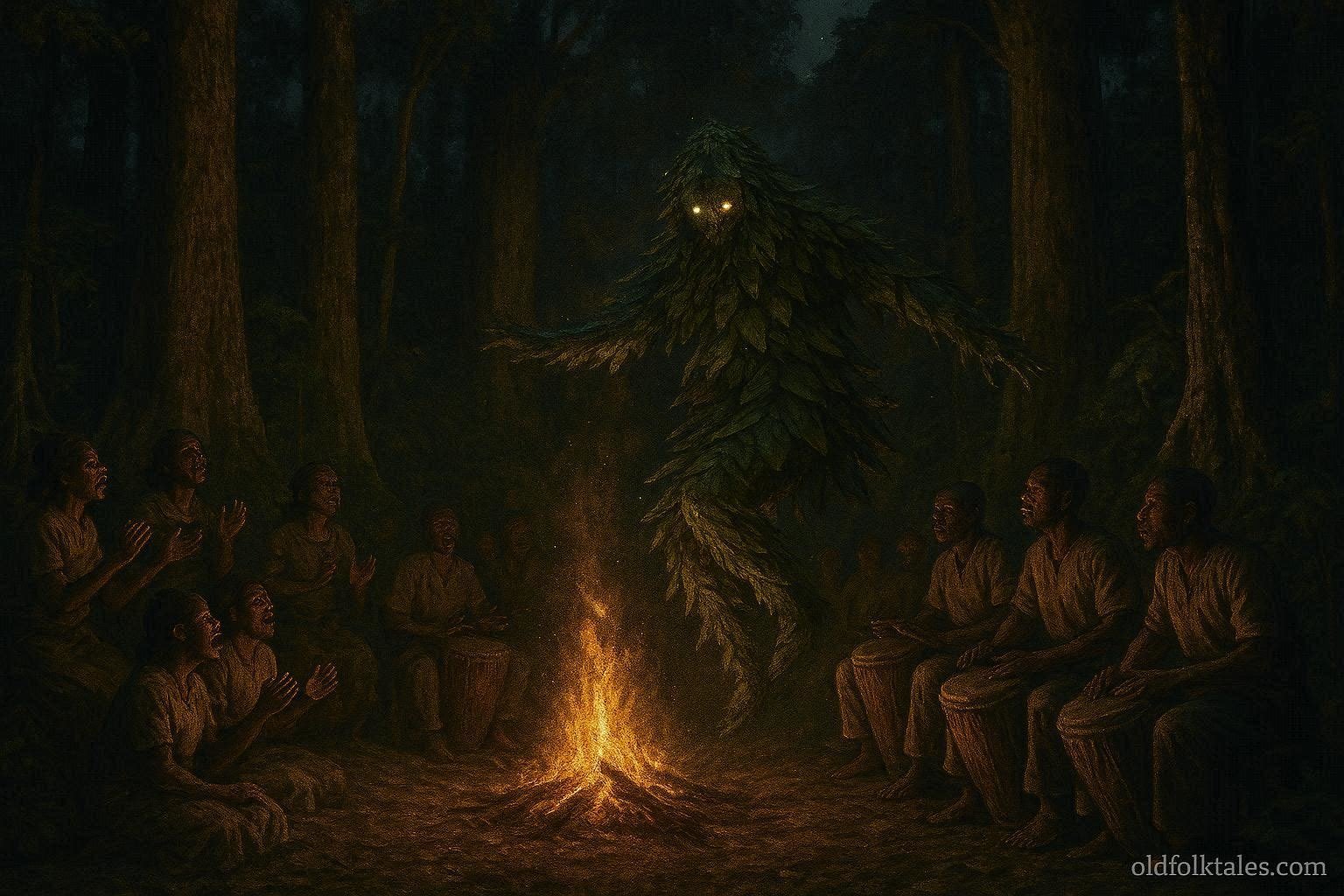
As darkness settled across the rainforest, fires were lit around the clearing.
The first drum sounded slowly.
Deep.
Steady.
Its rhythm echoed between the ancient trees.
Soon voices joined together.
The people sang songs their grandparents had learned from generations before them.
The melodies rose gently into the night.
Suma had never heard anything so beautiful.
The forest itself seemed to listen.
Then something remarkable happened.
A cool breeze passed through the clearing.
Leaves rustled high above the people.
The singing continued.
No one looked afraid.
Instead, every face reflected quiet joy.
Slowly, a magnificent figure emerged from the darkness.
Covered in fresh forest leaves and natural fibers, the figure moved with graceful, powerful steps.
Its appearance reflected the beauty and mystery of the rainforest.
The drums grew stronger.
The singing became louder.
Suma felt his heart race.
He looked toward his grandfather.
The old man quietly bowed his head.
“So Dzengi has come.”
The sacred figure moved among the people without speaking.
Children watched respectfully.
Adults continued singing.
No one reached out to touch the visitor.
Everyone understood that this was a moment of reverence rather than curiosity.
As Dzengi danced through the clearing, something unexpected happened.
People who had argued embraced one another.
Hunters quietly promised to protect the breeding grounds.
Families agreed to share food more generously during difficult seasons.
No one had been commanded to do these things.
The presence of Dzengi simply reminded them of the promises they had almost forgotten.
The ceremony continued until dawn.
As the first rays of sunlight reached the clearing, the drums became softer.
The singing slowed.
Gradually, Dzengi disappeared once again into the forest.
No one followed.
The elders simply smiled.
“The forest has heard us.”
Over the following weeks, gentle rains returned.
Streams filled once more.
Fresh shoots appeared across the forest floor.
Animals gradually returned to familiar paths.
The people celebrated, not because they believed the ceremony had forced the forest to change, but because it had first changed their own hearts.
Suma never forgot that night.
Years later, after becoming a respected elder himself, young children often asked,
“Did you truly see Dzengi?”
He smiled.
“Yes.”
“What was Dzengi like?”
Suma looked toward the endless green canopy.
“Dzengi reminded us that the forest is alive.”
“But the greatest miracle was not seeing Dzengi.”
“It was watching people remember how to care for one another and for the forest.”
The children thought quietly about his words.
Some expected stories of magic.
Instead, they received something greater.
Wisdom.
Even today, the ceremony of Dzengi remains one of the most respected cultural traditions among the BaAka, celebrating the sacred relationship between people and the rainforest. While traditions differ between communities, Dzengi continues to symbolize unity, respect for nature, and the understanding that human wellbeing depends upon living in harmony with the forest. The Coming of Dzengi honors this living cultural heritage by reflecting the values that have guided BaAka communities for generations.
Keep reading: Discover more Central African folktales
Moral Lesson
Nature flourishes when people live with gratitude, respect, and unity. Protecting the environment begins with caring for one another and honoring the gifts of the natural world.
Knowledge Check
1. What does Dzengi represent in BaAka tradition?
Dzengi symbolizes the sacred relationship between the BaAka people and the living forest.
2. Why did the elders prepare the ceremony?
They believed the community needed to renew its respect for the forest and for one another.
3. How did the people prepare for Dzengi’s coming?
They cleaned the gathering place, repaired drums, gathered forest decorations, and sang traditional songs.
4. What changed during the ceremony?
People reconciled with one another, renewed promises to protect the forest, and committed to sharing its resources wisely.
5. Why did the rains return after the ceremony?
The legend teaches that harmony with nature begins when people first change their attitudes and actions.
6. What is the central message of the story?
Communities thrive when they respect nature, preserve tradition, and live together in unity.
Source
Inspired by UNESCO Intangible Cultural Heritage, Colin Turnbull’s The Forest People, Jerome Lewis’s research on BaAka culture, and Congo Basin ethnographic studies.