The Congo Basin rainforest has long been the home of the BaAka, whose lives have been shaped by its rivers, towering trees, and countless living creatures. Elders teach that the forest is more than a place to hunt or gather food. It is a living world that provides, protects, and deserves respect. They remind every child that courage is admirable, but courage without humility can lead even the strongest person astray. The legend of Moke Beyond the Sacred Trees tells how one young hunter discovered that the deepest lessons of the forest cannot be learned with a spear alone.
In a BaAka camp beside the great rainforest lived a young hunter named Moke.
No one climbed trees faster than he did.
No one could follow fresh animal tracks more confidently.
Even experienced hunters admitted that Moke possessed remarkable skill for someone so young.
But alongside his talent grew something far more dangerous.
Pride.
Whenever elders warned hunters to avoid the oldest part of the forest, Moke laughed.
“The forest fears no one.”
“Why should I fear it?”
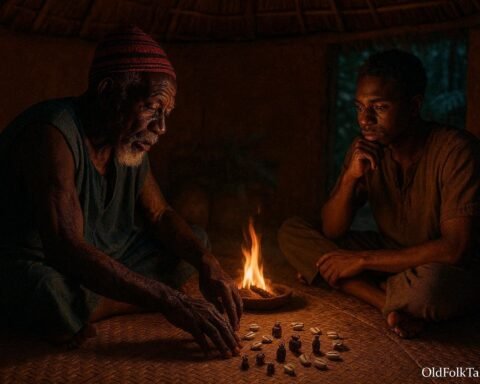
Old Papa Yando always answered calmly.
“We do not avoid that place because we are afraid.”
“We avoid it because we are grateful.”
Moke never understood.
To him, every path existed to be explored.
Every mystery existed to be solved.
One cool morning, before anyone else had awakened, Moke quietly left the camp.
Don’t miss out: Read more Southern African folktales
He carried only his spear, a small knife, and a woven bag.
He intended to prove that the stories about the sacred forest were nothing more than tales told to frighten children.
As the sun rose above the trees, he crossed familiar hunting paths.
He passed streams where women often collected water.
He walked beyond places where his people gathered wild fruits.
Finally, he reached a line of towering ancient trees unlike any he had seen before.
Their trunks were enormous.
Their roots rose from the ground like great walls.
The air itself seemed cooler.
Everything became strangely quiet.
No birds sang.
No monkeys called.
Even the wind seemed unwilling to disturb the silence.
For the first time that morning, Moke hesitated.
Still, pride pushed him forward.
“This is only another part of the forest.”
He stepped beneath the ancient trees.
Immediately, the light changed.
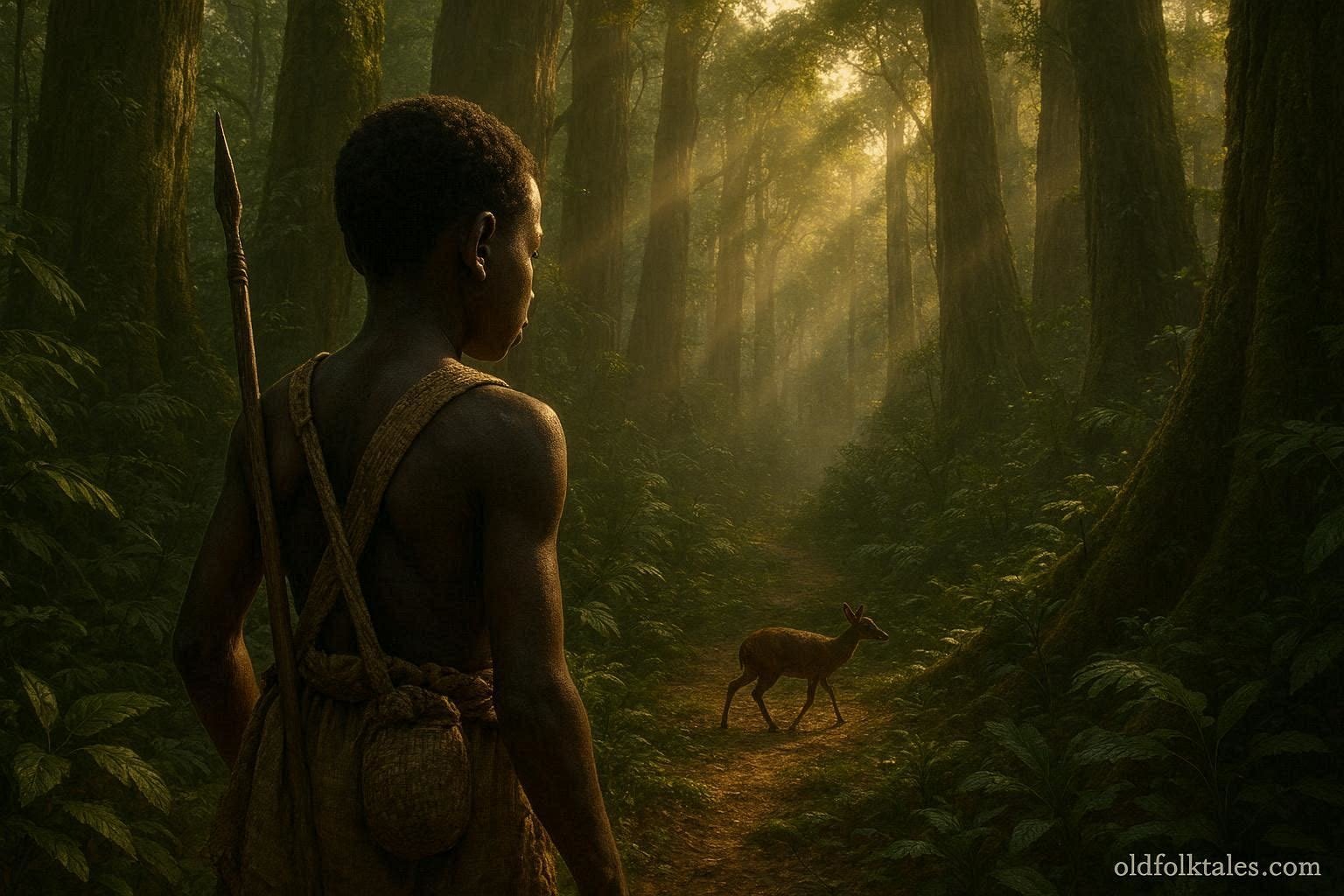
Sunlight filtered through the thick canopy in narrow golden beams.
Every sound became softer.
Every movement seemed slower.
As he searched for fresh tracks, he noticed something unusual.
The footprints of a forest antelope appeared clearly in the soft earth.
He followed them for several minutes.
Then, without warning, they disappeared.
Not gradually.
Completely.
The ground ahead remained smooth and untouched.
Moke searched carefully.
There were no signs of the animal turning aside.
No broken branches.
No crushed leaves.
Only silence.
He frowned.
“I must have overlooked something.”
He continued walking.
Hours later he found another trail.
This time it belonged to a wild pig.
Again, the tracks suddenly vanished.
Moke’s confidence began to weaken.
As afternoon approached, hunger reminded him that he had caught nothing.
He searched the trees for fruit.
Several branches were heavy with ripe forest figs.
He quickly climbed toward them.
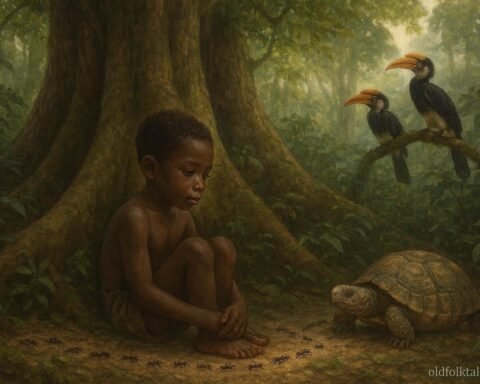
Just as he reached the fruit, a family of hornbills landed nearby.
Instead of flying away, they remained perfectly still.
The oldest bird gently pecked at one fruit before leaving the rest untouched.
Only then did the younger birds begin eating.
Moke watched carefully.
The birds never stripped the tree bare.
They left many fruits behind.
He quietly climbed down without taking more than he needed.
For the first time, he wondered whether the elders had noticed the same lesson long ago.
As evening approached, dark clouds gathered overhead.
Rain began falling heavily.
Moke searched desperately for shelter.
Then he noticed an enormous fallen tree whose hollow trunk provided just enough space to stay dry.
Inside, he listened to the rain striking thousands of leaves above him.
The forest did not feel empty.
It felt alive.
The following morning he continued deeper.
Near a clear stream he finally found fresh animal tracks again.
Excited, he raised his spear.
Just then he heard a soft cry.
A tiny forest duiker had become trapped beneath a fallen branch.
It struggled helplessly.
Moke stepped closer.
The frightened animal stopped moving.
Its wide eyes met his.
Slowly, Moke lowered his spear.
Instead of hunting, he lifted the heavy branch.
The little antelope quickly disappeared into the undergrowth.
Moments later, something remarkable happened.
From every direction, birds began singing once more.
Monkeys called across the treetops.
Butterflies drifted through shafts of sunlight.
The forest seemed to awaken.
Moke stood silently.
No voice spoke.
No spirit appeared.
Yet he understood.
The forest had never been testing his strength.
It had been watching his heart.
As he turned to return home, he noticed something he had completely missed before.
The paths were now easy to follow.
Streams seemed familiar.
Landmarks appeared where none had existed the day before.
It was as though the forest itself had decided to guide him home.
By sunset he reached the camp.
The elders were waiting quietly.
Papa Yando looked at him and smiled.
“You crossed the sacred trees.”
Moke nodded.
“You knew?”
“The forest always tells us when someone enters without listening.”
The young hunter lowered his head.
“I believed courage meant never turning back.”
The old elder gently placed a hand on his shoulder.
“And what do you believe now?”
Moke looked toward the towering rainforest.
“I believe courage begins with respect.”
“It is impossible to protect what we do not first learn to honor.”
From that day forward, Moke became one of the community’s most trusted hunters.
He never hunted more than his family needed.
He taught younger hunters to leave breeding animals undisturbed.
He reminded children that every tree, river, and creature shared the same living forest.
Whenever anyone asked why the oldest trees remained untouched, he smiled and answered,
“Because some places exist not for ownership, but for gratitude.”
Generations later, BaAka elders continued telling the story of Moke Beyond the Sacred Trees, reminding every child that the rainforest is not an enemy to conquer but a home to cherish. Though the legend belongs to oral tradition, it reflects the deep respect for nature that has guided BaAka communities for countless generations.
If you liked this story, see our Central African folktales collection
Moral Lesson
True courage is shown not by conquering nature but by respecting and protecting it with humility and gratitude.
Knowledge Check
1. Why did Moke enter the sacred part of the forest?
He wanted to prove that the elders’ warnings were only stories and that he feared nothing.
2. What unusual things happened inside the sacred forest?
Animal tracks disappeared, the forest fell silent, and nature seemed to respond to Moke’s actions.
3. Why did Moke spare the trapped duiker?
He realized that compassion and respect were more important than proving himself as a hunter.
4. What happened after Moke freed the young antelope?
The forest came alive with birdsong, and the paths became clear enough to guide him home.
5. What lesson did Papa Yando hope Moke would learn?
That courage without humility can become pride, and the forest deserves respect rather than conquest.
6. What is the central message of the story?
Nature rewards those who approach it with humility, gratitude, and respect.
Source
Inspired by BaAka oral traditions, Congo Basin ethnographic research, and studies on Indigenous ecological knowledge in Central African rainforests.