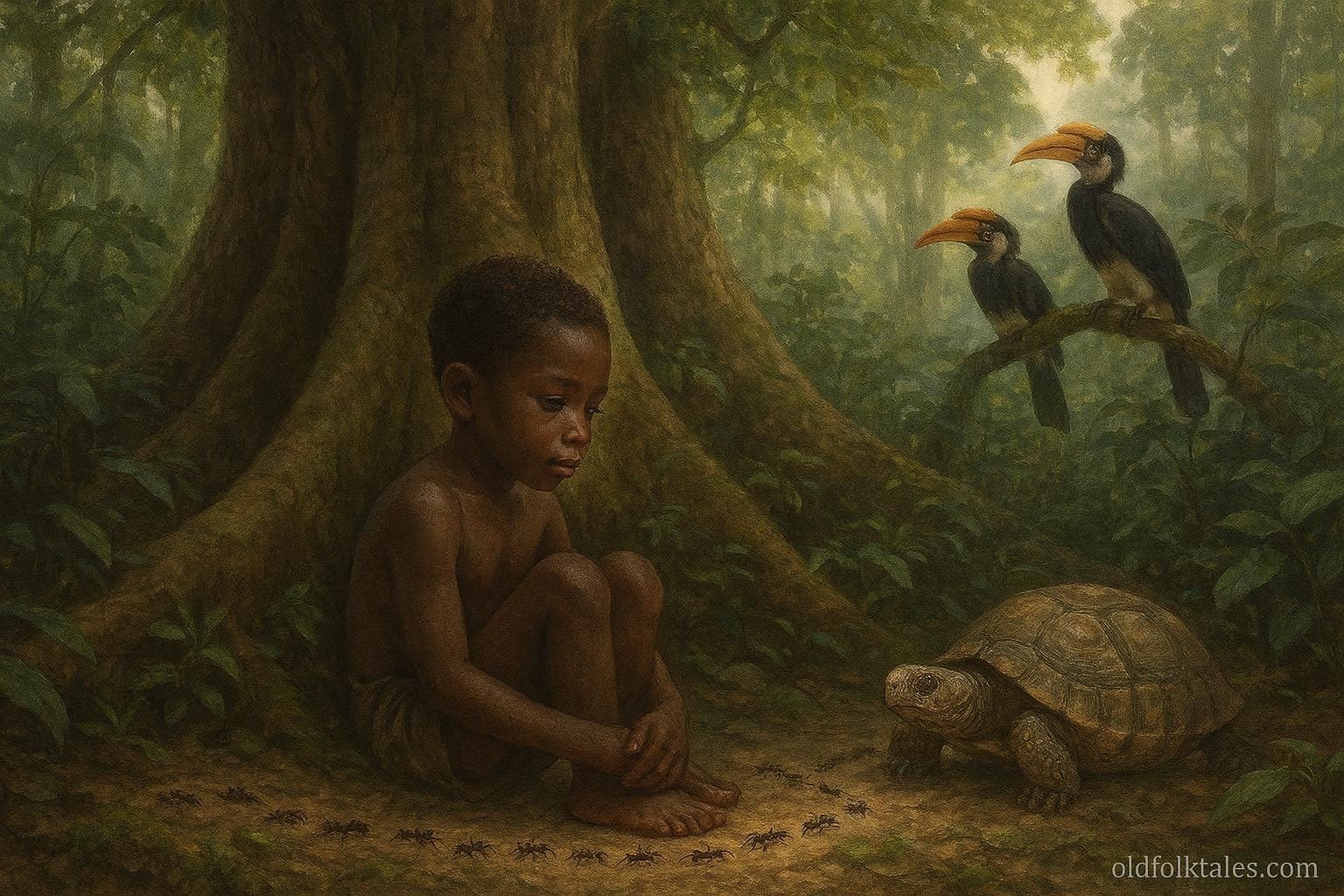
Among the Mandjia people of the Central African Republic, growing into adulthood was marked by more than age or physical strength. Through traditional rites of passage, young people were taught discipline, patience, courage, and respect for their community. Elders believed that wisdom was not something that could simply be given. It had to be earned through observation, endurance, and humility. One cherished legend tells of a stubborn boy whose seven days alone beneath an ancient tree transformed not only his understanding of the forest but also of himself.
In a Mandjia village surrounded by dense rainforest lived a boy named Beko.
No one doubted his courage.
He climbed the tallest trees without fear.
He outran boys older than himself.
He could throw a spear farther than most young hunters.
Because of these talents, Beko believed he already possessed everything needed to become a man.
Whenever elders offered advice, he smiled politely but rarely listened.
“What can they teach me?” he often whispered to his friends.
“I am already stronger than most of them ever were.”
The older villagers heard his words but chose not to argue.
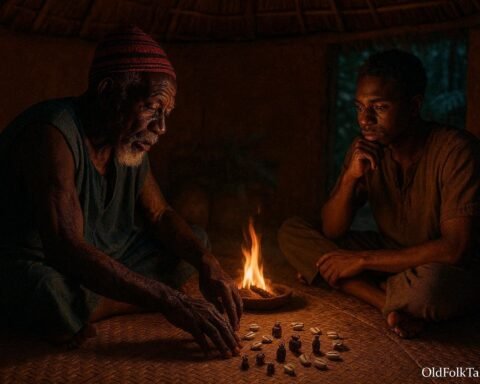
One evening, as the village gathered around the fire, the oldest elder, Mbaï, announced that the season of initiation had arrived.
Want more? Read more West African folktales now
Several boys, including Beko, would soon begin the traditional journey into adulthood.
The boys expected lessons about hunting.
They imagined proving their bravery by facing wild animals.
Instead, Mbaï simply pointed toward the forest.
“For seven days,” he said, “each of you will remain beneath the Great Tree.”
“You may carry food.”
“You may carry water.”
“But no one will teach you.”
“The forest will decide whether you are ready.”
Beko frowned.
“Only sitting beneath a tree?”
“That is all?”
The elder smiled.
“If you believe it is easy, the forest will answer you.”
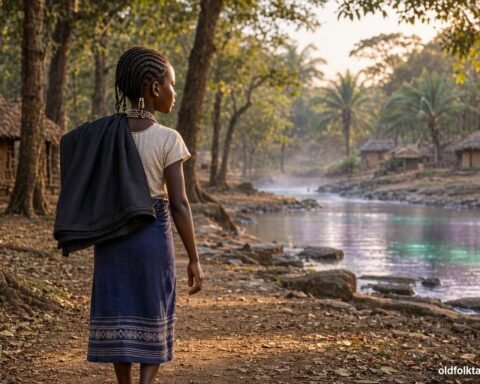
The following morning, before sunrise, the boys entered the sacred grove accompanied by the elders.
At its center stood an enormous ancient tree whose branches stretched high above the forest floor.
Generations of initiates had rested beneath its shade.
Each boy received a sleeping mat, a water gourd, and enough food for the journey.
Before leaving, Mbaï spoke only one sentence.
“Listen more than you speak.”
Then the elders disappeared into the forest.
Beko laughed quietly.
“This will be the easiest seven days of my life.”
He ate quickly.
He walked around the clearing.
He practiced throwing small sticks at tree trunks.
By sunset he had become restless.
“There is nothing to learn here.”
That night strange sounds filled the forest.
Owls called from distant branches.
Insects sang without pause.
Leaves rustled although no wind seemed to blow.
Beko slept poorly.
The second morning he awoke tired and impatient.
While searching for fruit nearby, he noticed a long line of army ants crossing the forest floor.
Thousands moved together without confusion.
Each carried a small piece of leaf or food.
No ant tried to push ahead of another.
When one obstacle blocked their path, they quietly changed direction together.
Beko watched for a moment before walking away.
“They are only ants.”
Later that afternoon heavy rain began falling.
Most animals quickly disappeared beneath shelter.
Beko remained standing beneath the open sky.
Within minutes his clothes became soaked.
Only then did he notice how the Great Tree protected much of the clearing beneath its enormous branches.
He quietly moved beneath its shelter.
For the first time, he wondered why generations had chosen this place.
On the third day a tortoise slowly emerged from nearby bushes.
It moved so slowly that Beko laughed.
“I could walk around you a hundred times.”
The tortoise ignored him.
Patiently, steadily, it continued its journey without stopping.
Hours later, when Beko wandered through the clearing once again, the tortoise had reached exactly where it intended to go.
Without rushing.
Without complaining.
Without wasting energy.
That evening Beko thought about the tortoise long after darkness settled over the forest.
Perhaps speed was not always the greatest strength.
The fourth morning brought something unexpected.
A pair of hornbills landed high among the branches above him.
For hours they worked together carrying fruit to their nest.
Again and again they returned.
Never arguing.
Never abandoning the task.
Only working patiently until their young were fed.
Beko found himself watching them until sunset.
The fifth day arrived in complete silence.
No birds sang that morning.
Even the insects seemed unusually quiet.
At first, Beko welcomed the peace.
But as the hours passed, the silence became uncomfortable.
Without companions to impress or conversations to distract him, he found himself listening to his own thoughts.
He remembered how often he had interrupted the elders.
He remembered laughing at children who asked too many questions.
He remembered ignoring his mother’s advice because he believed he already knew enough.
For the first time, he wondered whether strength without humility was really strength at all.
That afternoon, an elderly hunter quietly entered the clearing.
His hair was gray.
His walking stick was smooth from many years of use.
He greeted Beko with a gentle smile.
“You have remained here faithfully.”
Beko nodded.
“I expected to learn great secrets.”
The old hunter chuckled.
“And what have you learned?”
Beko looked around the forest.
“The ants taught me that no one succeeds alone.”
“The tortoise taught me not to confuse speed with progress.”
“The hornbills taught me that every family survives through cooperation.”
The hunter smiled.
“And what has the silence taught you?”
Beko lowered his eyes.
“That I have spent too much of my life talking.”
The old man nodded with approval.
Then, without another word, he disappeared among the trees.
Only later did Beko wonder whether the hunter had been sent by the elders or whether the forest itself had chosen the right teacher at the right moment.
The sixth day brought hunger.
Although he still had food remaining, he carefully divided it into smaller portions.
He no longer rushed through his meals.
He noticed the sweetness of every fruit.
He appreciated every drink of cool water.
Simple things that once seemed ordinary now felt like precious gifts.
As the sun began to set, a family of monkeys passed overhead.
The youngest monkey slipped from a branch.
Before it could fall, two older monkeys reached out together and pulled it safely back.
The little one immediately returned to playing.
Beko smiled.
The forest never stopped teaching.
Its lessons appeared everywhere for those willing to notice.
When the seventh sunrise finally arrived, the clearing looked exactly as it had one week earlier.
The Great Tree still stood quietly above him.
The birds welcomed the morning.
The breeze carried the familiar scent of damp earth and leaves.
Yet Beko knew something had changed.
It was not the forest.
It was himself.
Shortly after sunrise, the elders returned.
None of them asked what he had seen.
Instead, Mbaï looked into his eyes and asked one simple question.
“Are you ready to return?”
A week earlier, Beko would have answered immediately.
Now he paused before speaking.
“I think I have only just begun learning.”
A warm smile spread across the old elder’s face.
“Then your seven days were not wasted.”
Back in the village, everyone noticed the difference.
Beko no longer hurried to answer every question.
When elders spoke, he listened.
When younger children struggled, he patiently helped them instead of mocking their mistakes.
He still climbed trees.
He still hunted.
He remained brave.
But his greatest strength had become something entirely different.
Humility.
Years later, when he himself became an elder responsible for guiding new initiates, young boys often asked him,
“What is the greatest lesson beneath the Great Tree?”
Beko would point toward the forest before replying,
“The tree teaches nothing.”
“The forest teaches everything.”
“But only if you are quiet enough to hear it.”
Generation after generation, the story of Seven Days Beneath the Great Tree reminded Mandjia families that adulthood was never measured by age or physical strength alone.
It was measured by patience.
By self control.
By the willingness to keep learning throughout life.
Today, traditional initiation practices remain an important part of the cultural history of many Central African communities, including the Mandjia. While customs have evolved over time, elders continue to value the principles of discipline, observation, humility, and respect that such rites were intended to instill. Seven Days Beneath the Great Tree reflects these enduring values, showing that the greatest teacher is often not a person, but the quiet wisdom found in listening to the world around us.
Keep reading: Discover more Central African folktales
Moral Lesson
Wisdom cannot be rushed or demanded. It grows in those who are patient enough to observe, humble enough to listen, and willing enough to learn from every experience.
Knowledge Check
1. Why did Beko believe he was already ready for adulthood?
Because he was physically strong, fearless, and believed he no longer needed the advice of his elders.
2. What was the purpose of Beko’s seven days beneath the Great Tree?
It was part of his initiation, allowing the forest to teach him patience, humility, and wisdom through observation.
3. What lessons did Beko learn from the ants, tortoise, and hornbills?
He learned the value of cooperation, patience, perseverance, and working together for the good of others.
4. Why was the silence of the forest important to Beko’s transformation?
It gave him time to reflect on his own behavior and recognize his pride.
5. How did Beko change after returning to his village?
He became more patient, listened to others, respected the elders, and helped younger children with kindness.
6. What is the central message of the story?
True maturity comes through humility, patience, and a lifelong willingness to learn.
Source
Inspired by Mandjia initiation traditions and Central African rites of passage, with reference to Central African initiation studies, Mandjia ethnographic research, and Central African religious anthropology.