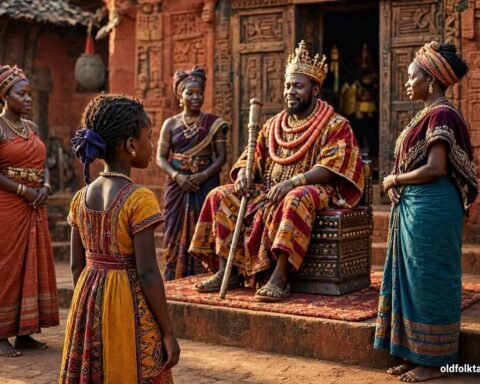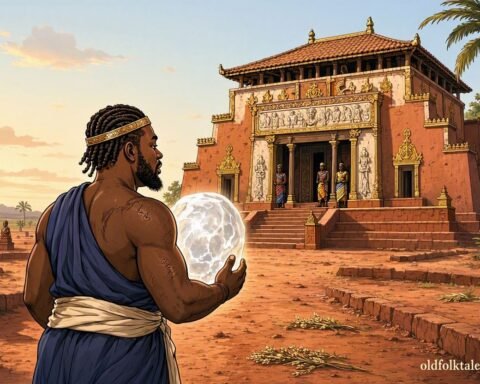
Among the Gbaya people of the Central African Republic, respected diviners have long been consulted during moments of uncertainty. Rather than claiming absolute control over destiny, they interpreted signs, studied sacred objects, and sought spiritual guidance to help people make wise decisions. Elders often reminded the young that the future belonged to the Creator and that wisdom came from living honorably in the present. One enduring Gbaya legend tells of a gifted diviner whose greatest ability came with an extraordinary condition. Anyone who wished to see tomorrow had to surrender something far more valuable than riches.
Long before roads crossed the forests of Central Africa, there lived a diviner whose wisdom reached every corner of the Gbaya lands.
His name was Ngoro.
People believed he understood messages hidden within the world around them.
He watched the flight of birds.
He studied sacred seeds scattered upon woven mats.
He interpreted signs carried by the wind, the rivers, and the voices of elders.
Chiefs sought his advice before settling disputes.
Hunters visited him before entering unfamiliar forests.
Parents came to ask blessings for newborn children.
Don’t stop yet! See our complete East African folktales collection
Yet Ngoro never promised certainty.
He often reminded every visitor,
“The future is a path, not a prison.”
His home stood beside a quiet stream beneath towering iroko trees.
The compound was simple.
There were no guards.
No treasures.
Only a small round hut, a carved stool, bundles of medicinal herbs, and a carefully woven mat upon which he performed his divinations.
Near the entrance stood an old wooden sign carved with unfamiliar symbols.
Every traveler eventually asked its meaning.
Ngoro would simply smile and reply,
“The future always asks for a price.”
Most people believed he referred to the gifts they brought.
Some left goats.
Others offered cloth, honey, kola nuts, or carved bowls.
Ngoro accepted only what was needed to support his modest life.
But the true price was something entirely different.
Few ever discovered it.
In a nearby village lived a hardworking young farmer named Kondo.
He possessed strong hands and an ambitious heart.
Unlike his father, who believed that patience shaped a person’s future, Kondo feared uncertainty.
Every season filled him with questions.
Would drought destroy his crops?
Would he become a respected elder?
Would he marry happily?
Would his family prosper?
The more he worried, the less peacefully he slept.
Finally he decided to visit the famous diviner.
His mother warned him gently.
“Not every question deserves an answer.”
His father added,
“Tomorrow arrives whether we chase it or not.”
But Kondo had already made his decision.
He packed dried meat, fine cloth, and several kola nuts before beginning the long journey through the forest.
After two days of travel, he reached Ngoro’s quiet home.
The old diviner welcomed him kindly.
“You have come carrying many questions.”
Kondo bowed respectfully.
“I wish to know my future.”
Ngoro remained silent.
He invited the young man to sit upon the woven mat.
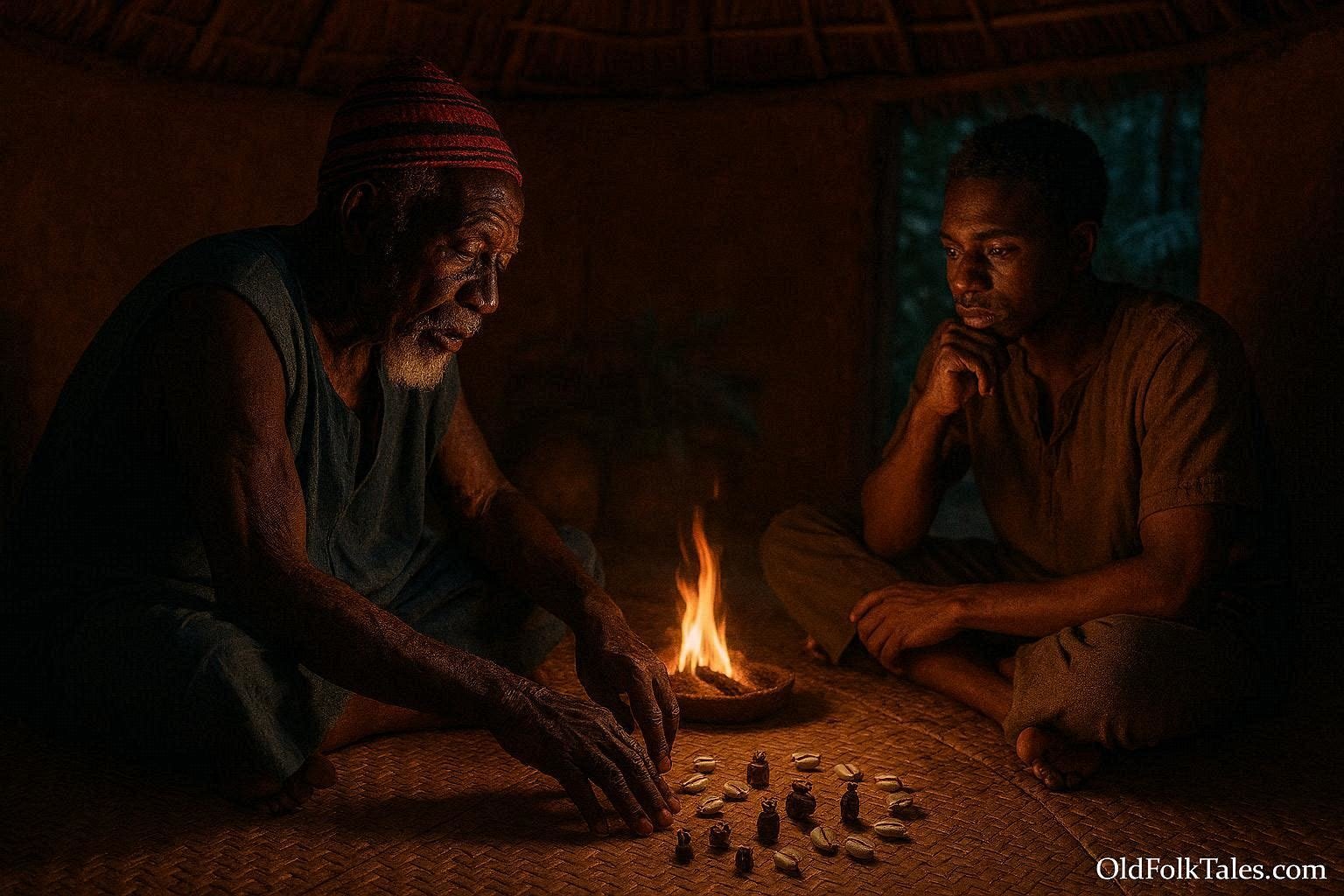
After arranging carved wooden pieces, cowrie shells, and sacred seeds, he slowly examined their patterns.
Minutes passed without a word.
Finally he looked directly into Kondo’s eyes.
“I can show you tomorrow.”
Hope filled the young man’s face.
“But first…”
“There is a price.”
Kondo quickly placed his gifts before the diviner.
“I have brought cloth.”
Ngoro smiled.
“I do not sell wisdom.”
“I can bring goats.”
“I have no need for goats.”
“I will work in your fields.”
“The future cannot be earned through labor.”
Confused, Kondo asked quietly,
“What must I give?”
The old man’s expression became serious.
“You must surrender the memory of the happiest day of your life.”
Kondo stared at him in disbelief.
“My happiest memory?”
Ngoro nodded.
“You will remember the people.”
“You will remember their names.”
“But the joy of that one precious day will vanish forever.”
Silence settled between them.
Kondo’s thoughts returned to a festival many years earlier.
His little sister had survived a terrible illness.
The entire village celebrated through the night.
His mother danced with tears of joy.
His father embraced every neighbor.
Laughter filled the air until sunrise.
Nothing in his life had ever matched that happiness.
Could he truly give it away?
He asked,
“Why must the price be a memory?”
Ngoro answered softly,
“Because people who know tomorrow often stop appreciating today.”
“A joyful memory reminds us why life is worth living.”
“If you wish to trade it for certainty, the choice is yours.”
Kondo lowered his head.
Fear whispered louder than wisdom.
At last he said,
“I accept.”
Ngoro closed his eyes.
He quietly spoke ancient words taught by generations before him.
The divination objects were cast upon the mat.
The room became strangely still.
Kondo suddenly felt warmth spread across his mind.
Then one beautiful memory simply faded away.
He remembered that a celebration had once taken place.
He remembered smiling faces.
But he could no longer remember why his heart had once been so full of joy.
The memory had become empty.
Ngoro slowly opened his eyes.
Then he spoke.
“You will marry a kind woman.”
“You will become the father of three children.”
“There will be seasons of abundance and seasons of hardship.”
“You will lose your father sooner than you expect.”
“You will one day become the headman of your village.”
“And when that day comes, your greatest test will not be poverty.”
“It will be pride.”
Kondo listened carefully, committing every word to memory.
When the divination ended, he thanked the old man and began the journey home.
At first, he felt satisfied.
He finally knew what tomorrow held.
The fear that had troubled him for years seemed to disappear.
Whenever difficulties came, he simply remembered Ngoro’s words.
When drought struck, he remained calm because he knew prosperity would return.
When he married, he smiled because he had already expected it.
When his children were born, he welcomed them with confidence rather than surprise.
Everything unfolded just as the diviner had described.
Yet something inside him slowly changed.
Life no longer filled him with wonder.
He stopped celebrating small victories.
He rarely laughed with the carefree joy of his childhood.
Even during festivals, he felt as though he were merely watching events that had already been written.
One evening his young daughter ran toward him holding a woven bracelet she had made herself.
“Father!”
“I made this for you!”
Kondo smiled politely.
“It is beautiful.”
She waited.
She expected him to laugh, lift her into the air, and celebrate with her.
Instead, he quietly placed the bracelet beside his sleeping mat.
His wife noticed.
“You smiled.”
“But your eyes did not.”
Kondo could not explain why.
Months later, his father passed away exactly as Ngoro had foretold.
The villagers gathered to comfort him.
Although tears filled his eyes, he found himself thinking,
“I already knew this day would come.”
His grief felt strangely distant.
Years passed.
As the diviner had predicted, Kondo eventually became the headman of his village.
He judged disputes fairly.
He worked diligently.
The people respected him.
But many also noticed something unusual.
He was wise.
He was honest.
Yet he seldom seemed truly happy.
One afternoon, while watching children dance beneath the shade of a great tree, his mother quietly sat beside him.
“Do you remember the Festival of Returning Joy?”
Kondo frowned.
“I know it happened.”
“I remember everyone smiling.”
“But…”
“I cannot remember why it was the happiest day of my life.”
His mother looked at him with surprise.
“You carried your sister on your shoulders after she recovered.”
“You laughed until your voice disappeared.”
“You told me it was the happiest day you would ever know.”
Kondo closed his eyes.
He searched his memory.
Nothing.
Only emptiness.
For the first time since visiting Ngoro, he understood what he had truly lost.
He had not merely surrendered a memory.
He had surrendered the feeling that gave the memory life.
The following morning he returned to the old diviner’s home.
Ngoro was much older now.
His hair had turned completely white.
Without speaking, he invited Kondo to sit once again upon the woven mat.
“I have come to ask for my memory back.”
The old man sighed gently.
“I knew you would.”
“I will give you everything I own.”
“I need nothing.”
“I will serve you for the rest of my life.”
“I ask for no servants.”
Kondo’s voice trembled.
“I have seen tomorrow.”
“But I no longer know how to treasure today.”
Ngoro nodded.
“That is the true price.”
“Can nothing be done?”
The old diviner remained silent for a long time before answering.
“There is one way.”
Hope returned to Kondo’s face.
“What must I do?”
“You cannot recover the memory.”
“But you can create new ones.”
“Stop living as a man who already knows tomorrow.”
“Begin living as though every sunrise is a gift.”
Kondo left without another word.
From that day forward, he changed.
He laughed freely with his children.
He joined village dances without worrying about what the future held.
He celebrated successful harvests.
He comforted grieving neighbors.
He listened patiently to the stories of the elderly.
Years later, when his grandson asked why he never visited diviners to learn the future, Kondo smiled.
“The future belongs to tomorrow.”
“But today’s joy belongs to us.”
“I almost traded that away forever.”
The legend spread from village to village, reminding the Gbaya that wisdom is not found in knowing every step ahead but in walking faithfully through each day with hope, gratitude, and courage.
Today, traditional diviners continue to hold an important place in the cultural history of many Central African societies, including the Gbaya. Their role has traditionally been to interpret signs, resolve uncertainty, and guide communities rather than to offer complete certainty about the future. The Price of Seeing Tomorrow reflects this tradition while teaching that the greatest treasure is not knowledge of tomorrow, but the ability to fully cherish today.
Keep reading: Discover more Central African folktales
Moral Lesson
The desire to know the future should never rob us of the joy of living in the present. Every day is a gift meant to be experienced, not merely predicted.
Knowledge Check
1. Why did Kondo seek out the diviner Ngoro?
He wanted certainty about his future because he feared making the wrong choices.
2. What price did Ngoro demand for revealing the future?
Kondo had to surrender the memory of the happiest day of his life.
3. How did knowing the future affect Kondo’s life?
Although many predictions came true, he gradually lost his sense of wonder and stopped fully enjoying life’s joyful moments.
4. Why couldn’t Kondo recover his happiest memory?
The price of the divination was permanent, and some sacrifices cannot be reversed.
5. What advice did Ngoro give Kondo during their second meeting?
He told Kondo to stop living for tomorrow and begin creating new joyful memories in the present.
6. What is the central message of the story?
True happiness comes from embracing the present rather than seeking certainty about the future.
Source
Inspired by Gbaya traditional beliefs about divination and Central African religious practices, with reference to Central African religious anthropology, Gbaya ethnographic studies, and research on traditional divination in Central Africa.