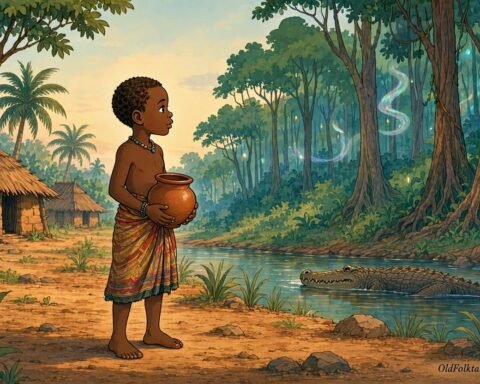
In a village surrounded by the vast and breathing landscapes of Madagascar, there lived a young girl known for her quick hands and quicker mind.
She was not lazy.
Want more? Read more West African folktales now
In fact, she worked harder than most. Each morning, before the sun fully stretched across the sky, she was already awake, fetching water, sweeping the yard, tending to small but endless tasks that filled her days. Her life, like that of many in the village, was shaped by rhythm and responsibility.
But there was something within her that did not rest.
Impatience.
Where others moved with steady acceptance, she moved with urgency. Where others understood that time and effort were part of life, she saw them as obstacles to overcome. Every task felt too long, every chore too heavy, every delay too frustrating.
She wanted more than completion.
She wanted speed.
The wind knew this.
In Malagasy belief, the world is alive, not only with what can be seen, but with what is felt. The wind is not empty air; it is presence. It moves with intention, touches everything, and listens more than it speaks.
And it had been watching the girl.
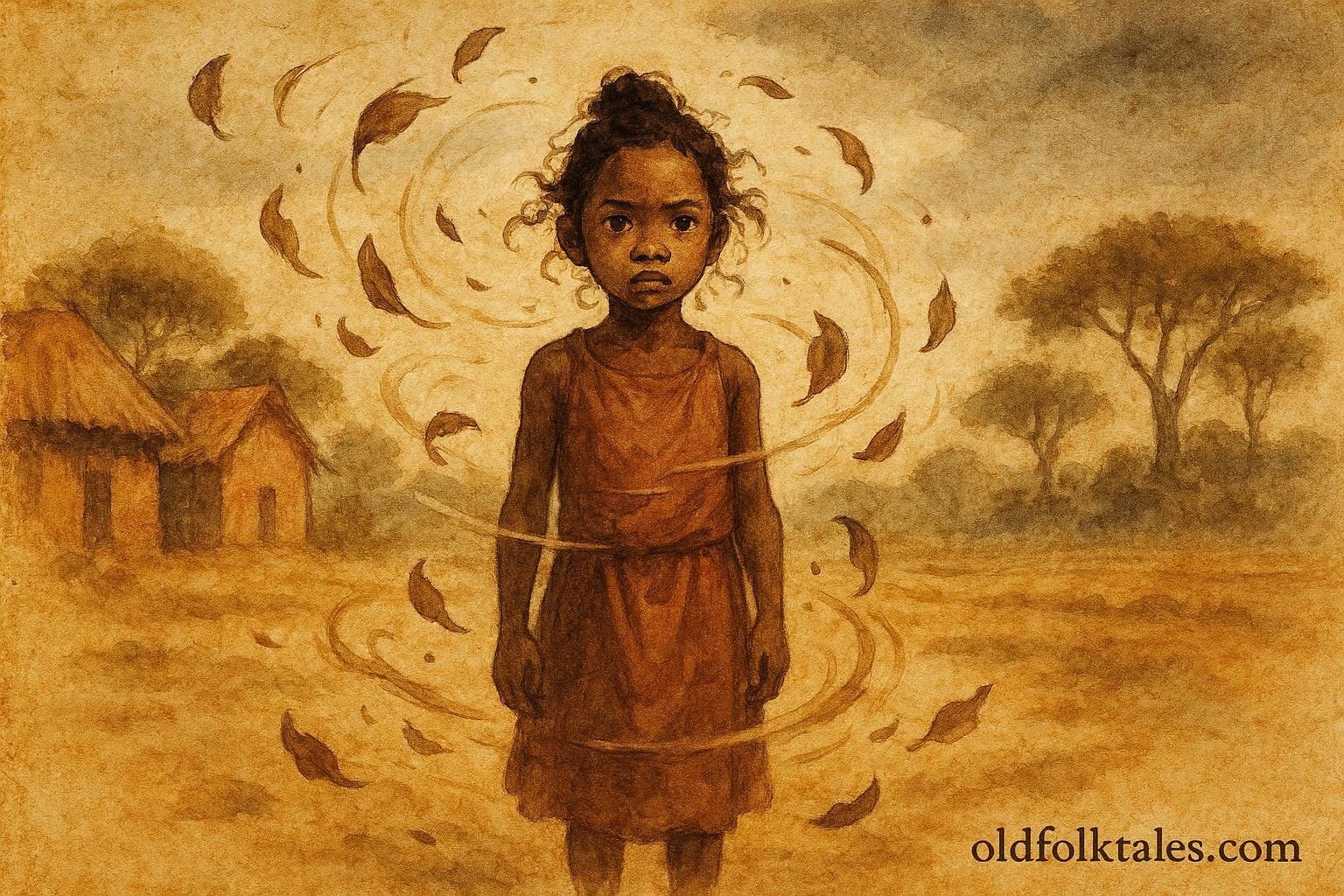
One day, as she struggled with her chores under the weight of her own impatience, the wind came close, not as a storm, not as a force of destruction, but as something gentle. It moved around her, brushing against her skin, lifting dust in quiet swirls, whispering through the leaves.
The girl paused.
She felt it.
And in that moment, an idea took hold of her.
If the wind could move so freely, so quickly… what if she could use it?
What if her burdens could be carried away, her work done in moments instead of hours?
Her thoughts turned from curiosity to desire.
And desire, when left unchecked, becomes action.
She reached out, not with her hands, but with her will, and asked for the wind’s power.
The wind did not resist.
Perhaps it was testing her. Perhaps it trusted her. Or perhaps it knew something she did not yet understand.
What mattered was this: the wind allowed itself to be borrowed.
At first, the change was astonishing.
Her chores, once slow and tiring, became effortless. The wind carried water before she could grow weary. It swept the yard in seconds. It lifted and moved and cleared, responding to her need with invisible strength.
The girl laughed.
For the first time, her days felt light. The weight she had always known was gone, replaced by ease and control. She no longer raced against time, she commanded it.
And with that came something subtle, but dangerous.
She began to feel entitled.
What had been borrowed started to feel owned.
The wind, once something to respect, became something she used without thought. She called on it again and again, not with gratitude, but with expectation.
Days passed.
And then, when the time came to return what she had borrowed…
She refused.
Why should she give it back?
Had she not used it well? Had it not made her life better? Why return to struggle when she could remain in ease?
She convinced herself that keeping the wind caused no harm.
But the world had already begun to change.
The wind does not belong to one place, or one person. It moves across land and sky, carrying life with it. It cools the earth, shapes the seasons, balances what cannot be seen.
Without it, the land began to feel the absence.
The air grew heavy.
The stillness settled in ways that felt unnatural. Leaves no longer stirred. Heat lingered longer than it should. The balance, once invisible but constant, began to tilt.
What the girl had taken was not just power.
It was harmony.
At first, she ignored it.
Her life was still easy. Her chores were still effortless. What happened beyond her immediate world felt distant, unimportant.
But imbalance does not remain distant.
It spreads.
The quiet grew uncomfortable. The air, unmoving, pressed against everything. What had once been a living environment now felt suspended, incomplete.
And slowly, the girl began to feel it too.
Her ease no longer brought joy.
Something was wrong.
The same wind that had once responded to her so freely now felt different, strained, as if it did not belong where it was being held. The lightness she had once felt began to fade, replaced by unease.
She had gained control.
But she had lost peace.
It was then that understanding began to form.
Not all power is meant to be kept.
Not all gifts are meant to be owned.
Some things exist to move, to flow, to belong to the world, not to one person’s desire.
The girl, who had once acted without thinking, now faced the weight of her choice.
And for the first time, she felt responsibility.
She knew what she had to do.
Returning the wind was not simply an action, it was an acknowledgment. It meant accepting that she had taken what was not hers to keep. It meant letting go of the ease she had grown used to.
It meant choosing balance over control.
So, she did.
She released the wind.
Not reluctantly, but with understanding.
The moment it left her, the world responded.
The air moved again. Leaves rustled. The stillness broke, replaced by the familiar rhythm of life. What had been held in imbalance began to restore itself.
The wind returned to where it belonged, everywhere.
The girl stood in its presence once more, but now, she felt it differently.
Not as something to command.
But as something to respect.
Her chores remained. The effort returned. The pace of her days slowed back to what it had always been.
But she was no longer the same.
She worked with patience now, not urgency. She understood that time and effort were not burdens to escape, but parts of life to move through.
She had learned what many only learn too late:
That harmony cannot be forced.
That power without responsibility leads to imbalance.
And that the world is not meant to be controlled but lived within.
Continue your journey: Read more East African folktales
Moral Lesson
Borrowed power always carries responsibility. When humans take more than they should, especially from nature, they disrupt balance. True wisdom lies in respecting limits and understanding that harmony is more valuable than control.
Knowledge Check
- What is the main lesson in “The Girl Who Borrowed the Wind”?
The story teaches that borrowed power requires responsibility and that balance with nature must be respected. - Why did the girl borrow the wind’s power?
She was impatient and wanted to complete her chores quickly and effortlessly. - What happened when she refused to return the wind?
The natural balance was disrupted, causing stillness and imbalance across the land. - What does the wind symbolize in the folktale?
The wind represents natural forces, spiritual balance, and power that cannot be owned. - How does the girl change by the end of the story?
She learns patience, responsibility, and the importance of respecting nature. - What cultural belief is reflected in this Malagasy folktale?
It reflects the belief that nature is alive and must be treated with respect to maintain harmony.
Source: Inspired by environmental and moral tales recorded in “Angano: Malagasy Folk Tales” by Dahle (1877)
Cultural Origin: Malagasy folklore, Madagascar