Far across the fertile lands and forested regions of northern Zambia lived the Bemba Kingdom, one of the most influential royal societies in Central Africa. For generations, Bemba rulers governed through alliances, military strength, ancestral traditions, and carefully preserved systems of leadership respected across surrounding territories.
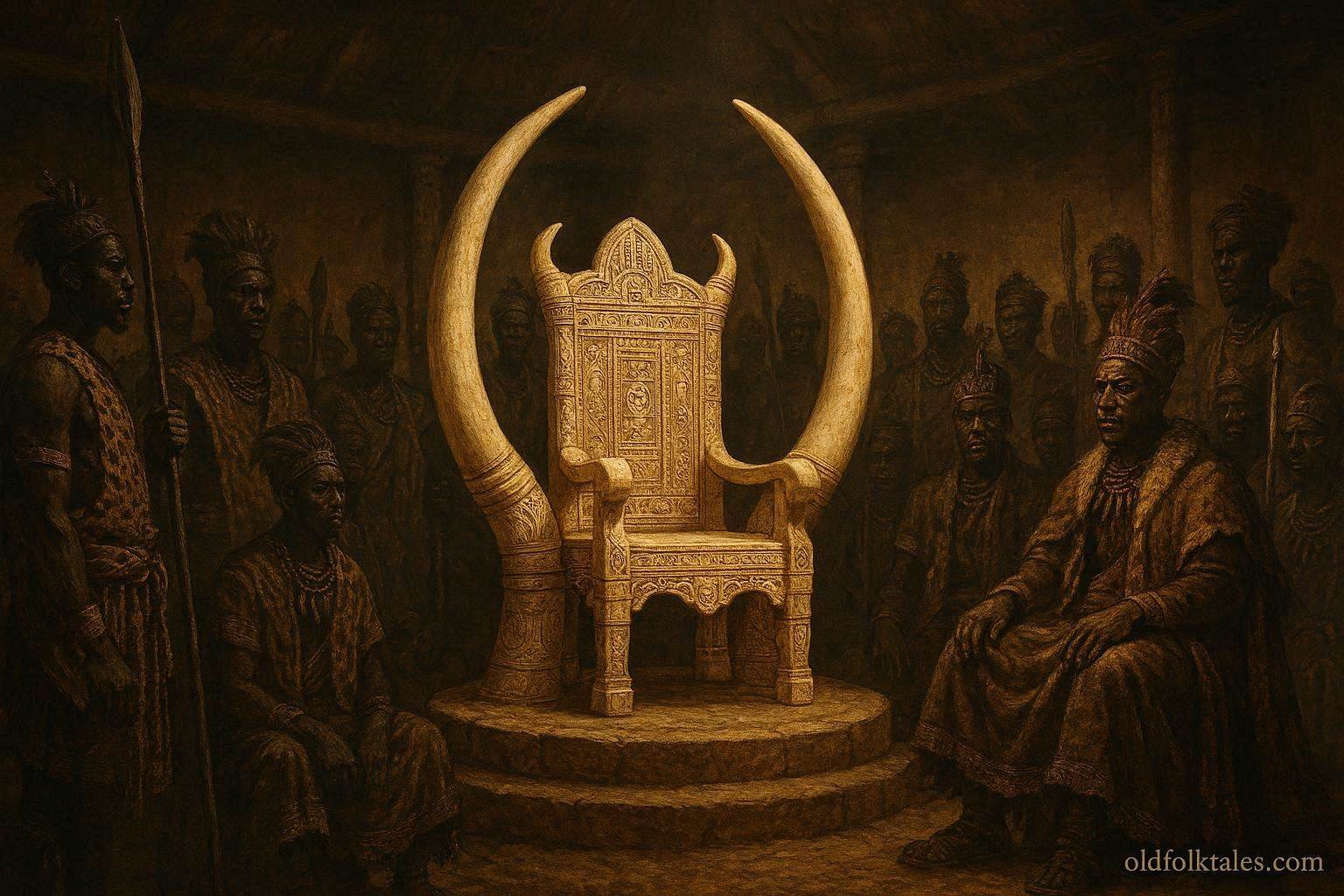
At the center of royal authority stood the Ivory Throne.
Carved generations earlier from wood and decorated with ivory patterns symbolizing wisdom, protection, and continuity, the throne represented far more than political power. According to Bemba royal tradition, the throne connected each ruler spiritually to the ancestors who guided the kingdom before them.
No king ruled legitimately without being recognized beside it.
The throne appeared during coronations, royal judgments, ceremonies, and gatherings involving matters affecting the future of the kingdom. Elders believed the throne itself carried ancestral memory and could reveal whether a ruler governed with honesty or selfish ambition.
For many years, the kingdom prospered under King Chitimukulu Kalunga, a respected ruler remembered for maintaining peace between rival clans while expanding trade and protecting farming communities during difficult seasons.
Don’t stop yet! See our complete East African folktales collection
But after many years upon the throne, the old king died unexpectedly following a brief illness.
His death shook the kingdom deeply.
Across villages and royal compounds, mourning ceremonies lasted for days while elders gathered secretly to discuss succession. According to tradition, selecting a new ruler required careful agreement among royal family lines, spiritual advisers, and influential clan leaders.
Yet this time, unity quickly disappeared.
Two powerful candidates emerged almost immediately.
The first was Prince Mulenga, nephew of the late king and respected military leader admired for bravery and discipline. Many younger warriors supported him strongly because they believed the kingdom needed strength against growing external threats from rival territories.
The second was Chief Chanda, an older royal relative known for wisdom, diplomacy, and deep knowledge of Bemba traditions. Elders favored him because they feared conflict if an ambitious military ruler gained too much power.
Both men possessed legitimate royal connections.
And both believed they deserved the Ivory Throne.
As discussions continued, tension spread rapidly across the kingdom.
Supporters of Mulenga accused the elders of clinging to outdated leadership during dangerous times. Chanda’s allies warned that placing the throne under military influence could destroy traditional balance within the royal system.
Soon villages themselves became divided.
Markets filled with rumors.
Secret alliances formed quietly between rival clans.
Even the royal court grew unstable as advisers shifted loyalties depending upon which candidate appeared stronger politically.
At the center of the crisis remained the sacred Ivory Throne itself.
Stored within a heavily guarded ceremonial chamber, the throne could not legally be used until the royal council formally recognized the next ruler. Spiritual custodians protected it carefully because many believed misuse of the throne would anger ancestral spirits watching over the kingdom.
Then disaster struck.
One morning, the ceremonial chamber was discovered empty.
The Ivory Throne had vanished.
Panic spread instantly across the royal capital.
No signs of forced entry appeared, and guards insisted no one entered the chamber during the night. Yet somehow, the kingdom’s most sacred royal symbol disappeared without explanation.
Fear consumed the kingdom.
Some believed one candidate secretly stole the throne to strengthen his claim. Others suspected betrayal within the royal council itself. More frightening rumors claimed the ancestors removed the throne because the kingdom’s divisions dishonored royal tradition.
Without the Ivory Throne, no coronation could proceed.
The kingdom drifted dangerously toward chaos.
Prince Mulenga demanded immediate investigations and accused Chanda’s allies publicly of manipulating the succession process. Chanda rejected the accusations angrily while warning that reckless ambition threatened civil conflict.
As tensions worsened, a respected elderly woman named Namfumu requested permission to address the royal council.
For decades, Namfumu served quietly as caretaker of several ancestral shrines connected to Bemba royal history. Though not politically powerful, many people respected her spiritual wisdom.
“The throne is hidden because the kingdom has forgotten its purpose,” she declared before the council.
Some dismissed her words immediately.
But Namfumu continued calmly.
“The Ivory Throne was never created to glorify rulers. It exists to protect the people. The ancestors will not allow it to return while pride controls the royal house.”
Her statement unsettled both factions deeply.
Then Namfumu proposed an ancient solution rarely used within living memory.
Instead of selecting a ruler through political rivalry alone, both candidates must travel separately to sacred ancestral sites across the kingdom and demonstrate service to the people rather than personal ambition.
Only afterward would the ancestors reveal who deserved the throne.
Though reluctant, the divided council agreed because no other solution prevented further unrest.
Over the following weeks, Prince Mulenga and Chief Chanda traveled across the kingdom fulfilling difficult responsibilities assigned by elders and local communities.
Mulenga defended isolated farming villages threatened by raiders without demanding tribute or loyalty in return.
Chanda organized food distribution and peaceful negotiations between rival clans fighting over land disputes worsened by drought.
Gradually, something unexpected happened.
Both men began understanding the kingdom’s suffering beyond political competition.
Meanwhile, divisions across the villages slowly eased as people witnessed cooperation replacing rivalry among the royal factions.
Finally, after several months, both candidates returned to the royal capital for a final gathering beneath the ancestral shrine forests.
There, before elders, villagers, and spiritual custodians, Namfumu revealed astonishing news.
The Ivory Throne had been hidden intentionally by senior custodians loyal to the old king.
They feared civil war would destroy the kingdom if either faction seized power too quickly.
Now, after witnessing humility and service from both candidates, the custodians believed the ancestors accepted reconciliation within the royal house once again.
The throne was returned publicly before the assembled kingdom.
Then something unexpected occurred.
Instead of fighting further, Prince Mulenga stepped forward first.
“The throne should belong to the ruler who best preserves unity,” he declared before the crowd.
To the surprise of many, he supported Chanda’s coronation while accepting responsibility as protector of the kingdom’s military and borders.
The decision prevented conflict entirely.
Under the restored balance between wisdom and strength, the Bemba Kingdom entered another long period of stability remembered for generations afterward.
According to old Bemba tradition, the Ivory Throne still symbolizes an important truth.
A kingdom survives not through ambition alone but through leadership worthy of ancestral trust.
Don’t miss out: Read more Southern African folktales
Moral Lesson
True leadership requires humility, service, and commitment to unity rather than personal ambition.
Knowledge Check
- What was the Ivory Throne?
It was a sacred royal throne symbolizing legitimate leadership in the Bemba Kingdom. - Why did conflict begin after the king’s death?
Two powerful candidates both claimed the right to rule. - What happened to the throne during the crisis?
The sacred throne mysteriously disappeared from the royal chamber. - Who was Namfumu?
She was a respected spiritual caretaker connected to ancestral traditions. - Why did Prince Mulenga support Chanda eventually?
He realized unity and stability mattered more than personal ambition. - What lesson does the story teach?
Good leadership depends on humility, service, and preserving unity.
Source
Zambian royal folklore. Adapted from Bemba royal oral histories documented in Central African historical and ethnographic studies.