Many generations ago, in the ancient Kingdom of Owo, one of the most treasured symbols of royal authority was a ceremonial gong known as Agogo Oba, the King’s Gong. Crafted by master metalworkers and preserved within the royal palace, the gong was believed to represent the voice of the kingdom itself.
Whenever an important announcement was made, the gong was sounded throughout the town. Its deep, powerful tone called people together during celebrations, ceremonies, and moments of national importance. Over time, the people came to associate the gong not only with royal authority but also with justice, unity, and responsible leadership.
According to tradition, the gong was first used by a wise ruler who believed that power should always serve the people. Before making major decisions, he would summon chiefs, elders, and community representatives to discuss matters affecting the kingdom. The sound of the gong became a reminder that leadership required consultation and accountability.
Explore the wisdom and wonder of North African folktales
For many years, the gong remained at the center of royal life.
Then, during a period of political unrest, disaster struck.
A fire broke out in a section of the palace. Although many sacred objects were rescued, the King’s Gong disappeared during the confusion. Despite extensive searches, no trace of it was ever found.
As the years passed, the loss became part of Owo’s history.
Generations grew up hearing stories about the missing artifact.
Some believed it had been destroyed.
Others claimed it had been hidden for safekeeping.
A few insisted that the gong would one day return when the kingdom needed it most.
Time moved on, and the legend remained.
Many decades later, a succession dispute emerged within the kingdom.
Following the death of a respected ruler, several candidates laid claim to the royal throne. Each possessed supporters who argued passionately in favor of their preferred candidate.
The disagreement gradually divided the community.
Chiefs debated endlessly.
Families argued over ancient traditions.
Rumors spread throughout the kingdom.
While most people desired peace, uncertainty continued to grow.
The kingdom needed unity, but division seemed to deepen with each passing day.
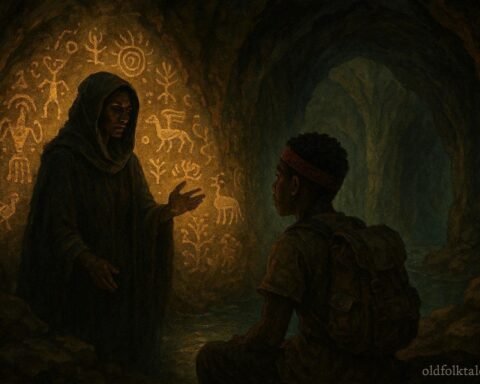
Among the palace officials was a young royal historian named Adegoke. His responsibility was to preserve records, traditions, and stories connected to Owo’s past.
Unlike others focused solely on the succession dispute, Adegoke believed that the solution might lie within the kingdom’s history.
Determined to learn more, he began studying ancient records and interviewing elderly custodians of tradition.
During his research, he repeatedly encountered references to the lost King’s Gong.
Several accounts described it as more than a ceremonial instrument.
It was regarded as a symbol of legitimate leadership and responsible governance.
One elderly chief shared a particularly interesting story.
“Our ancestors believed the gong would return when leaders became more concerned with power than service,” he said.
The statement remained in Adegoke’s mind.
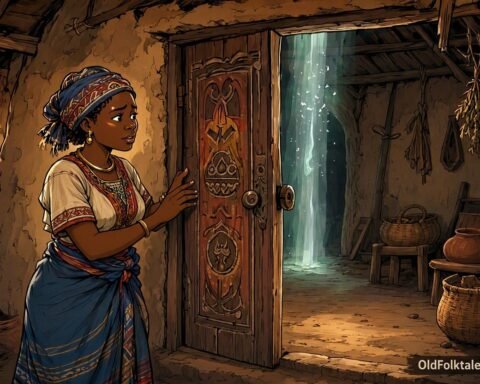
Weeks later, while examining an abandoned royal storage building on the outskirts of the palace grounds, he made a remarkable discovery.
Hidden beneath layers of dust and old wooden coverings was a large object wrapped in faded cloth.
Carefully removing the coverings, Adegoke froze in disbelief.
Before him stood the legendary King’s Gong.
Though aged by time, its craftsmanship remained unmistakable.
News of the discovery spread rapidly throughout Owo.
People traveled from neighboring communities to witness the artifact that many believed had been lost forever.
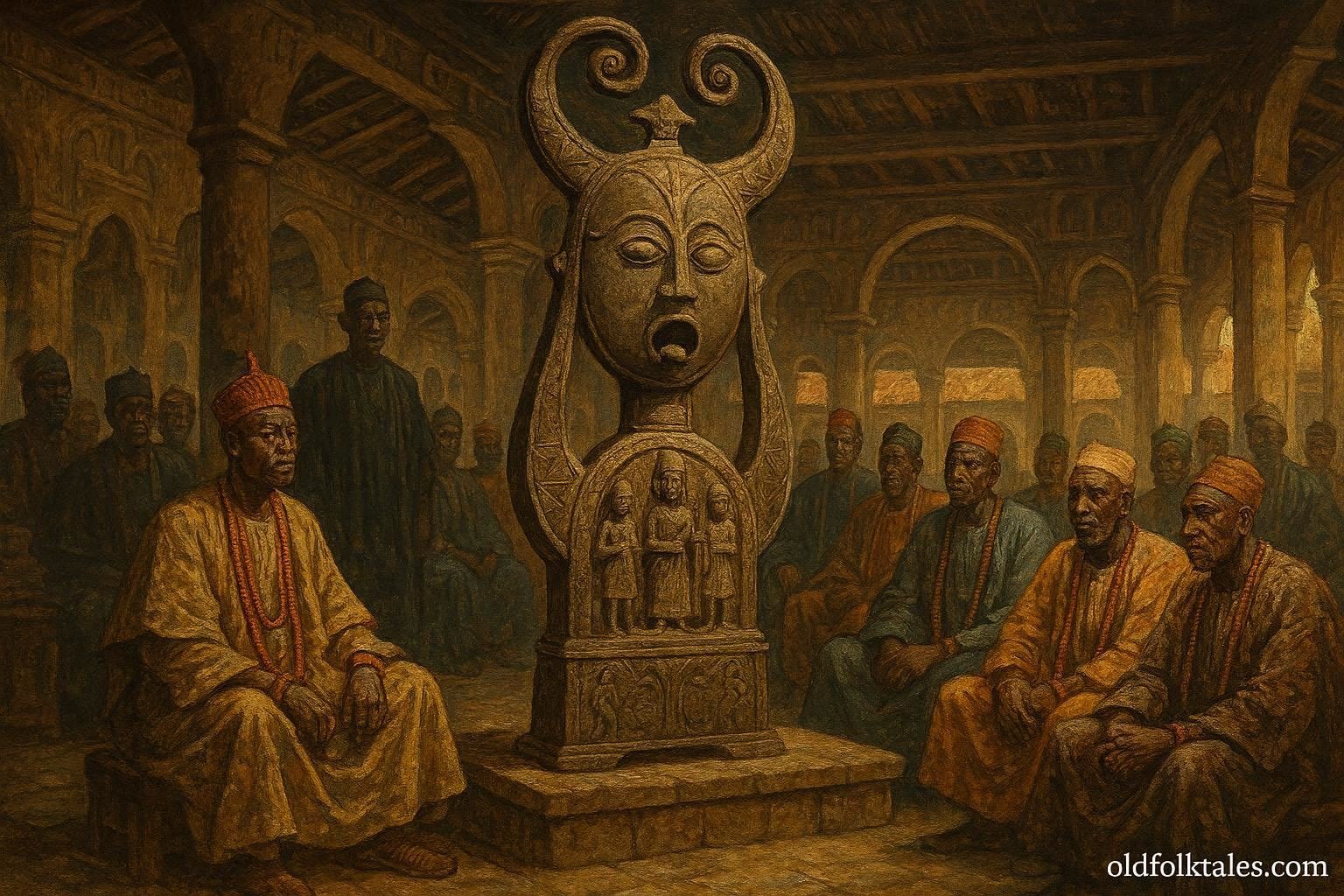
The chiefs immediately arranged for the gong to be presented before the royal council.
When the day arrived, the palace courtyard filled with spectators.
The succession dispute remained unresolved, and tensions were still high.
The elders placed the gong at the center of the gathering.
For a moment, silence filled the air.
Then the oldest chief stepped forward.
“The return of this gong is not merely a discovery,” he said. “It is a reminder.”
The crowd listened attentively.
“Our ancestors taught that leadership is not about privilege. It is about responsibility. Authority is not granted to satisfy ambition. It exists to serve the people.”
His words echoed through the courtyard.
One by one, the candidates seeking the throne were invited to address the gathering.
Rather than discussing their personal claims, they were asked a different question.
“How will you serve the kingdom?”
The question changed the tone of the entire discussion.
For the first time, attention shifted away from status and toward responsibility.
The candidates spoke about justice, unity, economic prosperity, and the welfare of the people.
The elders listened carefully.
So did the community.
After many days of consultation, a decision was finally reached.
A ruler was chosen not because of influence or ambition alone but because he demonstrated a genuine commitment to serving the kingdom.
When the selection was announced, the restored King’s Gong was sounded once more.
Its powerful voice echoed across Owo just as it had generations earlier.
The people celebrated not only the selection of a new ruler but also the restoration of an important lesson.
The gong’s return reminded everyone that symbols have meaning only when the values they represent are respected.
In the years that followed, the King’s Gong occupied a place of honor within the palace.
Future rulers were taught its story.
Whenever important decisions were made, the legend of the gong served as a reminder that leadership carried obligations as well as authority.
The story continued to be shared throughout Owo and beyond.
Some viewed the gong’s reappearance as a miracle.
Others believed it was simply a fortunate discovery.
Regardless of how it returned, its message remained clear.
A kingdom prospers when its leaders value responsibility above power and service above personal ambition.
And so the legend of the King’s Gong of Owo endured, reminding future generations that true authority is earned through wisdom, integrity, and dedication to the common good.
Click here to discover more legendary tales from West Africa
Moral Lesson
Leadership is not defined by power alone but by the willingness to serve others with responsibility, fairness, and integrity.
Knowledge Check
1. What was the King’s Gong of Owo?
It was a sacred ceremonial gong that symbolized royal authority, unity, and responsible leadership.
2. Why was the gong important?
It represented legitimate leadership and reminded rulers of their duty to serve the people.
3. What happened to the gong?
It disappeared during a palace fire and remained lost for generations.
4. Who rediscovered the gong?
A young royal historian named Adegoke found it in an abandoned royal storage building.
5. How did the gong affect the succession dispute?
Its return shifted attention from personal ambition to the qualities needed for responsible leadership.
6. What is the main lesson of the story?
True leadership requires service, accountability, and commitment to the welfare of the community.
Source
Adapted from Yoruba royal traditions, Owo historical narratives, and cultural folklore motifs preserved in Yoruba oral heritage studies and historical folklore archives.