On the western coast of Mauritius, between the mountains and the sea, lay the beautiful region of Rivière Noire. The area was known for its fishing villages, skilled craftsmen, and vibrant cultural traditions. Stories, songs, and ceremonies played an important role in community life, bringing people together during celebrations and important occasions.
Among the residents of Rivière Noire lived an artisan named Étienne. He was famous throughout the region for his remarkable talent as a mask maker.
His masks were unlike any others.
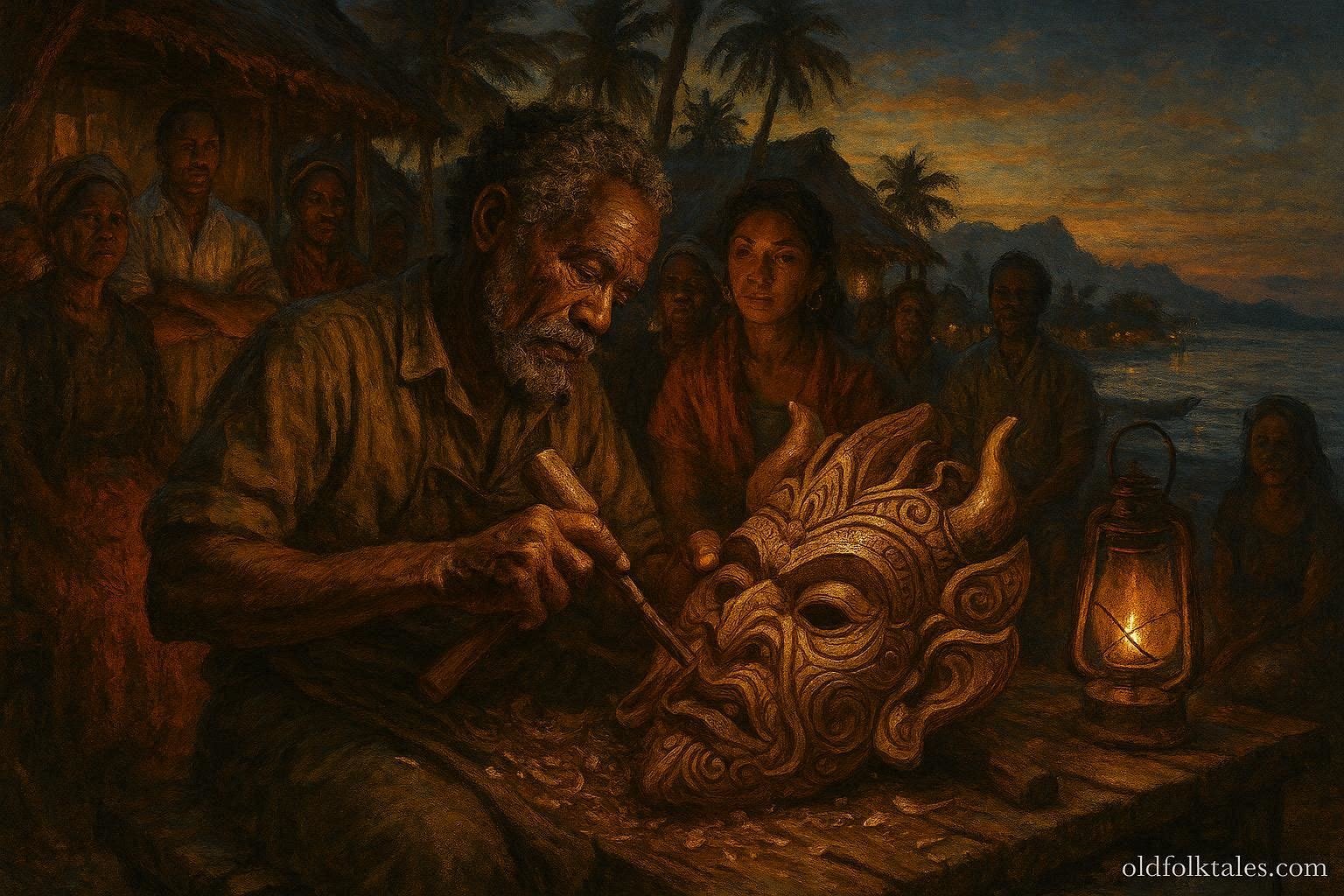
Each one was carved from carefully selected wood and decorated with intricate patterns inspired by nature, history, and local traditions.
People admired the beauty of his creations.
Yet what made them truly special was the legend surrounding them.
According to local folklore, Étienne’s ceremonial masks possessed an unusual gift.
When worn during important gatherings, they revealed hidden truths that people often tried to conceal.
Some believed the masks were enchanted.
Want more? Read more West African folktales now
Others believed they simply encouraged honesty by reminding people of their responsibilities.
Whatever the explanation, the masks became respected symbols within the community.
Étienne himself rarely spoke about the stories.
Whenever someone asked whether the masks truly possessed magical powers, he would smile and say, “The truth already exists. The mask only helps people see it.”
One year, Rivière Noire prepared for a major community festival.
Families gathered from neighboring villages.
Musicians rehearsed traditional performances.
Artisans displayed their finest work.
Leaders planned discussions about projects that would shape the future of the region.
Excitement filled the air.
However, beneath the surface, a serious problem threatened the community.
Funds that had been collected for repairing fishing docks had mysteriously disappeared.
The missing resources delayed important work and created growing distrust among residents.
Rumors spread quickly.
Some accused local officials.
Others blamed merchants.
Friendships became strained.
No one knew whom to trust.
As tensions increased, the elders worried that the dispute could divide the community.
Determined to restore harmony, they asked Étienne to create a special ceremonial mask for the upcoming gathering.
The artisan agreed.
For several weeks, he worked in his workshop.
He selected wood from a fallen tree that had stood near the coast for decades.
He carved symbols representing wisdom, justice, and responsibility.
Every detail was crafted with great care.
When the mask was completed, it was unlike any he had made before.
Its polished surface seemed almost alive in the light.
On the day of the festival, hundreds of people gathered in the central square.
Traditional music echoed through the village.
Dancers performed before enthusiastic crowds.
As evening approached, the elders announced a special ceremony.
The new mask was brought forward.
The crowd fell silent.
According to tradition, the mask would be worn by individuals invited to speak before the community.
The purpose was not to accuse or punish.
Instead, it encouraged honesty and accountability.
The first speakers discussed community achievements.
The ceremony proceeded peacefully.
Then attention turned to the missing funds.
Several people stepped forward to address the issue.
As each person spoke while wearing the mask, something remarkable happened.
Their words became increasingly sincere.
Excuses gave way to honesty.
Half-truths were replaced by complete explanations.
The atmosphere encouraged openness rather than fear.
Finally, a respected merchant named Marcel requested permission to speak.
Many people trusted him and were surprised by his request.
Wearing the mask, Marcel stood quietly for a moment before addressing the crowd.
With visible emotion, he admitted that he had made a serious mistake.
Faced with financial difficulties, he had secretly borrowed part of the dock repair funds, intending to replace the money before anyone noticed.
Unfortunately, circumstances prevented him from doing so.
Ashamed of his actions, he had remained silent while suspicion spread throughout the community.
Gasps filled the square.
Many people were shocked.
Yet Marcel continued speaking.
He accepted responsibility and promised to repay every amount that had been taken.
The elders listened carefully.
Although disappointed, they appreciated his honesty.
Rather than seeking harsh punishment, they focused on repairing trust and finding solutions.
The following weeks were challenging.
Marcel worked diligently to restore the missing funds.
Community members cooperated to complete the dock repairs.
Most importantly, lessons were learned about transparency, accountability, and responsibility.
The crisis gradually strengthened rather than weakened the community.
People realized that mistakes become more damaging when hidden.
Honesty creates opportunities for solutions and reconciliation.
The story of the ceremony spread throughout Rivière Noire and beyond.
Many credited the mask with revealing the truth.
Others believed the true power came from the values it represented.
Étienne himself offered no explanation.
He simply continued creating masks and teaching younger artisans.
Years later, after the artisan’s passing, his masks remained treasured cultural symbols.
They were displayed during important gatherings and preserved as reminders of the community’s heritage.
Whenever disputes arose, elders often shared the story of the Mask Maker of Rivière Noire.
The legend endured because it carried an important lesson.
Truth may sometimes be uncomfortable, but it is essential for trust.
Communities thrive when people accept responsibility for their actions and work together to correct mistakes.
And so the masks of Rivière Noire continued to symbolize honesty, wisdom, and respect, inspiring future generations to value truth above convenience and integrity above pride.
Looking for more? Explore the magic of East African folktales here
Moral Lesson
Honesty and accountability build trust, while hiding the truth often creates greater problems.
Knowledge Check
1. Who was Étienne?
Étienne was a skilled artisan from Rivière Noire known for creating ceremonial masks.
2. What was special about his masks?
According to legend, they helped reveal hidden truths during important community gatherings.
3. What problem affected the community?
Funds intended for repairing fishing docks had disappeared.
4. Who admitted taking the money?
A merchant named Marcel confessed after speaking during the ceremonial gathering.
5. How did the community respond?
They focused on restoring trust, repaying the funds, and solving the problem together.
6. What is the main lesson of the story?
Truth, responsibility, and honesty are essential for maintaining harmony within a community.
Source
Adapted from Mauritian Creole oral traditions, ceremonial performance folklore, and artisan legends preserved in Mauritian cultural performance archives.