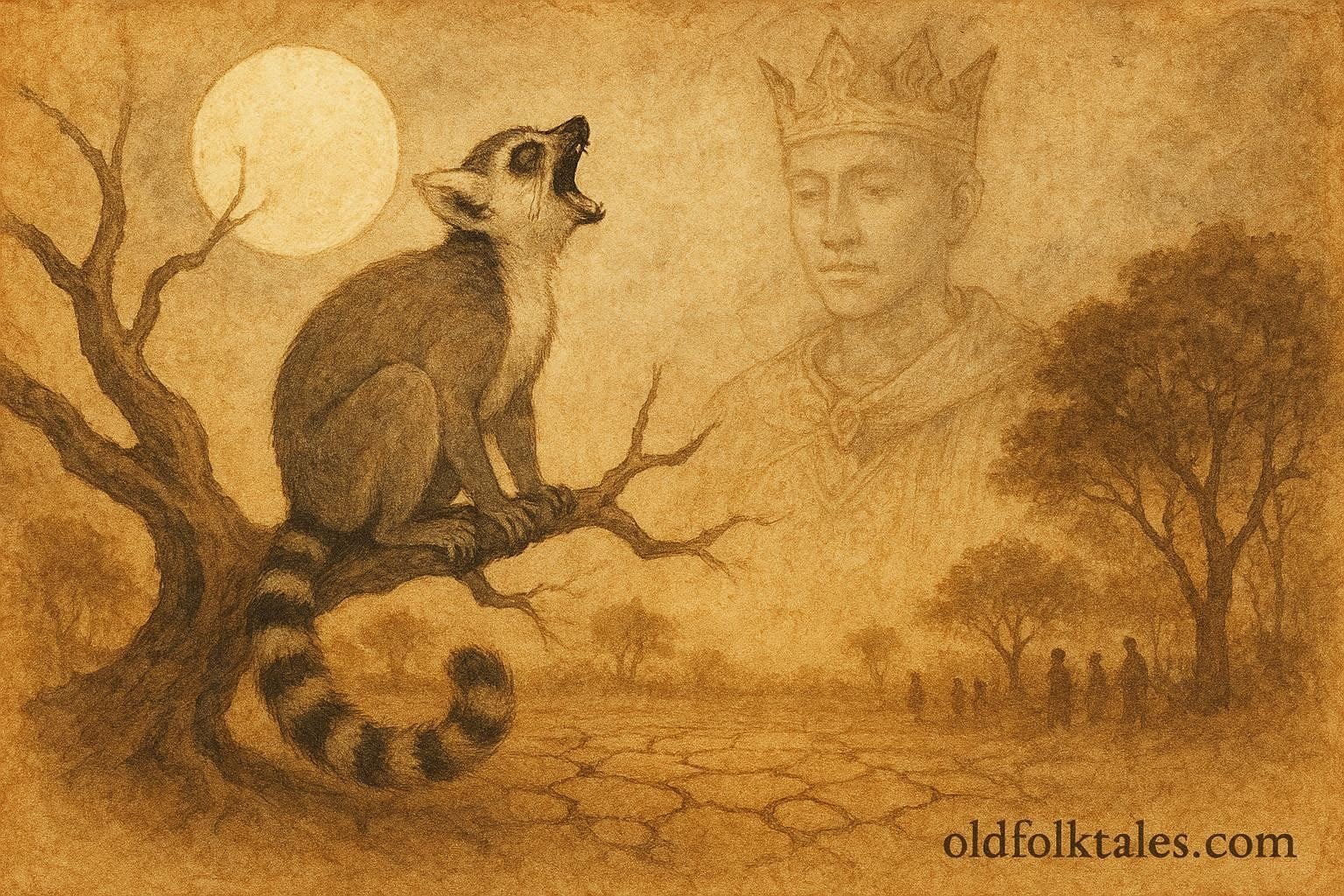
Long ago, in a fertile land now known as Madagascar, there lived a prince whose name was once spoken with hope.
He was born into abundance. The rivers ran full, the forests were thick with life, and the people of the kingdom prospered under the careful watch of his father, the king. From an early age, the prince knew comfort, fine cloth on his skin, rich meals before him, and the unquestioned respect of those around him.
Fascinated by this tale? Discover more North African folktales
But comfort can dull a person.
As he grew, the prince learned the language of power, but not the meaning of responsibility. He was taught how to command, but not how to listen. He understood that he would one day rule, but he did not understand what it meant to serve.
When his father died, the prince ascended to the throne. The people gathered, hopeful that the strength of the old king would live on in his son. They bowed their heads and offered their loyalty.
At first, nothing seemed wrong.
But the seasons began to change.
The rains, once steady and generous, faltered. The earth cracked beneath the sun. Crops failed. Rivers thinned. What had once been a land of abundance slowly became a place of hunger.
The famine came quietly at first, empty granaries in a few villages, thin cattle in the fields. Then it spread, tightening its grip across the kingdom. Children cried through the night. Elders grew silent with weakness. The people looked to their king.
They believed he would act.
But the prince, now king, did not feel their suffering as his father once would have. Where others saw desperation, he saw inconvenience. Where others felt urgency, he felt annoyance.
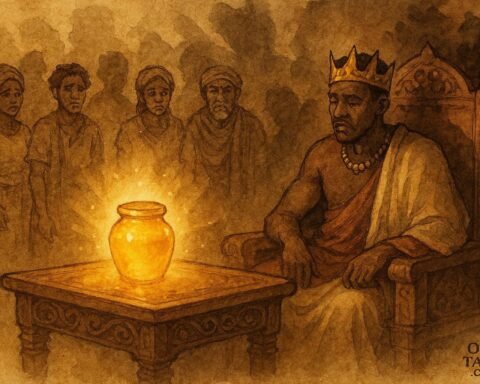
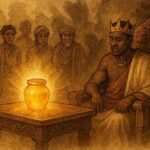
He still had food within the palace. His stores were guarded, hidden away from the growing need beyond the palace walls. He told himself that a king must preserve his strength, that his position required protection, that not everyone could be saved.
And so, he chose himself.
The people came to him, leaders from villages, mothers with hollow eyes, elders who could barely stand. They pleaded for help, for grain, for relief. Their voices carried the weight of a kingdom on the edge.
The king turned them away.
He spoke of order, of maintaining control, of the dangers of giving too much. He feared that generosity would weaken his authority. He believed that keeping what he had ensured his survival.
What he did not understand was this: a leader who hoards in times of suffering does not preserve power, he destroys it.
As the famine deepened, whispers spread.
The people began to speak not of their king with hope, but with bitterness. His name, once a symbol of protection, became a reminder of abandonment. Trust, once broken, does not fade quietly, it transforms.
The forests watched.
In Malagasy belief, the boundary between the human world and the spiritual world is thin. The ancestors see. Nature remembers. Actions do not disappear, they echo.
And the king’s actions had grown loud.
One night, when the air was heavy with hunger and grief, something shifted.
The king, restless in his abundance, stepped beyond the safety of his palace. Perhaps it was unease. Perhaps it was the weight of unseen eyes. Perhaps, deep within him, there was something stirring, something he had long ignored.
He walked toward the forest.
The trees stood tall and silent, their branches stretching like watchful arms. The night was thick, filled with sounds that seemed to carry meaning. The king, for the first time, felt small.
Then came the moment of reckoning.
It did not come with thunder or spectacle. It came with certainty.
The spirits of the land, those who witness the balance between human action and natural order, had judged him.
A king who turns away from his people in their greatest time of need has already abandoned his humanity.
And so, that humanity was taken from him.
His body changed.
His voice, once commanding, broke into something unfamiliar. His limbs shifted, his form reshaped. The strength he had relied upon disappeared, replaced by something smaller, more fragile.
He was no longer a king.
He was no longer even a man.
He had become a lemur.
Alone, stripped of power, he found himself in the very forest he had once ignored. The palace was gone to him now. The stores of food he had protected so fiercely were beyond his reach.
And for the first time, he understood hunger.
Not as an idea. Not as something distant.
But as something that lived within him.
Night after night, he moved through the trees. The darkness became his companion. The forest, once silent, now echoed with his cries.
Those cries were not just sounds.
They carried regret.
They carried memory.
They carried the weight of everything he had refused to see.
The people heard them.
In the stillness of night, the sound of the lemur’s cry traveled through the villages. It was haunting, filled with something deeper than instinct. The elders listened and understood.
This was no ordinary creature.
This was a warning.
Generations passed, but the story remained. Parents told their children of the selfish king who chose himself over his people. They spoke of how he was transformed, how he now roamed the forests, calling out in the darkness.
The lemur became more than an animal.
It became a reminder.
Even today, when the night falls and the forests of Madagascar come alive with sound, the cry of the lemur is not heard as noise alone.
It is heard as a voice from the past.
A voice that says: leadership without compassion leads to ruin.
A voice that says: what you do in power will follow you, long after that power is gone.
And in that cry, the lesson lives on.
Don’t stop yet! See our complete East African folktales collection
Moral Lesson
True leadership is measured not by how much power one holds, but by how one uses it in times of crisis. A leader who lacks compassion loses more than trust, they lose their humanity, and their actions will echo far beyond their lifetime.
Knowledge Check
- Why does the lemur cry at night in this Malagasy folktale?
The lemur’s cry represents the regret of a selfish king who was transformed after betraying his people during a famine. - What caused the prince’s transformation into a lemur?
His lack of compassion and refusal to help his starving people led to spiritual judgment and transformation. - What is the main lesson in “Why the Lemur Cries at Night”?
The story teaches that leadership without empathy leads to downfall and lasting consequences. - How does Malagasy culture influence this folktale?
It reflects beliefs in spiritual justice, ancestral oversight, and the connection between human actions and nature. - What does the lemur symbolize in the story?
The lemur symbolizes regret, consequence, and a living warning against selfish leadership. - Why is the famine important in the story?
The famine reveals the king’s true character and serves as the turning point for his betrayal and punishment.
Source: Adapted from animal transformation tales in “Contes et Légendes de Madagascar” by Paulhan (1967)
Cultural Origin: Malagasy folklore, Madagascar