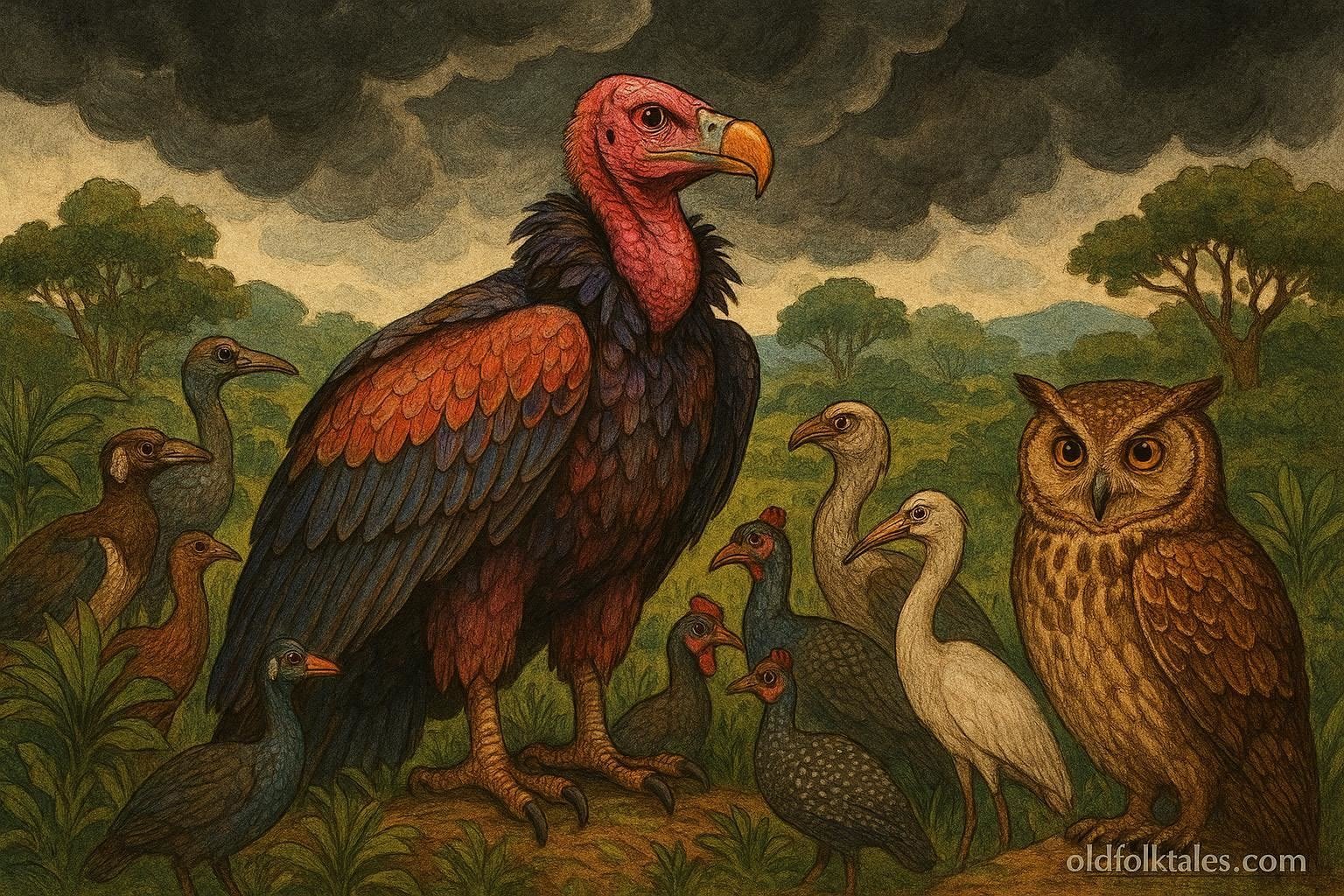
Many generations ago, when animals and birds were believed to speak and gather like human beings, the vulture was considered one of the most beautiful birds in the world. Its feathers shone with rich colors that reflected the sunlight, and its wings stretched wide and graceful across the sky. Wherever the vulture flew, other birds stopped to admire its appearance.
The vulture knew it was admired.
At first, it accepted the compliments with gratitude. But as time passed, pride slowly entered its heart. The bird began to believe that its beauty made it superior to every other creature. It mocked birds with plain feathers and laughed at those whose wings were smaller than its own.
The hornbill, the dove, the weaverbird, and even the eagle grew tired of the vulture’s boasting. Whenever they gathered near rivers or trees, the vulture found a way to remind everyone of its beauty.
“No bird in the sky is as splendid as I am,” it would say proudly. “The Creator must have spent extra time decorating my feathers.”
The other birds exchanged uncomfortable glances but usually remained silent.
One year, a great gathering of birds was announced.
Fascinated by this tale? Discover more North African folktales
Representatives from forests, grasslands, rivers, and distant hills were invited to attend. The purpose of the meeting was to discuss challenges affecting all birds, including changing seasons, scarce food supplies, and threats from hunters.
Birds from every corner of the land prepared for the important gathering.
Before the meeting, an elderly owl known for wisdom called the birds together.
“My friends,” the owl said, “this gathering concerns the welfare of us all. Let each bird come with respect and humility. Wisdom is heard most clearly when pride remains silent.”
Most of the birds nodded in agreement.
The vulture, however, secretly laughed.
“Why should I concern myself with humility?” it thought. “Everyone will be too busy admiring me to notice anything else.”
On the day of the gathering, birds arrived from every direction. The eagle came from the mountains. The kingfisher arrived from the rivers. The parrot flew in from the forest. Each bird dressed simply and respectfully.
The vulture had different plans.
Determined to attract attention, it spent hours grooming its feathers. It polished them with oils and decorated them with colorful leaves and flowers. By the time it arrived, its appearance was more extravagant than that of any other bird.
Gasps spread through the crowd.
The vulture smiled proudly.
Throughout the meeting, the bird paid little attention to the discussions. Instead, it admired its reflection in nearby pools of water and waited for compliments.
Whenever another bird spoke, the vulture interrupted.
Whenever advice was offered, the vulture dismissed it.
When the owl shared important guidance about cooperation and survival, the vulture rolled its eyes.
Eventually, the wise owl approached the proud bird.
“My friend,” said the owl gently, “beauty is a gift, but wisdom is greater. Listen carefully to what is being discussed.”
The vulture ignored the advice.
“What can wisdom give me that beauty has not already provided?” it replied.
The owl sighed but said nothing more.
As the gathering continued, dark clouds suddenly formed overhead.
A powerful storm approached.
The wind began to howl through the trees, and birds hurried to find shelter.
The owl immediately instructed everyone to seek safety beneath a large rocky cliff nearby.
“Come quickly,” the owl warned. “This storm is stronger than it appears.”
The birds obeyed without hesitation.
The vulture, however, hesitated.
It feared that rushing through the storm would damage its carefully arranged feathers.
Instead of following the others, it searched for a place where its appearance would remain untouched.
As the storm intensified, fierce winds swept across the land.
Branches snapped.
Leaves flew through the air.
Dust and rain battered everything in their path.
The vulture struggled desperately against the storm.
Its decorative leaves were torn away.
Its beautiful feathers became tangled and damaged.
The bird attempted to fly but was thrown about by the powerful winds.
Hours later, when the storm finally passed, the exhausted vulture emerged from its hiding place.
The other birds stared in surprise.
The once magnificent feathers covering the vulture’s head had been stripped away completely by the wind and debris.
Its head was now bare.
The vulture rushed to a pool of water and looked at its reflection.
It could hardly believe what it saw.
The feathers it had valued above everything else were gone.
For the first time in its life, the bird felt ashamed.
The owl approached quietly.
The vulture lowered its head.
“You warned me,” it said softly.
The owl nodded.
“I did.”
“I cared more about my appearance than wisdom.”
“Yes.”
“I ignored advice because I believed I was better than everyone else.”
Again, the owl nodded.
The vulture remained silent for a long time.
At last, it spoke.
“I understand now.”
From that day forward, the vulture changed.
It stopped boasting about itself.
It listened more carefully to others.
It treated every bird with respect, regardless of appearance.
Though its head never regained its feathers, the experience taught a lesson far more valuable than beauty.
The other birds gradually forgave the vulture.
They welcomed it back into their gatherings and appreciated the humility it had gained.
Whenever young birds asked why the vulture’s head was bare, elders shared the story.
They explained how pride had caused the bird to ignore wisdom and how humility had helped it become a better member of the community.
And so, according to the old Igbo tale, the vulture’s bald head remains a reminder that beauty fades, but wisdom and humility endure.
Click here to discover more legendary tales from West Africa
Moral Lesson
Pride can blind people to good advice, while humility opens the door to wisdom and growth.
Knowledge Check
1. Why was the vulture admired by other birds?
The vulture was admired because it possessed beautiful and colorful feathers.
2. What character flaw did the vulture develop?
The vulture became proud and believed it was better than other birds.
3. Who warned the vulture about its behavior?
A wise old owl advised the vulture to practice humility and listen carefully.
4. What happened during the storm?
The storm stripped away the feathers on the vulture’s head.
5. What lesson did the vulture learn?
The vulture learned that wisdom and humility are more valuable than physical beauty.
6. Why does the vulture have a bald head according to the story?
The story explains that the vulture lost the feathers on its head because of its pride and refusal to listen to wise advice.
Source
Adapted from traditional Igbo animal tales and Nigerian oral folklore collections that use animal characters to teach moral lessons about pride, wisdom, and humility.