In a village where ancient customs still held sway, there lived a young man named Dschemil and his cousin Dschemila. Their parents had promised them to each other when they were but children playing in the dusty streets, and now that they had grown, the time had come for their union. Dschemil’s heart swelled with anticipation as he prepared for the journey to the nearest town, two or three days’ travel away, where he would purchase fine furniture and soft cushions for their new home.
While Dschemil was away selecting carpets and beautiful things for his bride, Dschemila and her friends ventured into the neighboring woods to gather firewood. The young women laughed and chattered as they collected sticks, their voices echoing through the trees. As Dschemila bent to pick up branches, her eyes fell upon something unusual, an iron mortar lying abandoned on the forest floor. She thought it would be useful for grinding spices and grain, so she placed it atop her bundle of wood.
But the mortar refused to stay still. Each time she hoisted the bundle onto her shoulders, it slipped sideways, tumbling to the ground. After several frustrating attempts, she realized the only solution was to tie it securely in the very center of her bundle. She had just unfastened her sticks to rearrange them when her companions’ voices rang out through the darkening woods.
Don’t stop yet! See our complete East African folktales collection
“Dschemila, what are you doing? Night is falling! If you’re coming with us, hurry!”
But Dschemila, with the stubbornness that would prove her undoing, called back, “Go on without me. I’m not leaving my mortar behind, even if I must stay here until midnight!”
“Do as you please,” the girls replied, shaking their heads as they departed.
Darkness descended swiftly over the forest. As the last ray of sunlight disappeared beyond the horizon, a terrible transformation occurred. The iron mortar suddenly became a fearsome ogre who seized Dschemila and threw her onto his broad back. He carried her through the night, across vast stretches of desert, to a lonely castle that stood a full month’s journey from her home. There he locked her in a high tower and spoke words that chilled her blood: “Do not fear for your life, I will not harm you.” Then he departed, leaving the maiden weeping bitter tears over the fate her own foolishness had brought upon her.
Meanwhile, Dschemila’s friends reached the village, and her mother rushed out to greet them. “Where is my daughter?” she asked, her voice sharp with worry.
“We had to leave her in the wood,” they explained. “She found an iron mortar and couldn’t manage to carry it, but she refused to leave it behind.”
The old woman immediately set off for the forest, calling her daughter’s name. The townspeople tried to stop her. “Let us go instead! This is work for strong men, not for a woman alone. We fear we may find only her corpse, perhaps she was bitten by serpents or devoured by wild beasts.”
But the mother would not be deterred. “Go then, but I will go with you!”
The men relented and brought one of the girls to show them the spot where they had left Dschemila. They found the bundle of wood lying where she had dropped it, but the maiden herself had vanished completely. They called her name until their throats were raw. They lit a fire, hoping she would see it and return. They searched the forest in every direction, looking for signs of a lion’s attack or a place where she might have fallen asleep. But dawn broke with no trace of the missing girl.
Exhausted and defeated, the searchers finally told the mother, “It’s no use. Your daughter has run away with a man.”
“Let me search the river first,” the mother insisted. “Perhaps someone has thrown her in.” But Dschemila was not in the river either.
For four agonizing days, the parents waited, hoping their daughter would return. Finally, they devised a desperate plan. “What will we tell Dschemil when he comes back? Let us kill a goat and bury its head in a grave. We will tell him Dschemila is dead.”
When the young bridegroom returned, his arms laden with beautiful carpets and soft cushions, Dschemila’s father met him at the town gate with sorrowful words: “Greeting to you. She is dead.”
Dschemil’s cries of anguish pierced the air. When he could finally speak, he asked where she was buried. At the churchyard, he laid the beautiful things he had brought upon the grass and wept until darkness fell. Every day for six months, he returned to that grave, sitting beside it from dawn to dusk, playing softly on his flute, his heart breaking with each mournful note.
One scorching day, a traveler who had lost his way in the desert came upon a lonely castle rising from the sand. Seeking refuge from the merciless sun, he stretched out in its shadow. As sleep was about to claim him, a voice called down softly: “Are you a ghost or a man?”
He looked up and saw a maiden leaning from a high window. “I am a man,” he replied boldly, “and a better one than your father or grandfather!”
“May fortune smile upon you,” she said, “but what brings you to this land of ogres and terrors?”
“Does an ogre truly live here?” the traveler asked, suddenly alert.
“He does indeed, and he will return soon. Flee quickly, dear friend, before he makes you his supper!”
“But I am dying of thirst! Please, give me water, or tell me where I might find some.”
The maiden considered. “The ogre always brings water from that direction. If you follow the same path, you may find a spring.”
As the traveler prepared to leave, the maiden called out again. “Tell me, where are you bound?”
“I travel to Damascus. Why do you ask?”
“I have an urgent message. When you reach my village, seek out a man named Dschemil. Say to him: ‘Dschemila greets you from the castle that lies far away and is rocked by the wind. In my grave lies only a goat. So take heart.'”
The traveler promised and soon found the spring. After drinking deeply and resting, he resolved to honor his promise to the maiden who had saved his life. For a full month he traveled until he reached Dschemila’s town. There, sitting before his door with an unkempt beard and wild hair hanging over his eyes, sat Dschemil himself, a man transformed by grief.
“Welcome, stranger,” Dschemil said listlessly. “Where have you come from?”
“From the west, traveling toward the east.”
“Rest with us and eat,” Dschemil offered, though he himself sat apart on the threshold, eating nothing.
When one of the brothers called for Dschemil to bring water, the stranger suddenly remembered his mission. “Is there a man here named Dschemil? I lost my way in the desert and came to a castle where a maiden spoke to me…”
“Be quiet!” the family members hissed, but Dschemil had heard. He sprang forward, his eyes blazing with sudden life. “What did you see? Tell me truly, or I’ll cut off your head this instant!”
The stranger recounted everything, the castle, the maiden, the message about the goat in the grave.
Dschemil turned to his family, his face a mixture of hope and rage. “Is this true? Is Dschemila not dead but stolen?”
“No, no! His story is lies. Dschemila is truly dead. Everyone knows it.”
“I will see for myself!” Dschemil seized a spade and raced to the grave. When he uncovered only a goat’s head, he returned and demanded the truth.
The family finally confessed the entire story, the iron mortar, the disappearance, their desperate deception to prevent him from embarking on a hopeless quest.
“Give me food and my sword,” Dschemil commanded. “We leave at once.”
Though the stranger protested about wasting a month on such a journey, Dschemil persuaded him to lead the way for three days. After they parted, Dschemil traveled alone for twenty-six more days until he finally saw the green oasis and the castle beyond it.
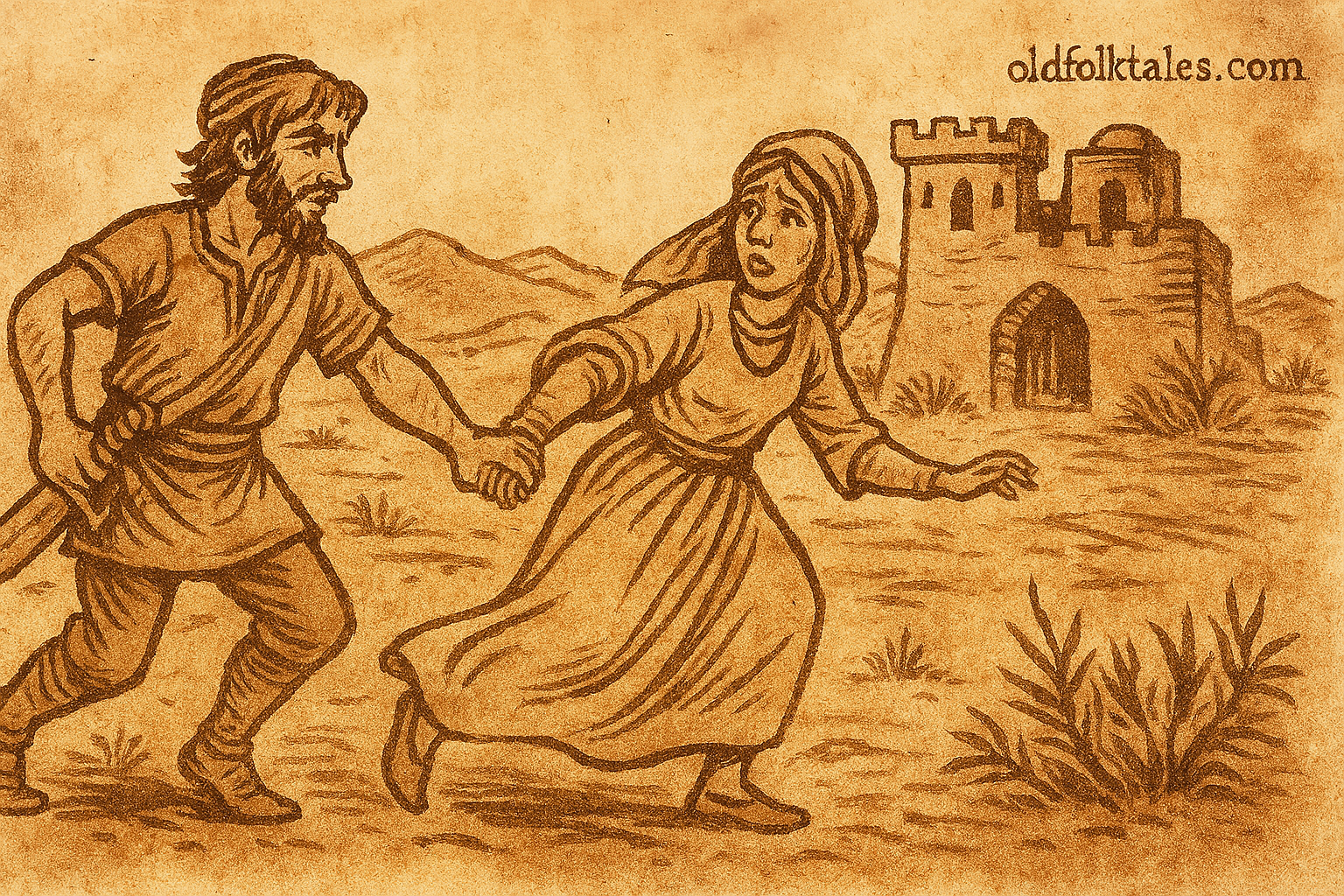
When he climbed the wall and heard Dschemila’s voice calling his name, both cousins wept with joy. But their reunion was brief, the ogre would return soon. Dschemila hid Dschemil in a chest just as the ogre’s heavy footsteps sounded on the stairs.
“I smell the smell of a man!” the ogre thundered upon entering.
Through quick thinking, Dschemila convinced him it was only carrion dropped by ravens. That night, as the ogre slept, the cooking meat called out warnings, but Dschemila cleverly explained away each cry. She learned the secrets of the ogre’s magic, the pin that became an iron mountain, the needle that became a sea, the hatchet that became a thorn hedge.
When a red light finally shone, indicating the ogre was deep in sleep, the cousins escaped into the night. But the ogre’s dog woke its master, and the chase began. Three times Dschemila threw the magical objects behind them, and three times the ogre overcame the obstacles.
As the ogre finally closed in, he cast a terrible curse: “Dschemila, let your head become a donkey’s head, and your hair become fur!”
When Dschemil saw his beloved cousin transformed into a creature with an ass’s head, horror overcame him. “She is truly a donkey, not a woman at all!” he cried, and abandoned her.
For two days, Dschemila wandered alone, fighting off wolves, her heart broken not just by the curse but by her cousin’s betrayal. Finally, Dschemil’s conscience drove him back. He found her defending herself from wild beasts and, ashamed, admitted he had thought her a witch.
“Did you not see the ogre curse me with your own eyes?” she asked bitterly.
They waited until darkness fell before Dschemil brought her secretly to her mother’s house. Even her own mother initially recoiled at the sight, but when Dschemila revealed the scars that proved her identity, her mother embraced her weeping daughter. They hid Dschemila away, telling no one she had returned.
Three months passed. Then a Jewish merchant, traveling through the desert, rested beneath the ogre’s castle. The ogre appeared and gave him a mirror and comb. “Find Dschemila in the town,” the ogre commanded. “Tell her to look in this mirror and comb her hair, and her true form will return. If you fail, I will devour you when next we meet.”
Terrified, the merchant obeyed. After thirty days of travel, he arrived at the town and encountered Dschemil, who brought him to Dschemila. When she looked in the mirror and combed her hair, the curse was broken her beautiful face returned.
The news of Dschemila’s return spread quickly through the town. Preparations began for the wedding, but Dschemila was terrified the ogre would reclaim her. Despite everyone’s assurances that two thousand armed men would protect her, she refused to leave her father’s house.
“Let her stay,” Dschemil finally declared. “I will live here, and we will marry in her father’s home.”
And so they were wed at last. The young couple lived the rest of their days together without a single quarrel, having learned that true love perseveres through even the darkest enchantments.
Moral Lesson
This tale teaches us about the consequences of stubbornness and the power of steadfast love. Dschemila’s initial refusal to abandon the iron mortar led to her capture, showing how small decisions can have enormous consequences. Yet the story also celebrates the triumph of devotion, Dschemil’s unwavering love and determination ultimately rescued his beloved from an impossible situation. Even when he faltered and abandoned her in fear, his conscience brought him back. The story reminds us that true love means standing by those we cherish through their darkest transformations, and that redemption is possible for those willing to face their mistakes.
Knowledge Check
Q1: What does the iron mortar symbolize in this Middle Eastern folktale?
A: The iron mortar represents the danger of stubborn attachment to material objects and the consequences of poor judgment. Dschemila’s refusal to abandon this heavy, unwieldy object despite the approaching darkness shows how clinging to things of little value can lead to disaster. It also symbolizes how seemingly innocent choices can transform into life-altering traps, the mortar literally transforms into the ogre who imprisons her.
Q2: Why does Dschemil initially abandon Dschemila after the ogre curses her?
A: Dschemil abandons Dschemila because fear overcomes his love, he believes she has become a witch or truly transformed into a donkey rather than recognizing she remains his beloved cousin under an enchantment. His abandonment represents the human tendency to reject those who have been changed by trauma or misfortune. His return demonstrates moral growth and the power of conscience to correct our mistakes.
Q3: What is the significance of the ogre sending the mirror and comb to break his own curse?
A: The ogre’s act of breaking his own curse suggests complex motivations perhaps guilt, respect for Dschemila’s spirit, or acknowledgment that she had suffered enough. It demonstrates that even antagonists can possess honor or mercy. The magical objects represent the power of transformation and restoration, showing that curses can be broken when the one who cast them chooses redemption.
Q4: How does this tale reflect Middle Eastern cultural values about family and marriage?
A: The story emphasizes the importance of arranged marriages between cousins (a common practice in traditional Middle Eastern cultures), family loyalty, and collective decision-making. The entire community participates in the search for Dschemila and later in wedding preparations. The tale also values patience, as shown by Dschemil mourning at the false grave for six months, and shows respect for parental authority in marital arrangements.
Q5: What role does the traveling stranger play in the story’s structure?
A: The stranger serves as a messenger and catalyst who reconnects the separated lovers. His role emphasizes the importance of keeping promises and showing gratitude, he honors his word to Dschemila because she saved his life by directing him to water. In Middle Eastern storytelling traditions, such travelers often serve as bridges between worlds, carrying crucial information across vast distances and linking isolated communities.
Q6: Why does Dschemila refuse to be carried in a litter to her wedding?
A: Dschemila’s refusal stems from legitimate trauma and fear, having been kidnapped once by the ogre, she cannot trust that she is truly safe, even surrounded by two thousand armed men. Her fear demonstrates the lasting psychological impact of captivity and enchantment. It also shows her wisdom, as she understands the ogre’s power better than those who haven’t experienced it. Her insistence on marrying in her father’s house represents her need for security and control after her traumatic ordeal.