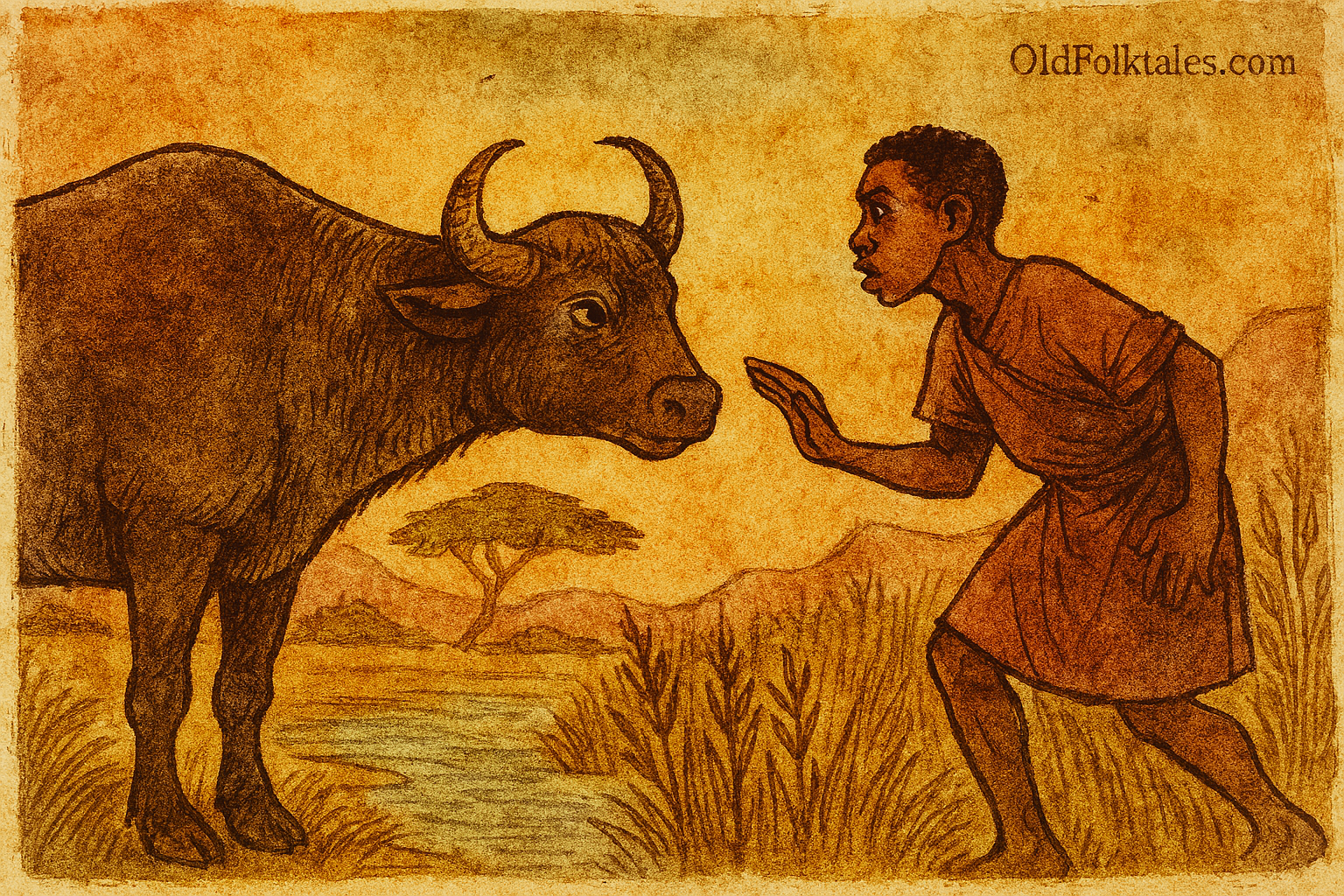
Near the eastern coast of Africa, where the vast ocean meets the land, there once lived a family blessed with two children, a son and a daughter. Like parents everywhere, the father and mother dreamed of the prosperous marriages their children would one day make. In that country, young people married early, and it wasn’t long before a wealthy man from beyond the great hills sent messengers offering a magnificent herd of fat oxen in exchange for the daughter’s hand.
The entire village celebrated as the girl departed for her new home. When the festivities ended and quiet returned to the household, the father turned to his son with practical wisdom.
“Now that we possess such a splendid herd of oxen, you should marry quickly before illness or misfortune strikes the animals. I’ve seen several beautiful maidens in the neighboring villages whose parents would gladly accept less than half our herd. Choose one, and we’ll arrange everything.”
Looking for more? Explore the magic of East African folktales here
But the young man shook his head firmly. “No, Father. The girls I’ve seen don’t please me. If I must marry, let me travel and find a wife who suits my heart.”
His parents exchanged worried glances. “Very well, it shall be as you wish. But if trouble comes from this decision, remember, it will be your doing, not ours.”
The youth wouldn’t be swayed. He bid his parents farewell and set out on his quest, wandering far beyond the familiar boundaries of his homeland. Over steep mountains and across rushing rivers he traveled, until he reached a distant village where the people looked and spoke differently from his own tribe. The settlement bustled with activity, maidens pounding maize with steady rhythm, women stirring fragrant stews in earthen pots that made his mouth water after his long journey.
One of the young women noticed the stranger’s exhaustion and offered him food. As he ate gratefully, the youth studied her face and decided immediately that she would be his wife and no other.
He sent word to her parents, requesting their daughter’s hand in marriage. The next day they came to discuss terms, their faces shrewd with negotiation.
“We will give you our daughter,” they said carefully, “if you pay a worthy price. Never has there been such a hardworking girl! How we shall manage without her, we cannot imagine. Surely your father and mother will come themselves to bring the bride price?”
“No need,” the young man replied, producing a handful of gleaming gold pieces. “Here is the price. Take it.”
The old couple’s eyes glittered with greed, though custom prevented them from touching the gold until all arrangements were finalized.
“At least,” they continued after a pause, “we may expect your family to escort your wife to her new home?”
“They are not accustomed to such long journeys,” the bridegroom answered. “Let us perform the ceremony now and depart at once. The distance is great, and I wish to travel while the weather holds.”
The parents summoned their daughter, who had been resting in the sun outside their hut. Before the assembled village, a ceremonial goat was slaughtered, the sacred dance was performed, and blessings were spoken over the young couple’s heads. Afterward, the bride’s father took her aside to offer the traditional parting counsel.
“Be good to your husband’s parents,” he advised solemnly. “Always obey your husband’s wishes.” The girl nodded obediently.
Then her mother approached with the customary question: “Which of your sisters will you choose to accompany you? You’ll need help carrying water and cutting wood in your new home.”
“I want none of them,” the daughter answered dismissively. “They’re useless, they’ll drop the wood and spill the water.”
“Then perhaps some of the younger children?” her mother suggested. “We have plenty to spare.”
But the bride’s answer came swift and certain: “I will have none of them! Give me our buffalo, the Rover of the Plain. He alone shall be my servant.”
Her parents recoiled in shock. “What madness is this? Give you the Rover of the Plain? You know our very lives depend on him! Here he’s well-fed and comfortable on soft grass. How can you guarantee his welfare in a strange country? The food may be poor, he might starve and if he dies, we die also!”
“I can care for him as well as you do,” the bride insisted. “Prepare him for the journey. The sun is setting, and we must leave now.”
She gathered her possessions, a small pot filled with healing herbs, a horn she used for tending the sick, a sharp little knife, and a calabash containing deer fat. Hiding these items about her person, she embraced her parents and departed alongside her new husband across the mountains.
The young man never saw the magnificent buffalo that followed them silently, leaving his comfortable home to serve as his wife’s devoted companion.
No one could explain how news of the couple’s approach reached the village ahead of them, but when they arrived, every man, woman, and child stood in the road, shouting welcomes.
“So you’re alive after all!” they cried. “You’ve found a wife to your liking, though you rejected all our local girls. Well, you’ve chosen your own path but don’t complain if trouble comes from it!”
The next day, the husband took his wife to the fields and showed her which plots belonged to him and which to his mother. The girl listened attentively, walking beside him back to their hut. But near the doorway, she stopped abruptly.
“I’ve dropped my necklace of beads in the field. I must go search for it.”
This was merely an excuse to find the buffalo. She discovered him crouching beneath a tree, and he snorted with pleasure at her appearance.
“You may graze in these fields,” she instructed, pointing, “for they belong to my husband. That wood is his also—you can hide there. But avoid those other fields entirely, for they’re my mother-in-law’s property.”
“I will beware,” the buffalo promised. She patted his massive head affectionately and returned home.
What a magnificent servant he proved to be! When she needed water, she simply crossed the maize patch and found the buffalo’s hiding place. She would set down her empty pail and rest while he carried it to the lake and brought it back brimming. When she needed firewood, he broke branches from the trees and laid them at her feet. The villagers watched her return each day carrying impossible loads.
“The girls from her country must be far stronger than ours,” they marveled. “None of our women could cut wood so quickly or carry so much!”
But nobody knew about the buffalo servant.
However, the girl had only one dish in her household the one she and her husband shared at meals. In her parents’ home, there had been a special dish set aside expressly for the Rover of the Plain. The buffalo endured his hunger silently for as long as possible, but one day, when his mistress sent him to fetch water, his knees nearly buckled from weakness. That evening, he finally spoke.
“I’m starving. I haven’t eaten since we arrived. I cannot work anymore.”
“Alas!” his mistress replied helplessly. “I have only one dish. You’ll have to steal beans from the fields. Take just a few here and there, but never too many from one place, or the owners will notice.”
The buffalo had always lived honestly, but without food from his mistress, he had no choice. That night, when darkness blanketed the village, he crept into the bean fields and ate sparingly from various plots, just as instructed. When his hunger was finally satisfied, he returned to his hiding place in the wood.
But buffaloes leave traces, and the next morning the women who came to work in the fields stopped in astonishment.
“Look at this! Some wild beast has been destroying our crops, you can see its hoofprints everywhere!” They hurried home to spread the alarm.
That evening, the girl visited the buffalo’s lair and whispered, “They’ve discovered what happened. Tonight you should seek food farther away.” The buffalo nodded and followed her advice, but the next morning, those distant fields also bore clear evidence of the nighttime visitor. The women ran to their husbands, begging them to bring guns and watch for the thief.
The stranger girl’s husband was the finest marksman in the village. That night he concealed himself behind a thick tree trunk and waited.
The buffalo, reasoning that searchers would concentrate on the fields he’d raided the previous night, returned to the bean patch belonging to his mistress. The young man saw him approaching and gasped in wonder.
“A buffalo! I’ve never seen one in this country before!” He raised his gun carefully, aimed just behind the creature’s ear, and fired.
The buffalo leaped high into the air, then crashed to the ground, dead.
“An excellent shot,” the young man congratulated himself. He ran to the village to announce that the thief had been punished.
When he entered his hut, he found his wife twisting and writhing, tears streaming down her face.
“Are you ill?” he asked with concern.
“Yes,” she moaned. “I have terrible pains throughout my body.” But she wasn’t ill at all, she was heartbroken over the death of the buffalo who had served her so faithfully. Her worried husband sent for the medicine man, but the girl secretly threw all his remedies out the door.
At first light, the entire village awakened. The women armed themselves with baskets while the men sharpened their knives to butcher the buffalo. Only the girl remained in her hut, but after a while she too joined them, groaning and weeping as she walked.
“What are you doing here?” her husband asked when he spotted her. “If you’re ill, you should stay home.”
“I couldn’t bear being alone in the village,” she replied. Her mother-in-law left her work to scold her, warning that such foolishness would kill her. But the girl ignored them both and sat down to watch.
When the buffalo’s flesh had been divided and each woman had her family’s portion in her basket, the stranger wife stood up.
“Let me have the head,” she requested.
“You could never carry something so heavy,” the men protested, “especially when you’re ill.”
“You don’t know my strength,” she answered. They reluctantly gave it to her.
She didn’t walk home with the others but lingered behind. Instead of entering her hut, she slipped into the small shed where cooking pots and maize storage vessels were kept. There she laid down the buffalo’s head and sat beside it. Her husband came searching for her, begging her to rest in bed after such exhaustion, but the girl refused to move. Her mother-in-law added her pleas, but received only a cross reply.
“I wish you would leave me alone! It’s impossible to sleep with people constantly coming in.” She turned her back on them and wouldn’t touch the food they brought. They departed, and the young man soon stretched out on his sleeping mat, but his wife’s strange behavior troubled him. He lay awake all night, listening.
When all was silent, the girl built a fire and boiled water in a pot. Once it was steaming hot, she added the medicine she’d brought from home. Then, taking the buffalo’s head, she made careful incisions with her little knife behind the ear and near the temple where the shot had struck. She applied her horn to the wound and blew with all her strength until, gradually, blood began flowing again. Next she spread deer fat from her calabash over the wound and held it in the steam rising from the hot water. Finally, she sang in a low, mournful voice, a sacred dirge for the Rover of the Plain.
As she chanted the final words, the head stirred. Limbs materialized and reattached themselves. The buffalo began feeling alive again, shaking his horns, standing up, and stretching his massive body.
Unfortunately, at precisely that moment, the husband said to himself, “I wonder if she’s still crying. What could be wrong with her? Perhaps I should check.” He rose and, calling her name, approached the shed.
“Go away! I don’t want you!” she cried frantically. But it was too late. The buffalo collapsed to the ground dead again, the wound in his head exactly as before.
The young man, who unlike most men in his tribe feared his wife somewhat, returned to bed without having seen anything clearly, though he wondered greatly what she was doing. After waiting several minutes, she began her task again. At the end, the buffalo once more stood on his feet, alive and whole.
But just as the girl was rejoicing that her work was complete, her husband entered the shed again to see what his wife was doing. This time he sat down inside the hut, declaring that he wished to observe whatever was happening. Then the girl gathered her pitcher and all her other things and left the shed, attempting for the third time to resurrect the buffalo.
She was too late. Dawn was already breaking across the sky, and the head fell to the ground dead and decaying as before.
The girl entered the hut where her husband and mother-in-law were preparing for the day’s work.
“I want to go down to the lake and bathe,” she announced.
“But you could never walk so far,” they protested. “You’re so exhausted you can hardly stand!”
Despite their warnings, the girl left the hut in the direction of the lake. Very soon she returned, weeping bitterly, and sobbed out her story: “I met someone from my country in the village. He told me my mother is gravely ill. If I don’t reach her immediately, she’ll die before I arrive. I’ll return as soon as I can. Farewell.” She set forth toward the mountains.
But this story was false. She knew nothing of her mother’s condition she simply needed an excuse to return home and tell her family that their prophecies had proven true, that the buffalo was dead.
Balancing her basket on her head, she walked swiftly. As soon as the village disappeared behind her, she broke into the mournful song of the Rover of the Plain. At day’s end, she reached the cluster of huts where her parents lived. Her friends rushed to greet her, and through her tears, she told them the buffalo was dead.
This devastating news spread like wildfire across the countryside. People flocked from near and far to mourn the loss of the beast who had been their pride and protection.
“If only you had listened to us,” they cried, “he would still be alive! But you refused all the little girls we offered you, insisting on nothing but the buffalo. And remember the medicine-man’s prophecy: ‘If the buffalo dies, you die also!'”
They lamented their fate to one another, so absorbed in grief that for a while they didn’t notice the girl’s husband sitting in their midst, his gun leaning against a tree. Then one man turned, beheld him, and bowed mockingly.
“Hail, murderer! Hail! You have slain us all!”
The young man stared in confusion. “I shot a buffalo. Is that why you call me a murderer?”
“A buffalo, yes! But the servant of your wife! It was he who carried her wood and drew her water. Did you not know?”
“No, I didn’t know,” the husband replied in astonishment. “Why did no one tell me? Of course I wouldn’t have shot him!”
“Well, he is dead,” they answered grimly, “and we must die too.”
At this, the girl took a cup in which poisonous herbs had been crushed. Holding it in her trembling hands, she wailed: “O my father, Rover of the Plain!” Then, drinking deeply, she fell back dead. One by one, her parents, brothers, and sisters drank from the cup also and died, each singing a dirge to the memory of the buffalo.
The girl’s husband watched in horror. He returned sadly across the mountains to his home and, entering his hut, threw himself on the ground. At first he was too devastated to speak, but eventually he raised his head and told the entire story to his father and mother, who sat watching him in silent concern.
When he finished, they shook their heads knowingly. “Now you see that we spoke no idle words when we warned you that ill would come of your marriage! We offered you a good, hardworking wife, and you refused her. And it’s not only your wife you’ve lost, but your fortune too. Who will return your gold if they’re all dead?”
“It is true, Father,” the young man answered. But in his heart, he thought far more of losing his beloved wife than of the money he had paid for her.
Moral Lesson
This profound folktale teaches us that ignoring warnings and cultural wisdom often leads to tragic consequences. The story illustrates how ignorance even innocent ignorance can destroy what we most cherish. The young man’s refusal to understand his wife’s customs and his impatience to know her secrets prevented the buffalo’s revival and ultimately caused the death of his wife and her entire family. The tale also explores the theme of interconnected lives and mystical bonds, showing how the death of one being can doom many others. Most importantly, it reminds us that respecting the mysteries and traditions of others is essential, and that sometimes curiosity and interference at the wrong moment can be fatal.
Knowledge Check
Q1: Who is the Rover of the Plain in this African folktale?
A: The Rover of the Plain is a mystical buffalo who serves as the bride’s devoted servant in this East African folktale. Unlike ordinary animals, he possesses the ability to carry water, cut wood, and communicate with his mistress. He represents the magical bond between the bride and her homeland, and his life is mystically connected to her entire family.
Q2: Why does the bride refuse to take her sisters as servants?
A: The bride refuses her sisters and other children as servants because she knows they are inadequate compared to the Rover of the Plain, the buffalo who has served her family faithfully. She claims they will “drop the wood and spill the water,” but the deeper reason is her spiritual and practical dependence on the buffalo, despite her parents’ warnings.
Q3: What does the buffalo symbolize in The Rover of the Plain folktale?
A: The buffalo symbolizes the bride’s cultural identity, family heritage, and the mystical bonds that connect her to her homeland. His presence represents traditions that cannot easily be transplanted to new environments, and his death symbolizes the fatal consequences of cultural misunderstanding and the breaking of sacred connections.
Q4: Why does the bride’s attempt to resurrect the buffalo fail?
A: The bride’s resurrection ritual fails because her husband interrupts her three times during the sacred ceremony. The first two interruptions force her to start over, but the third attempt fails because dawn breaks before she can complete the process. The story suggests that some mystical practices require absolute privacy, perfect timing, and uninterrupted concentration to succeed.
Q5: What is the moral lesson of The Rover of the Plain?
A: The folktale teaches that ignoring warnings and cultural traditions leads to tragedy. It emphasizes the importance of respecting mysteries we don’t understand, the danger of impatient interference, and how ignorance even innocent can destroy what we love most. The story also illustrates the interconnectedness of lives and the fatal consequences of breaking sacred bonds.
Q6: What cultural origin does The Rover of the Plain represent?
A: This folktale comes from East African oral tradition, specifically from the coastal regions of East Africa, and appears in Andrew Lang’s fairy book collections. It reflects African storytelling themes about mystical animals, bride price customs, family loyalty, and the consequences of violating sacred traditions and spiritual connections.
Source: East African folktale, collected in Andrew Lang’s Fairy Books