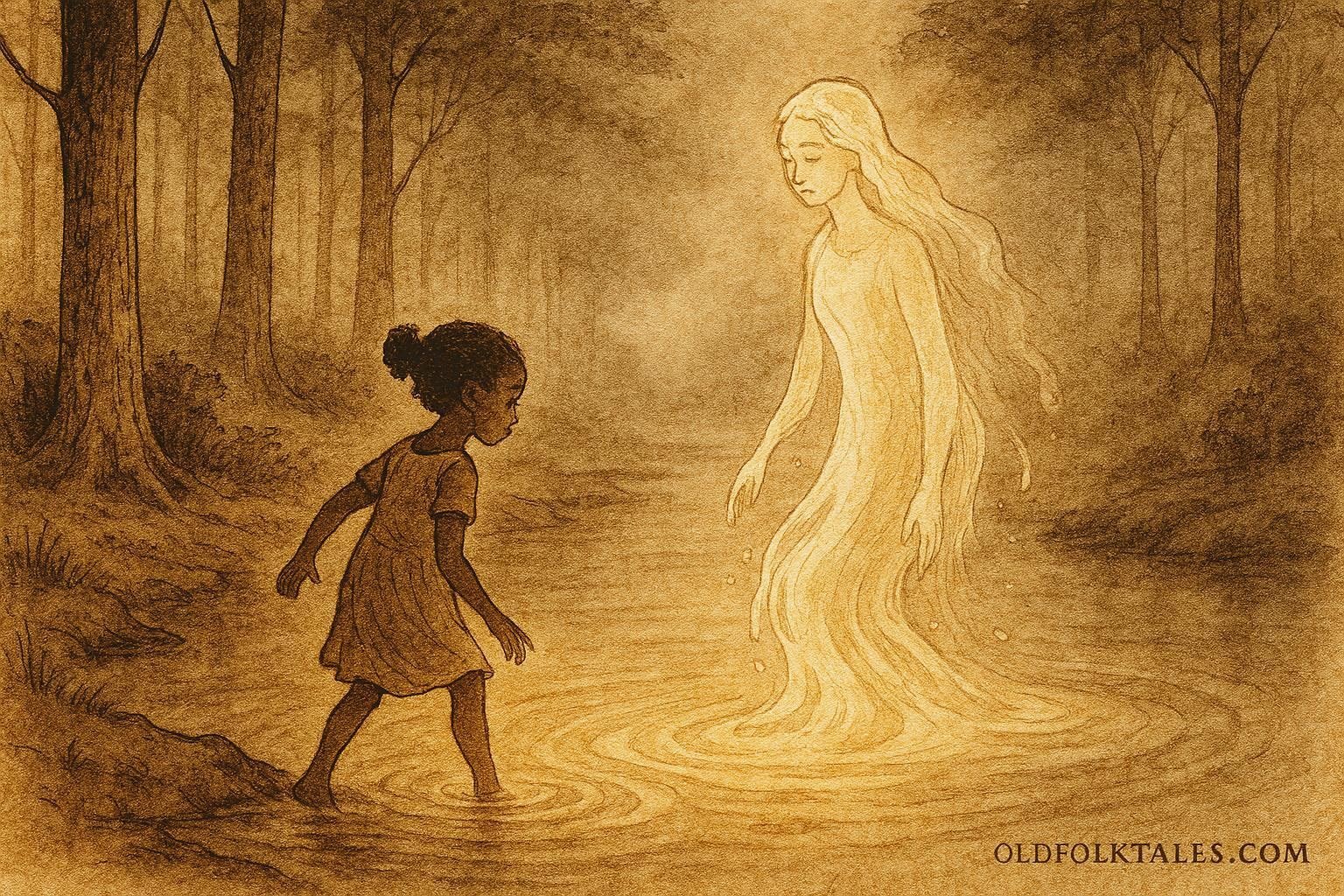
On Bioko Island, where the forest meets the sea and rivers wind like silver threads through the land, the Bubi people lived in close rhythm with nature. They understood that the world was layered, not only of what could be seen and touched, but also of what could be heard, felt, and remembered.
Among them lived a young girl, known for her quiet nature and thoughtful eyes.
Explore more Southern African folktales here
She was neither the most outspoken nor the most restless, but she possessed something deeper, a listening spirit. Where others heard noise, she heard meaning. Where others passed by, she paused.
Her days were simple. She helped her family, gathered water from the river, and listened to the stories told by elders in the evenings. These stories often spoke of unseen worlds, of spirits who moved between places, and of voices that called, not always to be followed.
She listened carefully.
But listening and understanding are not always the same.
One afternoon, as the sun softened and the shadows stretched long, she went to the river.
The water moved gently, its surface reflecting light in quiet patterns. She knelt at the edge, filling her calabash, her mind at ease.
Then she heard it.
A voice.
Soft at first, so soft she thought it might be the movement of water itself.
But it grew clearer.
Calling.
She froze.
The voice did not sound like anyone from the village.
It was neither near nor far, neither loud nor faint, it seemed to exist just beyond her reach.
“Come,” it said.
She looked around.
No one.
Only the river.
Her heart began to beat faster.
She remembered the stories.
Not every voice is meant to be followed.
But the voice came again.
Gentle.
Persistent.
“Come.”
She stood slowly.
Her mind held two paths, one shaped by caution, the other by curiosity.
The first said: Leave. Return home.
The second whispered: Just a little further.
She chose to follow.
The path along the river was one she knew, but soon it changed.
The familiar bends gave way to places she had never seen. The trees grew taller, their branches weaving tightly above. The air cooled, and the sounds of the village faded until only the river remained.
Still, the voice guided her.
“Closer.”
She walked on.
Each step felt both certain and uncertain, as though she moved through a place that shifted with her presence.
Then, at a bend in the river, she saw something.
The water was no longer flowing as before.
It was still.
Like a mirror.
And in that stillness, she saw movement.
Not of the surface, but beneath it.
The voice came again.
“Step forward.”
She hesitated.
The water was clear, but it held a depth she could not measure.
Her reflection looked back at her, but something about it felt distant, as though it belonged to another place.
“Come,” the voice repeated.
Slowly, she stepped into the water.
It was cool, but not cold.
And as her feet sank beneath the surface, the world shifted.
The forest faded.
The light changed.
The air itself seemed to move differently.
She was no longer standing at the river’s edge.
She was within another place.
The spirit world.
It was not entirely unfamiliar, yet not the same.
The shapes of things remained, but they were altered. Trees seemed taller, their forms more fluid. The ground felt solid, yet lighter. The air carried a quiet presence, as though it watched without judgment.
And there, before her, stood a figure.
It was neither fully human nor entirely something else.
Its form shifted gently, as though made of water and light.
“You have come,” it said.
The girl stood still.
Her voice came quietly.
“You called me.”
“Yes,” the spirit replied.
“Why?” she asked.
The spirit regarded her.
“To see if you would listen,” it said. “And to see if you would understand.”
The girl did not answer.
“You have crossed into a place not meant for all,” the spirit continued. “Here, what you carry within you matters more than what you show.”
The girl listened.
“You will be tested,” the spirit said. “Not with strength, but with choice.”
And so, the trials began.
The first was simple.
Before her appeared two paths.
One wide and easy, the other narrow and uncertain.
“Choose,” the spirit said.
She looked at both.
The wide path seemed safe.
Clear.
Inviting.
But something about it felt too easy.
The narrow path was less certain.
But it felt… true.
She chose the narrow path.
The spirit nodded.
The second trial came without warning.
A voice, different from the first, called to her.
This one sounded familiar.
Like someone she knew.
“Come back,” it said. “You do not belong here.”
She turned.
For a moment, doubt rose.
Was she meant to leave?
Had she gone too far?
But then she remembered.
The first voice had not sounded like this.
“This is not the same,” she said.
The voice faded.
The spirit watched.
“You begin to see,” it said.
The final trial came in silence.
Nothing appeared.
No voice.
No path.
Only stillness.
The girl stood.
Waited.
Listened.
Time passed, though she could not measure it.
At last, she spoke.
“I will not move without knowing,” she said. “And I will not follow what I do not understand.”
The silence lifted.
The spirit stepped forward.
“You have learned,” it said.
The world shifted again.
The river returned.
The forest reformed.
The air warmed.
She stood once more at the water’s edge.
The voice was gone.
But something remained.
Understanding.
She returned to her village.
Not in fear.
Not in confusion.
But with a quiet strength.
When others spoke of voices, of the river, of the unseen, she did not dismiss them.
But neither did she encourage blind following.
“Listen,” she would say. “But do not follow without knowing.”
And those who heard her understood that she spoke not from stories, but from experience.
Keep reading: Discover more Central African folktales
Moral Lesson
This folktale teaches that curiosity must be guided by wisdom. Not every call should be followed blindly, and true growth comes from discernment, patience, and understanding one’s place between the seen and unseen worlds.
Knowledge Check
- Why did the girl follow the river’s voice?
She was curious and drawn by a mysterious voice, despite remembering warnings about unknown spiritual calls. - What happened when she stepped into the river?
She entered the spirit world, where reality shifted and she was tested by unseen forces. - What were the girl’s trials in the spirit world?
She faced choices involving judgment, identity, and discernment rather than physical challenges. - How did the girl show wisdom?
She questioned what she heard, chose carefully, and refused to act without understanding. - Why did the spirit allow her to return?
She demonstrated awareness, restraint, and the ability to distinguish truth from deception. - What is the main lesson of this Bubi folktale?
It teaches that curiosity must be balanced with caution and that true growth comes from wise choices.
Source: Bubi oral narratives referenced in Oral Literature of African Islands (1983)
Cultural Origin: Bubi people, Bioko Island, Equatorial Guinea