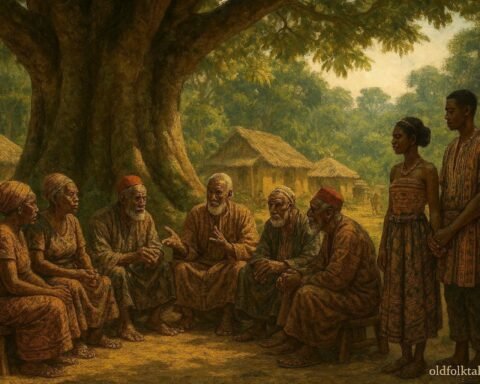
Along the coastal lands where the Ndowe people lived, the rhythm of life was shaped by both land and water. The forest stretched inland, rich with game, while the ocean breathed steadily against the shore. Between these two worlds, the people built their lives, guided not only by skill, but by tradition.
Among these traditions, one stood firm:
Don’t miss out: Read more Southern African folktales
What was taken from nature was not for one alone.
Food was shared.
Success was communal.
And those who received much were expected to give.
In one such village lived a hunter whose skill was unmatched.
He moved through the forest with quiet certainty, reading signs others could not see. His arrows found their mark, his traps rarely failed, and he returned each day with game that could feed many.
At first, he lived as others did.
He shared.
He gave.
He took his place within the circle of the village.
But slowly, something changed.
The more he succeeded, the more he began to see his skill as something separate, something earned by his own hands alone.
“Why should I share what I alone have hunted?” he began to think.
At first, the thought was small.
Then it grew.
One day, he returned from the forest with a large catch.
The villagers gathered, as they always did, expecting to divide the food.
But this time, the hunter stepped back.
“This is mine,” he said.
A silence fell.
“You have always shared,” an elder said gently.
“And I have chosen not to,” the hunter replied.
The villagers exchanged glances.
They did not argue.
They did not force him.
But something shifted.
That night, the hunter ate well.
Better than he ever had.
He felt satisfaction, not only in the food, but in keeping it.
The next day, he hunted again.
And again, he returned with abundance.
And again, he kept it.
Days turned into weeks.
The hunter grew accustomed to eating alone.
To storing more than he needed.
To watching others withhold their expectations.
But the forest was watching too.
At first, the change was subtle.
A missed track.
A delayed shot.
Nothing enough to concern him.
Then, one morning, he followed a trail he knew well.
Clear markings.
Fresh signs.
But they led nowhere.
He frowned.
“Strange,” he muttered.
The next day, his arrow flew wide.
The day after, his trap was sprung, but empty.
Still, he persisted.
“It is nothing,” he told himself. “My skill remains.”
But the forest had begun to answer.
Where once animals moved within his reach, they now seemed distant.
Where once the air carried signs, it now held silence.
And then came the day he returned with nothing.
The villagers saw him.
They said nothing.
But their silence was no longer neutral.
That night, his fire burned low.
His food was gone.
And for the first time in many days, he felt hunger.
The next morning, he went deeper into the forest.
Further than before.
Driven not by pride, but by need.
The air felt different.
Heavier.
Still.
At last, he reached a clearing.
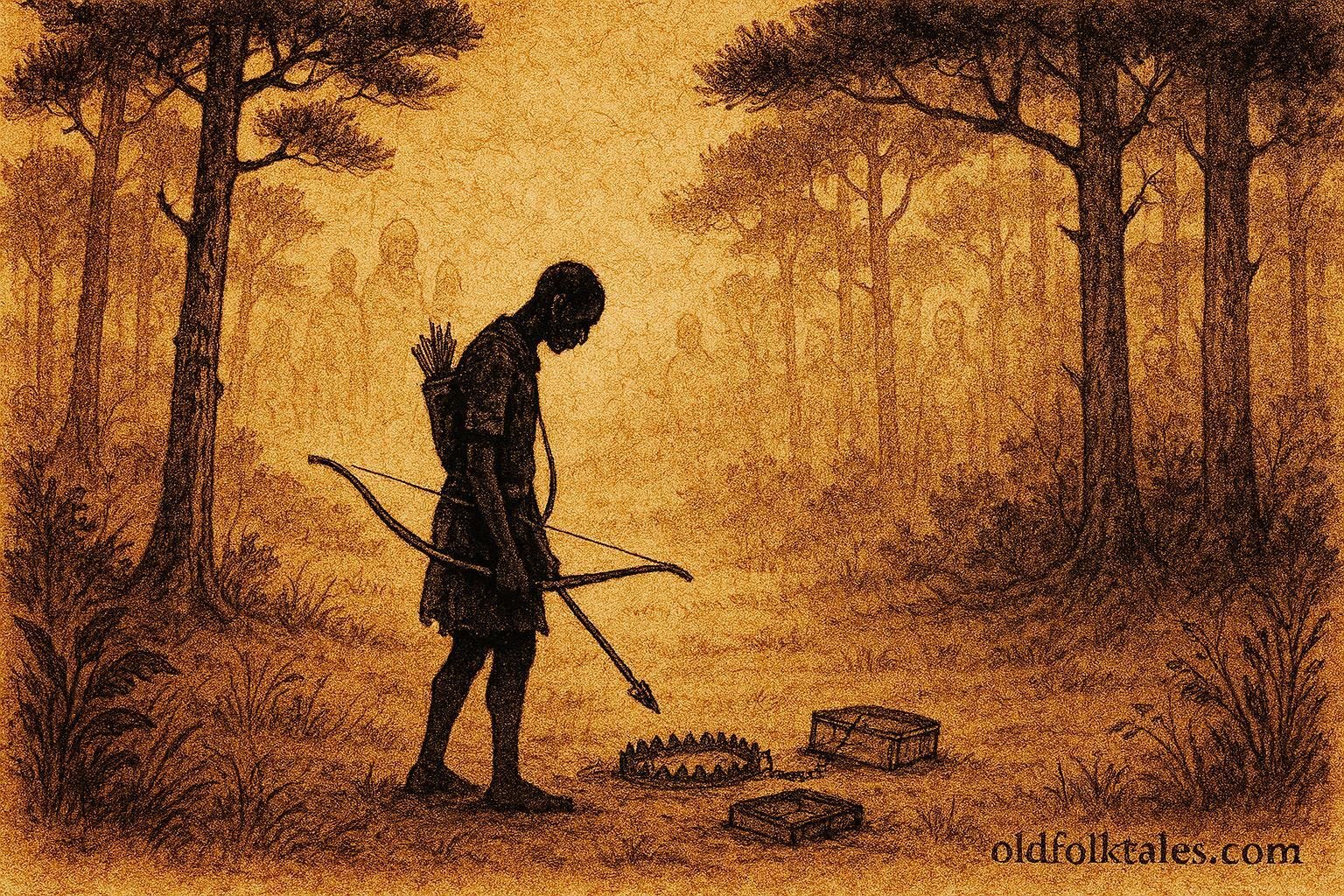
And there, as though waiting, stood figures.
The forest spirits.
They did not move as humans did.
Their presence was quiet, but unmistakable.
The hunter stood still.
For the first time in many days, he did not speak first.
“You have come,” one spirit said.
“My game has vanished,” the hunter replied. “My skill has failed.”
The spirit regarded him.
“Has it?” it asked.
The hunter frowned.
“I was once the best,” he said. “Now I return with nothing.”
“And what did you do with what you once received?” another voice asked.
The hunter hesitated.
“It was mine,” he said.
The clearing grew still.
“Was it?” the first spirit asked.
The hunter looked around.
The forest.
The trees.
The ground beneath him.
“I hunted it,” he said.
“And who gave it?” the spirit replied.
The hunter did not answer.
“You took,” the spirit continued, “but you did not give.”
The words settled heavily.
“The forest feeds many,” another spirit said. “Not one.”
The hunter lowered his gaze.
“I did not think,” he began.
“No,” the spirit said. “You did not.”
Silence followed.
Then, quietly, the hunter spoke again.
“I am hungry.”
The truth of it carried more weight than anything he had said before.
The spirits did not respond immediately.
“What do you seek?” one asked at last.
The hunter took a breath.
“Not just food,” he said slowly. “Understanding.”
The clearing seemed to shift.
“Understanding requires change,” the spirit said.
The hunter nodded.
“I will change.”
The words were simple.
But this time, they were not driven by pride.
Time passed.
The hunter did not return to abundance immediately.
Instead, he began again.
He greeted the forest when he entered.
He waited.
He observed.
When he caught something, even something small, he returned to the village.
And this time, he shared.
At first, the villagers were cautious.
But they accepted.
Days turned into weeks.
Slowly, the forest responded.
Tracks reappeared.
Game returned.
His aim steadied.
But something else had changed too.
He no longer hunted for himself alone.
He hunted as part of something larger.
When he returned with food, he did not step back.
He stepped forward.
“This is for all,” he said.
And the circle, once broken, began to close again.
Click here to explore more Central African folktales
Moral Lesson
This folktale teaches that generosity is not optional, it is a responsibility. When individuals place themselves above the community and nature, they lose the very support that sustains them. True success is not in having more, but in sharing what one has.
Knowledge Check
- Why did the hunter stop sharing his catch?
He became proud of his skill and believed his success belonged to him alone. - How did the forest spirits respond to his greed?
They gradually took away his ability to hunt successfully. - What signs showed the hunter was losing his skill?
He missed shots, found no tracks, and returned home empty-handed. - What realization did the hunter have in the forest?
He understood that his success came from the forest, not just his own effort. - How did the hunter regain his abilities?
By changing his behavior, respecting the forest, and sharing his catch with the village. - What is the main lesson of this Ndowe folktale?
It teaches that generosity and community are essential for survival and balance.
Source: Ndowe coastal oral traditions, compiled in Central African Folktales Anthology (1975)
Cultural Origin: Ndowe people, Equatorial Guinea