In the dry plains and scattered woodlands of western and northern Eritrea, where the earth stretches wide beneath an endless sky and the wind carries the sounds of distant life, there once lived a lion whose name alone stirred fear.
He was known among animals and humans alike as a ruler of terror.
Click here to discover more legendary tales from West Africa
From the rocky hills to the edges of nearby villages, his presence was felt before he was ever seen. Birds would scatter from the trees at the faintest echo of his roar. Herds would shift direction, abandoning fertile grazing lands just to avoid crossing his path. Even the strongest animals lowered their heads and stepped aside when he approached.
The lion believed this fear was his rightful power.
Each morning, he rose with the sun and walked through his territory as though inspecting what already belonged to him. His golden mane caught the light, and his heavy paws pressed deeply into the earth, leaving marks that others dared not cross.
“Everything you see,” he would say to no one in particular, “bows because I am the strongest.”
And in many ways, he was.
No animal could match his strength. None could outrun him for long. When he hunted, he did not do so quietly or with patience. Instead, he charged forward, roaring loudly, scattering everything in sight. Even when he caught nothing, he was satisfied, for he had reminded the land of who he was.
But strength alone had begun to shape something else within him.
Pride.
The lion no longer hunted because he needed to eat. He hunted to be seen. He chased animals not out of hunger, but to watch them flee. Sometimes, he would stalk near the villages, letting his shadow stretch across the fields so that the people would whisper of him in fear.
And they did.
Villagers spoke of him in hushed voices around their fires at night. Parents warned their children not to wander far. Farmers abandoned parts of their land, unwilling to risk encountering him.
The lion heard these stories, carried by the wind, and he welcomed them.
“Let them fear me,” he said. “Fear is the mark of a true leader.”
But not all who lived in those lands agreed.
Among the smaller animals, the quick-footed, the sharp-minded, the observant, there grew a quiet understanding. They knew they could not challenge the lion with strength. But they also knew something the lion did not.
Strength without wisdom creates blindness.
One evening, as the sky softened into deep shades of orange and purple, a group of animals gathered near a dry riverbed. They spoke in low tones, careful not to draw attention.
“We cannot continue like this,” one said. “The lion takes what he wants and leaves fear behind.”
“He does not listen,” another added. “He does not see beyond himself.”
A smaller voice spoke from the edge of the group. “Then we must show him what he cannot see.”
The others turned.
“How?” they asked.
The answer came calmly.
“Through his pride.”
The plan was not built on force, but on understanding, understanding the lion’s greatest weakness: his belief that nothing could outmatch him.
The next day, the lion roamed as he always did, his head held high, his steps heavy with confidence. As he approached a clearing, he noticed something unusual.
A small animal stood in the open, unmoving.
The lion slowed, curious.
Most creatures fled at the mere sound of his approach. But this one remained still, watching him.
“Why do you not run?” the lion demanded.
The small animal tilted its head slightly. “Why should I?”
The lion’s eyes narrowed. “Because I am the strongest creature in this land.”
The small animal nodded thoughtfully. “That is what you believe.”
The lion felt a flicker of irritation. “It is not belief. It is truth.”
“Then prove it,” the small animal said.
The lion stepped closer, his tail flicking. “I have nothing to prove.”
“Of course you do,” the animal replied. “A true ruler does not rely on fear alone. A true ruler shows mastery over all things, strength, wisdom, and control.”
The lion paused.
No one had spoken to him this way before.
“What do you suggest?” he asked.
“There is a place,” the small animal said, “where only the greatest can stand without faltering. A place where true power is revealed.”
The lion’s interest sharpened. “Take me there.”
The small animal turned and began to walk, leading the lion through winding paths and over uneven ground. The journey was longer than the lion expected, but he did not question it. His mind was already filled with the thought of proving his greatness once more.
At last, they arrived at a narrow clearing surrounded by thick brush and low-hanging branches. In the center lay a patch of ground that looked ordinary at first glance, but beneath it, hidden by layers of dry leaves and soil, was a carefully concealed trap.
“This is the place,” the small animal said.
The lion looked around. “There is nothing here.”
“Stand in the center,” the animal replied. “If you are truly unmatched, the ground itself will hold you.”
The lion scoffed. “The ground cannot challenge me.”
“Then you have nothing to fear.”
The words echoed in his mind.
Nothing to fear.
With a confident stride, the lion stepped forward and placed himself at the center of the clearing.
For a brief moment, everything was still.
Then the ground gave way.
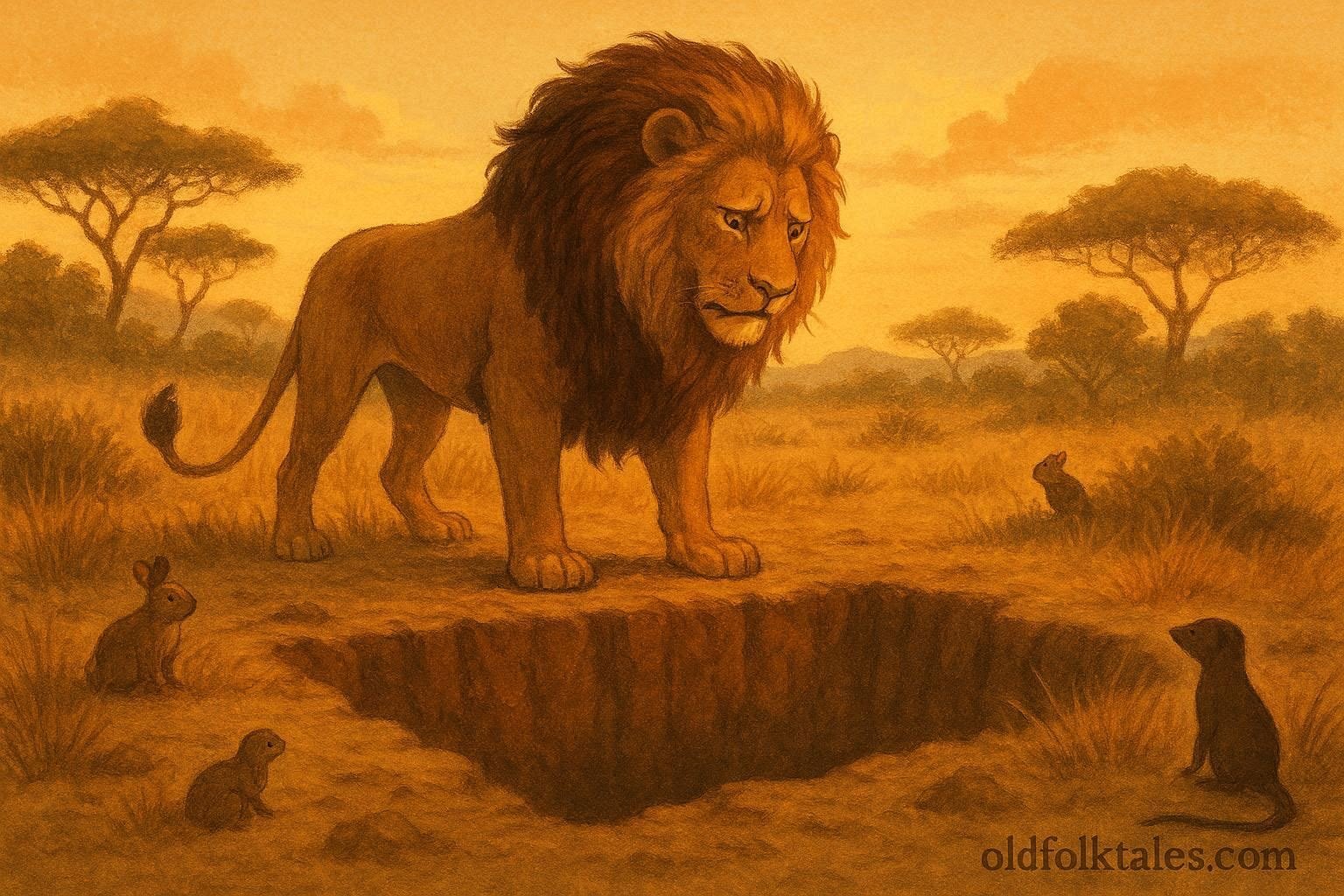
The lion dropped suddenly into a hidden pit, the earth collapsing beneath his weight. Dust rose into the air as he landed heavily at the bottom, the walls too steep and narrow for him to climb.
His roar shook the clearing.
The small animal stepped back, watching quietly.
The lion leapt, clawed, and pushed against the walls, but each attempt failed. The more he struggled, the more the loose soil slipped beneath him.
His strength, once his greatest advantage, now worked against him.
Hours passed.
The sun began to lower, casting long shadows across the pit. The lion’s movements slowed. His roars grew less fierce, replaced by heavy breaths.
For the first time in many days, he was still.
Above him, shapes began to appear along the edge of the pit, animals of all kinds, watching.
Not with fear.
But with calm.
The lion looked up at them, his pride clashing with the reality of his situation.
“Help me out,” he demanded.
No one moved.
“You should fear me,” he added, though his voice lacked its usual certainty.
The small animal stepped forward.
“Fear is not respect,” it said.
The lion lowered his gaze.
“You ruled through fear,” the voice continued. “But fear does not create loyalty. It does not create understanding. It only creates distance.”
The lion said nothing.
“You believed strength made you invincible,” the animal went on. “But strength without wisdom leads to downfall.”
The words settled heavily in the air.
For the first time, the lion did not argue.
Night approached, and the sky darkened. The animals remained, silent witnesses to the moment.
Finally, the lion spoke again, but this time, his voice was different.
“Help me,” he said quietly.
There was no command in his tone. No pride. Only honesty.
The animals exchanged glances.
Then, together, they began to act.
They gathered branches, lowered them into the pit, and created a path the lion could climb. It was not easy, and it required patience, but eventually, the lion pulled himself free.
When he stood again on solid ground, he did not roar.
He looked at the animals around him, truly looked at them, for the first time.
“I was wrong,” he said.
The words felt unfamiliar, but they carried weight.
“I believed fear made me strong. I believed it made me a leader.”
He paused.
“But I see now that I stood alone.”
The animals listened.
“A true leader does not stand above others through fear,” the lion continued. “A true leader stands with others through understanding.”
The clearing was quiet, but the silence felt different now, lighter, open.
From that day forward, the lion changed.
He still carried his strength, but he no longer used it to dominate. He hunted with purpose, not pride. He moved through the land with awareness, not arrogance. When he walked, the animals did not scatter in panic, they stepped aside with calm respect.
Even the villagers noticed the difference.
The lion no longer came near to stir fear. The land, once tense, began to feel balanced again.
And though the lion remained powerful, it was no longer his strength that defined him.
It was his humility.
Looking for more? Explore the magic of East African folktales here
Moral Lesson
Pride may create the illusion of power, but it leads to isolation and downfall. True leadership is rooted in humility, wisdom, and respect for others.
Knowledge Check
- Why was the lion feared in this Eritrean folktale?
The lion terrorized animals and villagers, using his strength and dominance to create fear. - How did the smaller animals outsmart the lion?
They used his pride against him, leading him into a hidden trap that he could not escape. - What mistake did the lion make as a leader?
He believed fear and strength alone made him a great leader, ignoring wisdom and respect. - What lesson did the lion learn from being trapped?
He learned that humility, patience, and understanding are essential for true leadership. - What role do smaller animals play in the story?
They represent wisdom, unity, and strategic thinking over brute strength. - What is the main theme of “The Lion Who Learned Humility”?
The story highlights how pride leads to downfall and why humility is essential for leadership.
Source: African folktale, Eritrea. Collected in Horn of Africa animal tales and Eritrean folklore documentation projects (1960s–1980s ethnographic records).
Cultural Origin: Tigre and Tigrinya oral storytelling traditions, western and northern Eritrea