In the southwestern lands of Eritrea, where the earth stretches warm beneath the sun and trees rise like silent witnesses over fields and pathways, there once lived two brothers who shared not only blood, but the memory of a father who had worked the land with patience and care.
Their father had been a man of quiet strength. He did not speak often, but when he did, his words carried weight. He taught his sons to respect the землю, to work honestly, and to remember that what is given must be used wisely.
Fascinated by this tale? Discover more North African folktales
When he passed on, he left them something simple, yet meaningful.
Land.
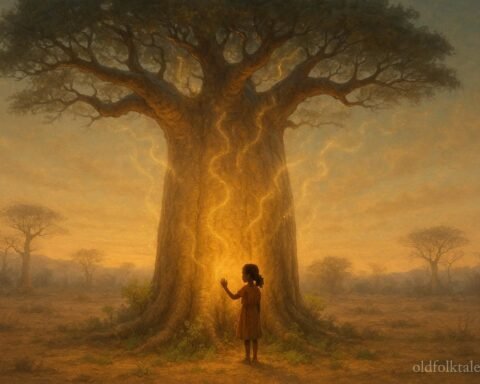
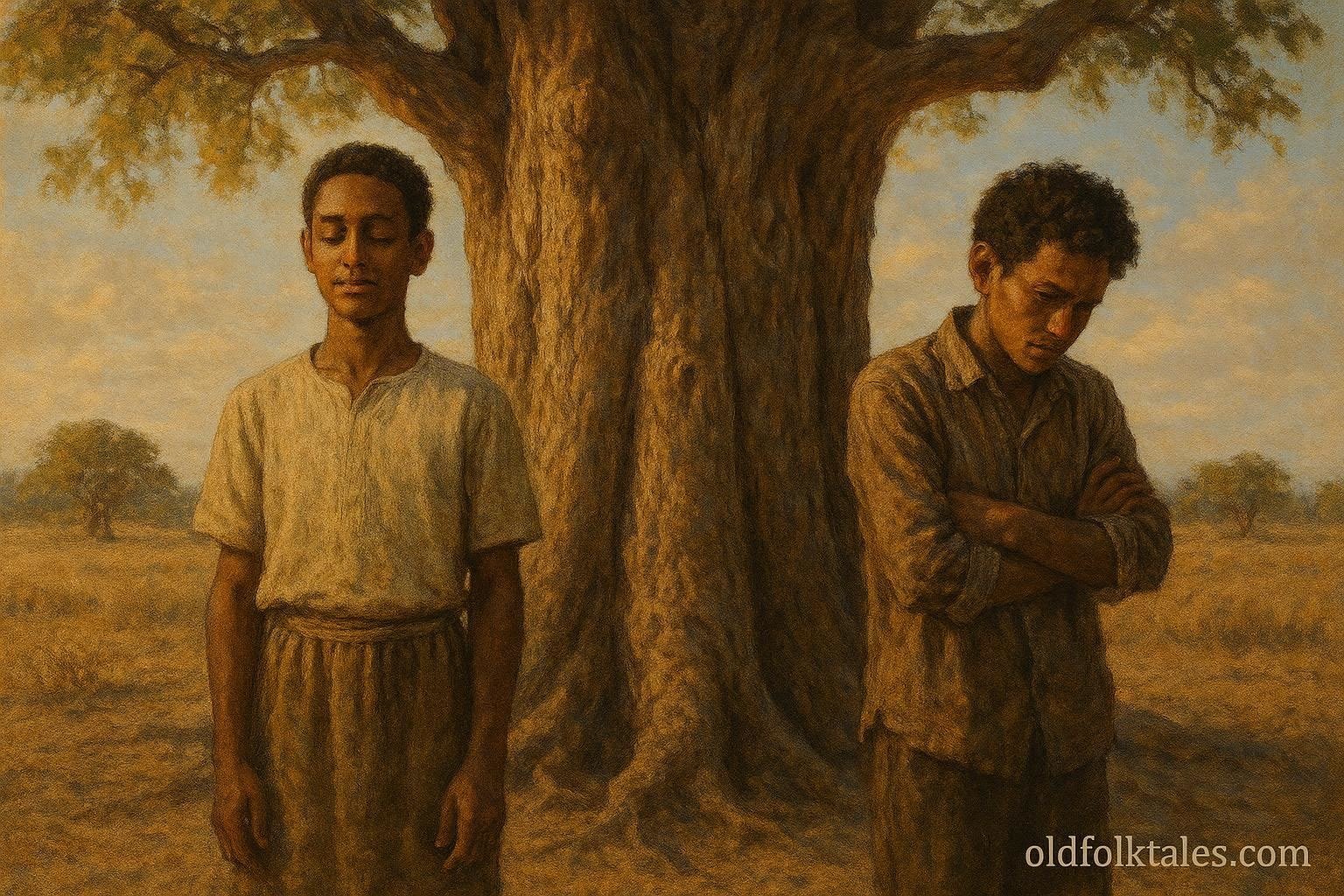
It was not vast, but it was fertile. At its center stood a large, ancient tree whose roots spread deep into the soil and whose branches reached wide, casting shade across the ground. The tree had always been there, older than the brothers, older even than their father. It had witnessed seasons come and go, rains fall and fade, and generations pass beneath it.
The brothers stood together on that land, looking out at what had been entrusted to them.
At first, they agreed to share it.
“We will work it together,” the younger brother said. “As our father did.”
The elder brother nodded, though his eyes lingered on the tree.
“Yes,” he said. “Together.”
But agreement, when not rooted deeply, can shift like dry soil.
As days passed, the brothers began to see the land differently.
The younger brother walked through it with care. He studied the soil, observed where the light fell best, and thought of how to grow crops that would sustain them both. He respected the tree, often resting beneath its shade, as his father had done.
The elder brother saw something else.
He saw ownership.
“This part is better,” he said one day, pointing to a section of land closer to the tree. “The soil is richer here. I should take this side.”
The younger brother hesitated. “The land was given to both of us,” he replied. “We can share it as we agreed.”
The elder brother frowned.
“Sharing is not always equal,” he said. “Each person must take what suits him best.”
The younger brother did not argue further, though he felt unease settle in his heart.
The land was divided.
The elder brother claimed the portion closest to the tree, the area with the richest soil and the widest shade. The younger brother took the remaining land, which was drier and more exposed to the sun.
Still, he worked it without complaint.
Days turned into weeks. The younger brother rose early, tending his crops with patience. He carried water, removed stones, and gave attention to every small detail. Though his land was less fertile, he worked with care, trusting that effort and honesty would bring results.
The elder brother, confident in his advantage, worked differently.
He relied on the strength of the soil alone. He planted quickly, without much thought, believing that the richness of his portion would ensure success.
At first, his crops grew faster.
He looked across at his brother’s field and smiled.
“You see?” he called out. “The land rewards those who choose wisely.”
The younger brother nodded quietly, saying nothing.
But as time passed, something began to change.
The elder brother noticed that his crops, though quick to grow, were uneven. Some flourished, while others withered without clear reason. The soil, though rich, did not respond as he expected.
One evening, as the sun lowered and shadows stretched across the land, the elder brother stood beneath the great tree, thinking.
Then he heard it.
A voice.
Low, steady, and unmistakable.
“You take much, but give little.”
The elder brother froze.
He looked around, but saw no one.
“Who speaks?” he demanded.
“I have always spoken,” the voice replied.
The elder brother’s eyes moved slowly upward, toward the branches of the tree.
“You…” he whispered.
The leaves rustled softly, though the air was still.
“You stand beneath me,” the voice said. “You rest in my shade. Yet you do not see.”
The elder brother felt a flicker of discomfort.
“I have done nothing wrong,” he said quickly. “This land is mine. I have the right to use it as I wish.”
“Right without truth is empty,” the tree replied.
The elder brother’s jaw tightened. He turned away, unwilling to listen further.
But the voice did not leave him.
The next day, as both brothers worked their fields, the younger brother approached the tree to rest. As he sat beneath it, the same voice came, but its tone was different.
“You work with care,” it said.
The younger brother looked up, surprised but calm.
“I do what I can,” he replied.
“You take little, but give much,” the tree continued.
The younger brother bowed his head slightly, not out of fear, but respect.
“The land provides,” he said. “It is right that we respect it.”
The tree’s leaves stirred gently.
“Truth grows where it is tended,” it said.
The younger brother returned to his work, thoughtful but steady.
Days passed, and the differences between the brothers became clearer.
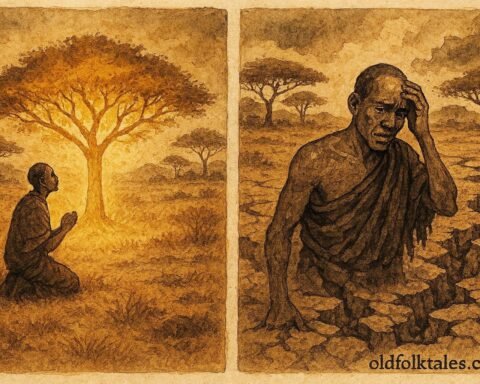
The younger brother’s crops, though slower to grow, became strong and consistent. His field, once dry, began to show signs of life, green spreading steadily across the land.
The elder brother’s field, however, grew unpredictable. Patches of growth were followed by patches of loss. The soil, though rich, seemed to resist him.
Frustration took root.
“This makes no sense,” he muttered. “I have the better land.”
One evening, anger rising within him, the elder brother returned to the tree.
“If you speak truth,” he called out, “then tell me why my land fails.”
The tree answered without hesitation.
“Because you do not honor what you have taken.”
The elder brother clenched his fists.
“I work the land,” he said. “I plant, I water, what more is required?”
“Honesty,” the tree replied.
The word hung in the air.
“You claimed more than your share,” the tree continued. “Not because you needed it, but because you desired it.”
The elder brother’s anger faltered, replaced by something else, something quieter, harder to face.
“You believed the land alone would reward you,” the tree said. “But the land responds not only to hands, but to intention.”
The elder brother said nothing.
For the first time, he considered the truth of what had been said.
Meanwhile, the younger brother continued his work without bitterness. Though he had less, he used it fully. He did not look toward his brother’s land with envy. Instead, he focused on what was within his care.
His harvest, when it came, was steady and abundant.
The elder brother’s harvest was not.
What he gathered was inconsistent, much of it unusable. The richness he had relied on had not sustained him.
Loss replaced pride.
At last, with little left, the elder brother approached his brother.
“I was wrong,” he said, his voice low.
The younger brother looked at him, not with triumph, but with understanding.
“We can share the land again,” the elder brother continued. “As we should have from the beginning.”
The younger brother nodded.
“It is not too late,” he said.
Together, they returned to the tree.
The elder brother stood beneath it once more, but this time, he did not speak with certainty.
“I did not listen,” he said quietly.
The tree’s leaves moved softly.
“Now you do,” it replied.
The brothers worked the land together again, not divided by greed, but guided by fairness. They shared both the labor and the harvest, and the land responded in kind.
The tree remained, as it always had, watching, witnessing, not judging with anger, but reflecting truth.
And from that time forward, the brothers remembered that what is given is not only to be taken, but to be honored.
Continue your journey: Read more East African folktales
Moral Lesson
Honesty and fairness bring lasting reward, while greed and selfishness lead to loss. What we take must be matched by how we care for it.
Knowledge Check
- What caused the conflict between the two brothers in the Eritrean folktale?
They argued over how to divide and use the land they inherited from their father. - What role did the talking tree play in the story?
The tree acted as a moral witness, revealing truths about the brothers’ intentions and actions. - Why did the elder brother’s land fail despite being fertile?
His selfishness and dishonesty affected the outcome, showing that intention matters as much as resources. - Why did the younger brother succeed?
He worked with honesty, patience, and respect for the land, leading to a successful harvest. - What lesson did the elder brother learn?
He learned that greed and unfairness lead to loss, while honesty and sharing bring prosperity. - What is the main theme of “The Two Brothers and the Talking Tree”?
The story emphasizes honesty, fairness, and the consequences of greed.
Source: African folktale, Eritrea. Documented in indigenous oral narratives collected by anthropologists (1960s–1980s field studies).
Cultural Origin: Kunama and Nara oral traditions of southwestern Eritrea