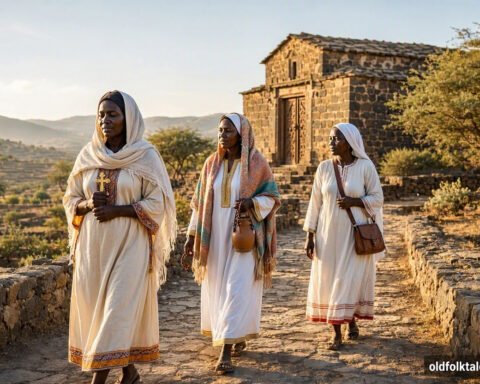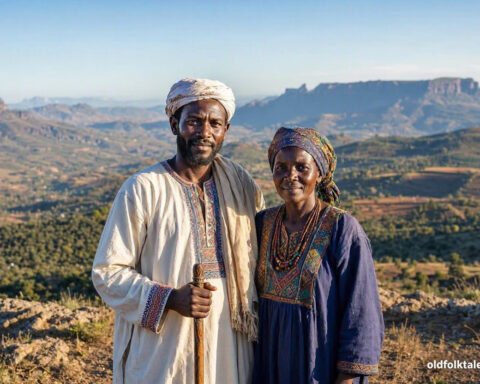
In the wide and ancient lands of Eritrea, where the sky stretches vast above hills, plains, and scattered villages, there was once a time when the rising and setting of the sun was not taken for granted.
In those days, the world was held together not only by what could be seen, but by the quiet labor of those chosen to keep balance.
Click here to discover more legendary tales from West Africa
Among the people of one such village lived a woman known for her strength, not the kind that draws attention, but the kind that endures. She rose before the first light touched the earth, long before others stirred from their sleep. Her hands were always busy, grinding grain, fetching water, tending to the needs of her household, and working the land beneath the heat of the day.
She did not complain.
Her life, like that of many others, was shaped by duty.
Yet even among those who worked hard, there was something about her that stood apart. She carried her responsibilities with steadiness, with care, and with a quiet acceptance that seemed deeper than routine.
It was this that the spirits noticed.
For beyond the visible world, there were forces that watched, not with judgment, but with awareness. They observed how people lived, how they worked, and how they carried what was given to them.
And when the time came to choose someone for a task unlike any other, they chose her.
One night, as the village rested and the sky stretched wide with stars, the woman felt a presence unlike anything she had known. The air around her grew still, yet full, as though the world itself had paused.
A voice came, not from outside, but from within the stillness itself.
“You have been seen,” it said.
The woman rose slowly, her heart steady despite the strangeness of the moment.
“What is required of me?” she asked.
“You will carry the sun,” the voice replied.
The words settled in the air, heavy with meaning.
Each day, before dawn, you will lift it from where it rests and guide it across the sky. You will carry it until it reaches its place of rest at the end of the day.”
The woman did not speak immediately.
She understood what this meant, not just the action, but the weight of it. To carry the sun was to carry light, warmth, time itself.
“Why me?” she asked quietly.
“Because you do not turn away from duty,” the voice said. “Because you carry what is given, even when it is unseen.”
The woman lowered her gaze.
She knew there was no refusal in such a calling.
“I will do it,” she said.
And so, before the first dawn of her new task, she rose earlier than ever before and walked beyond the village, beyond the familiar paths, to a place where the earth met the edge of light.
There, she found it.
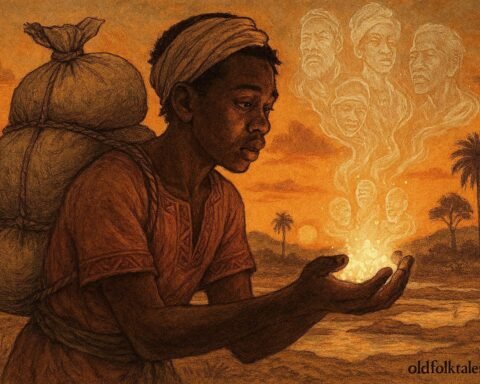
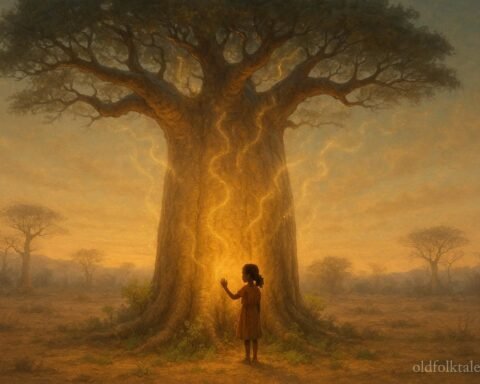
The sun rested low, not yet risen, glowing softly like an ember waiting to be stirred.
She approached it carefully.
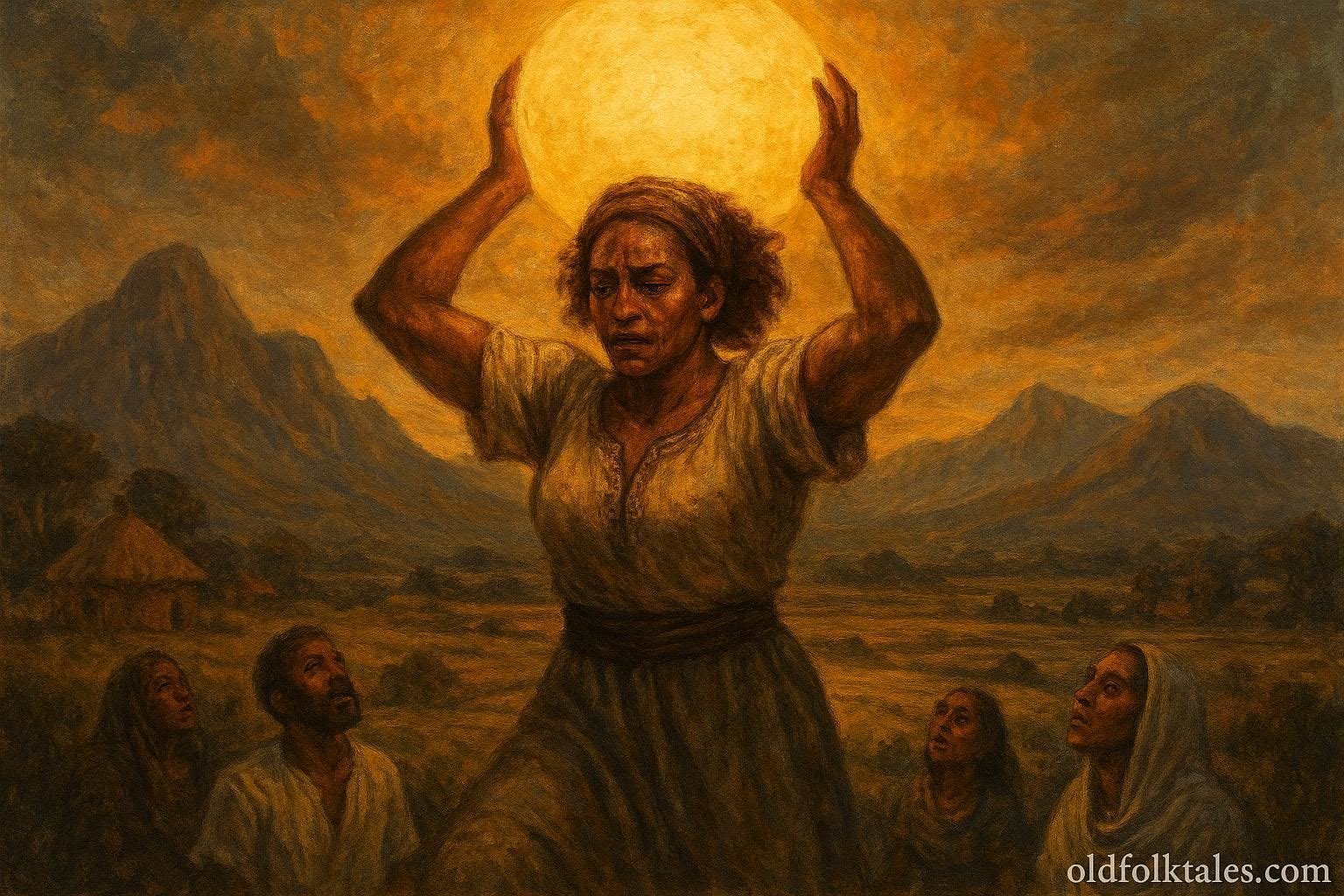
When she reached out, its warmth spread through her hands, then her arms, then her entire being. It was not a weight like stone or wood, it was something greater, something that pressed not only on the body, but on the spirit.
Still, she lifted it.
Slowly, steadily, she began to walk.
As she moved, the light spread across the land. Shadows withdrew. The sky brightened. The world awakened.
The sun rose.
All across the land, people stepped into their days, unaware of what had brought the light to them.
But the woman knew.
She carried it across the sky, step by step, hour by hour, until the day stretched full and the sun reached its highest point. From there, she guided it downward, toward the place where it would rest again.
By the time she returned, her body was heavy with exhaustion.
Yet the next day, she rose again.
And again.
Days turned into weeks. Weeks into months.
The rhythm of the world depended on her.
But her life did not change.
She still woke before dawn. She still worked in her home. She still tended to her responsibilities among her people. And in between, she carried the sun.
No one saw.
No one knew.
At first, her strength held.
She moved with determination, just as she always had. But over time, the weight began to deepen. The effort stretched her thinner with each passing day. The warmth of the sun, once steady, began to feel intense, pressing, relentless.
Her steps slowed.
Her breaths grew heavier.
Still, she did not speak of it.
One morning, as she reached for the sun, her hands trembled.
For a moment, she hesitated.
The world around her was quiet, waiting.
“I am tired,” she whispered.
The words did not change the task before her.
So she lifted it again.
But that day, something was different.
Her steps were uneven. The path across the sky felt longer than before. The sun did not rise as smoothly, nor did it travel as steadily.
Across the land, people began to notice.
“The light is dim today,” one said.
“The day feels shorter,” said another.
Still, no one understood why.
The woman continued, but the strain grew.
And then, one day, she did not rise at all.
The sun remained where it rested.
Morning did not come.
At first, the people thought the dawn was simply delayed. They waited, watching the horizon. But the light did not appear.
Darkness lingered.
Hours passed. Then more.
Confusion turned to unease.
“What has happened?” people asked.
The animals grew restless. The land cooled. The rhythm of life, once steady, began to falter.
Without the sun, there was no time. No movement. No balance.
The world had shifted.
The spirits watched.
Not with anger, but with understanding.
For they knew what had led to this moment.
The woman, exhausted beyond measure, lay still. Her body had carried more than it could sustain alone. The burden, though accepted, had never been shared.
And so, the spirits spoke again.
This time, not only to her, but to the people.
“What you depend on is not without cost,” the voice carried across the land. “What sustains you is carried by someone.”
The people listened, though they did not yet fully understand.
“The balance of the world is not held by one alone,” the voice continued. “It is a shared responsibility.”
Slowly, awareness began to grow.
The people looked at one another. They thought of their own lives, their own work, their own ways of depending on what they had never questioned.
And then, they acted.
They gathered together, not in confusion, but in purpose. They walked beyond the village, following the unseen path the woman had taken so many times before.
When they found her, they did not speak loudly. They did not demand.
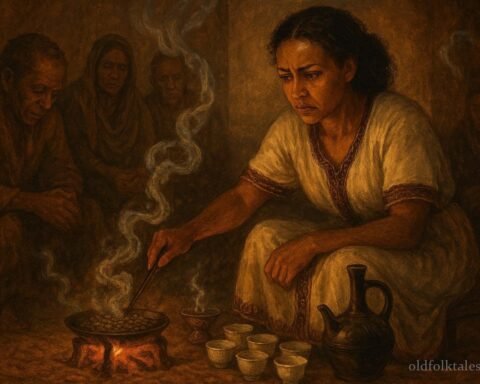
They stood in quiet understanding.
“You have carried what we did not see,” one elder said.
“We did not know,” another added.
The woman opened her eyes slowly.
“I could not carry it alone anymore,” she said.
“You should not have had to,” they replied.
The words settled deeply.
Together, they turned toward the place where the sun rested.
This time, the woman did not lift it alone.
Hands reached forward, many hands. The weight, once overwhelming, was shared. The warmth spread across them all, not as a burden, but as a responsibility held together.
They lifted.
And the light returned.
The sun rose once more, steady and full, carried not by one, but by many. The path across the sky became smoother, stronger, sustained by shared effort.
From that day forward, the duty of carrying the sun was no longer placed on a single person. It became a responsibility understood by all, not in the same way, not in the same form, but in the awareness that what sustains the world must be supported together.
The woman no longer carried the sun alone.
But her role was never forgotten.
For she had shown what it meant to endure, and what happens when the weight of the world rests on one without recognition.
And in the rhythm of each day, as the sun rose and set, the people remembered.
Looking for more? Explore the magic of East African folktales here
Moral Lesson
No single person should carry the burden of sustaining others alone. True balance comes from shared responsibility, awareness, and collective effort.
Knowledge Check
- Why was the woman chosen to carry the sun in this Eritrean folktale?
She was chosen because of her strength, discipline, and willingness to fulfill her responsibilities without complaint. - What happened when the woman became too tired to continue her duty?
She stopped carrying the sun, causing darkness to spread and disrupting the balance of the world. - What lesson did the community learn from this event?
They learned that important responsibilities should be shared and that unseen labor must be recognized. - What role do the spirits play in the story?
They observe human behavior and guide the balance of the world by assigning and revealing responsibilities. - How was balance restored in the world?
The community came together to help carry the sun, sharing the responsibility and restoring light. - What is the main theme of “The Woman Who Carried the Sun”?
The story emphasizes shared responsibility, sacrifice, and the importance of recognizing unseen burdens.
Source: African folktale, Eritrea. Appears in Eritrean mythological folklore documentation and oral heritage archives (1950s–1980s recordings).
Cultural Origin: Mixed Eritrean oral traditions with strong roots in rural cosmological storytelling, Eritrea