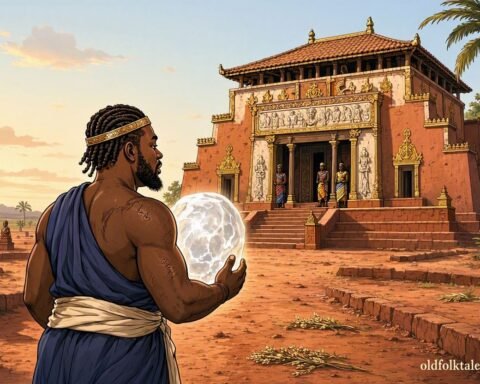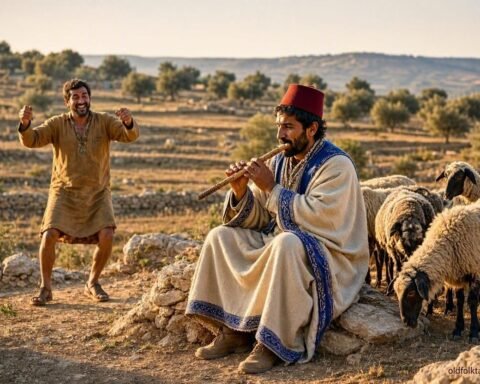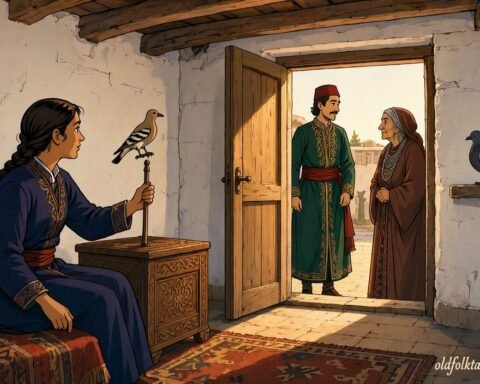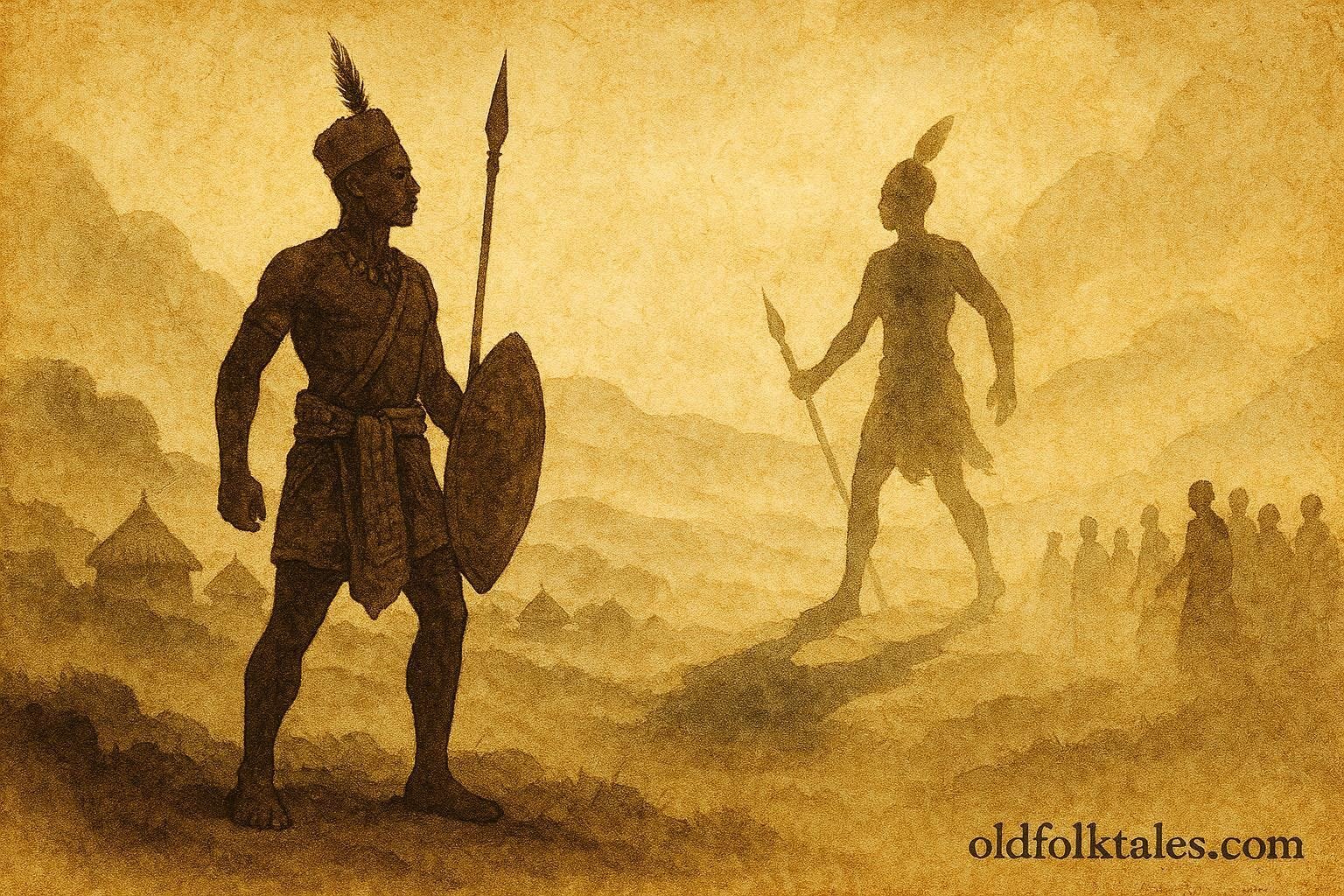
In the highlands of Madagascar, where mist clings to the hills and the land seems to breathe with memory, there once lived a warrior known for his bravery.
He was not the loudest among his people, nor the most boastful. His courage was quieter than that, steady, dependable, trusted. When danger approached, others looked to him not because he feared nothing, but because he did not turn away when fear arrived.
Want more? Read more West African folktales now
In his village, courage was not spoken of as a feeling alone, but as something deeply connected to the balance between body and spirit. A person was not complete without both, and rituals were performed to align them, to keep harmony between what is seen and what is unseen.
It was during one such sacred ritual that everything changed.
The ritual was meant to strengthen the bond between a warrior and his inner essence, to sharpen resolve and deepen spiritual balance. Fires were lit, chants were spoken, and the air itself felt charged with meaning. The warrior entered it with respect, as one does when stepping into something older than memory.
But something went wrong.
No one could later explain the exact moment it happened. There was no sound of breaking, no visible rupture in the world. Yet something fundamental shifted within him.
When the ritual ended, the warrior felt… incomplete.
At first, he could not name what was missing. His body was unchanged. His voice was the same. His strength remained. But something within him had loosened, as if a thread that once anchored him had been pulled away.
And then he saw it.
His shadow.
It no longer followed him.
Where it should have rested beside his steps, there was only absence. And beyond that absence, movement.
The shadow had separated from him.
It stood for a moment as though unsure of its own existence, and then, like something newly freed, it turned and slipped away from him into the world beyond.
The warrior called out, but the shadow did not return.
And with its departure came something even more unsettling.
Fear.
Not the kind that arrives in battle or danger, but something quieter, deeper, and far more disorienting. A fear that did not respond to reason. A fear that came from within.
Because with the shadow gone, so too had something essential within him shifted.
His courage was gone.
The village noticed it first.
The warrior no longer moved with his usual certainty. His presence, once steady, now carried hesitation. He still stood tall, but something about him felt fractured, as though part of him was always elsewhere.
He searched for answers, but none came.
What he did not yet understand was that in Malagasy spiritual belief, the shadow is not merely an absence of light, it is an extension of the self, tied to identity and balance between the physical and spiritual worlds. When separated, that balance is disturbed.
And something unbalanced does not remain still.
The shadow moved through the land.
Where it passed, fear followed.
Not loud fear. Not obvious fear.
But the kind that spreads quietly, through uncertainty, through doubt, through the feeling that something unseen is wrong.
Villages that had once been calm began to feel uneasy. People spoke in lower voices. Nights felt heavier. Even familiar paths seemed less certain under its passing.
The shadow did not speak.
It did not need to.
It simply existed outside its rightful place, and that alone was enough to unsettle those it touched.
Back in his village, the warrior felt the growing distance between himself and what had been taken from him. It was not only that he had lost his shadow, it was that he had lost the part of himself that faced fear without retreating.
He tried to recover it through strength. Through discipline. Through memory of who he had been.
But courage cannot be rebuilt through effort alone when it has been displaced.
It must be understood.
And so, the warrior began a journey, not outward at first, but inward.
He reflected on what courage had meant to him before. He realized something that had always been true, though he had never named it:
He had never been without fear.
He had only chosen not to let fear decide for him.
That realization changed everything.
Because if courage had never been something external, never something held in shadow or spirit, then it could not truly have been stolen.
It could only have been forgotten.
And somewhere in that forgetting, the shadow had become something separate, something untethered, something that wandered because it no longer knew where it belonged.
The warrior understood then that he could not simply chase the shadow as if it were an enemy.
He had to restore what had been broken within himself.
Across the villages where fear had spread, the shadow continued its path. It lingered in places where people hesitated too long, where uncertainty was allowed to grow unchecked. It was not destruction, it was distortion. A reflection of fear left unchallenged.
And the warrior followed.
Not in pursuit of battle, but in pursuit of understanding.
He moved through the same places his shadow had touched, witnessing the fear it had stirred. And with each step, something within him steadied.
Because he began to see clearly:
Fear grows when it is not faced.
But courage is not the absence of fear, it is movement despite it.
Eventually, the warrior found the shadow.
It stood alone, no longer simply moving, but lingering, as if it too was waiting for something it did not understand.
There was no confrontation.
No struggle.
Only recognition.
The warrior did not demand it return. He did not attempt to force it back into place.
Instead, he stood before it fully aware of what he had learned.
That courage had never left him.
It had only been obscured.
And in that clarity, something shifted.
The shadow no longer felt like something separate.
It was still there but no longer wandering.
Because what had been divided was understood again.
And what is understood can return to balance.
When the warrior returned to his village, he was not different in appearance.
But he was whole again.
Not because the shadow had been captured or defeated, but because he had understood what it truly was.
Courage had never been outside him.
It had always been the choice to face fear, even when fear was present.
And the shadow, once separated by imbalance, no longer needed to steal what had never truly been lost.
Don’t stop yet! See our complete East African folktales collection
Moral Lesson
Courage is not something external that can be taken or lost, it is an inner decision to face fear despite its presence. When fear grows unchecked, it distorts perception, but understanding restores balance between self and spirit.
Knowledge Check
- What caused the warrior to lose his courage in the folktale?
His shadow detached from him during a sacred ritual, disrupting his spiritual balance. - What does the shadow represent in the story?
The shadow represents a distorted part of the self tied to identity and fear when spiritual balance is broken. - How did the shadow affect other villages?
It spread fear and unease wherever it passed, disturbing emotional and social balance. - What does the story teach about courage?
It teaches that courage is not the absence of fear but the decision to act despite it. - How is Malagasy spiritual belief reflected in the tale?
It reflects beliefs in duality between body and spirit, where imbalance can separate parts of the self. - How was the warrior’s courage restored?
Through understanding that courage was internal, not external, restoring his spiritual and emotional balance.
Source: Inspired by shadow-spirit motifs in “Myths and Legends of Madagascar” by Razafindralambo (1983)
Cultural Origin: Malagasy folklore, Madagascar, rooted in spiritual duality beliefs linking body and spirit