In the vast, sun-washed plains of the Somali bush, where thorny acacia trees stretch their arms against the sky and the wind carries whispers through dry grass, stories travel just as far as the herds. Among these stories, one name is spoken with caution, Dhegdheer.
The elders say her name softly, especially when children are near. Not because the children should not hear it, but because they must understand it.
Fascinated by this tale? Discover more North African folktales
Dhegdheer was no ordinary woman. She was an ogress, a being feared not only for her hunger but for her cunning. She did not chase her victims openly like a lion on the hunt. No, Dhegdheer preferred something far more dangerous: she waited, watched, and deceived.
The Woman in the Bush
There was once a time when children from a small pastoral settlement wandered freely along the edges of the bush. They gathered firewood, chased goats, and followed winding paths without fear. Their laughter echoed across the plains, carried by the breeze.
One afternoon, as the sun leaned westward and shadows grew long, a group of children strayed farther than usual. The land began to change, trees grew denser, the paths less familiar, and the sounds of home faded into silence.
It was then they saw her.
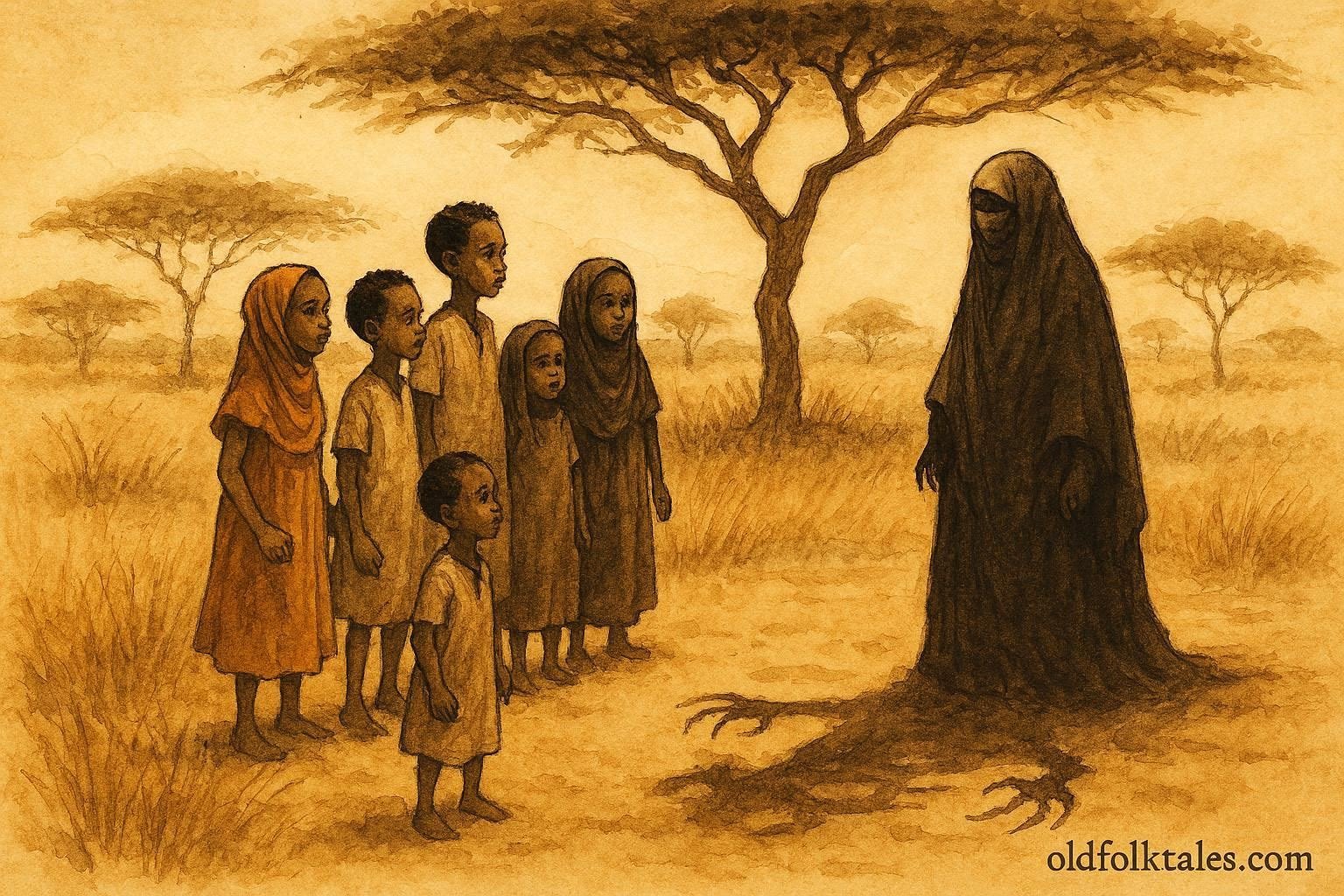
A woman stood beneath a wide acacia tree. She was wrapped in flowing cloth, her posture calm, her face gentle. She looked like any other traveler, perhaps someone’s mother, someone’s aunt.
“Children,” she called, her voice warm like evening milk. “You look tired. Come, rest. I have food and water.”
The children hesitated. They had been taught not to trust strangers. But this woman smiled kindly, and her words felt comforting. Hunger and curiosity began to outweigh caution.
All except one.
Among them was a child whose eyes missed little. While the others stepped forward, this child lingered behind, watching, not the woman’s face, but everything else.
Something Was Not Right
The child noticed first the silence. No birds sang in the branches above the woman. No insects buzzed nearby. Even the wind seemed to hold its breath.
Then came the shadow.
As the sun cast its golden light across the ground, every object stretched its shadow long and clear. The children’s shadows lay beside them. The trees cast their shapes across the earth.
But the woman’s shadow…
It did not match her form.
Where there should have been the outline of a human figure, there was something twisted, something unnatural, longer, sharper, almost clawed.
The child’s heart began to beat faster.
Still, the others moved closer. The woman gestured toward a shaded area, where a mat had been laid out. “Sit,” she said gently. “You must be hungry.”
Her movements were careful, almost too careful. When she reached for a calabash, she turned slightly away. When she smiled, her lips remained tight, as though hiding something.
The child stepped closer, not out of trust, but out of curiosity sharpened by unease.
“Mother,” the child said softly, “why does your shadow not follow you?”
For a moment, everything stopped.
The woman froze.
Her smile did not fade, but it changed, tightening, stretching in a way that no longer felt warm.
“You are tired, child,” she replied. “The sun plays tricks on your eyes.”
But the child did not look away.
“And why,” the child continued, “do the birds not sit near you? Why does the wind not touch your clothes?”
The other children began to shift, their comfort dissolving into confusion.
The woman straightened slowly.
The Truth Revealed
The air grew heavy.
Her gentle posture began to change. The softness in her eyes hardened. Her fingers, once graceful, curled slightly, revealing nails too long, too sharp.
“Children,” she said again, but now her voice carried a different weight. “You ask too many questions.”
The disguise, so carefully maintained, began to crack.
The child stepped back.
“Run,” the child whispered.
For a heartbeat, no one moved.
Then the woman’s shadow shifted again, no longer hiding its true form. It stretched into something monstrous, something that did not belong among humans.
And in that moment, the children understood.
They turned and ran.
The Chase Through the Bush
The bush erupted with movement, feet pounding against dry earth, branches snapping, breath catching in throats. The children ran as fast as they could, fear lending strength to their legs.
Behind them, Dhegdheer followed.
She no longer pretended.
Her movements were swift, unnatural. She did not run like a human, she seemed to glide, to close distances too quickly. Her presence pressed against them like a storm.
But fear can sharpen the mind.
The clever child did not run blindly. Instead, they guided the others toward familiar ground, toward open spaces where the bush thinned and the paths grew clearer.
“Stay together!” the child called.
They weaved through thorn trees, leapt over dry roots, and pushed forward without looking back.
Gradually, the sounds of home began to return, the distant bleating of goats, the faint voices of people, the comforting signs of life.
Dhegdheer slowed.
The closer they came to the settlement, the less she followed.
Creatures like her thrived in isolation, in shadows, in places where help could not reach.
At the edge of the village, she stopped completely.
Her figure lingered for a moment among the trees, her form half-hidden, her eyes watching.
Then, as silently as she had appeared, she disappeared back into the bush.
After the Escape
The children collapsed near the settlement, breathless and shaken. Their families rushed to them, alarmed by their condition.
When they spoke of the woman, of the shadow, of the chase, the elders nodded gravely.
“You have seen Dhegdheer,” they said.
They turned to the child who had spoken first, the one who had noticed.
“You have done well,” an elder said. “It is not strength that saved you, but awareness.”
From that day on, the story spread further.
Children were reminded not only to listen, but to observe. Not only to hear words, but to question what lies beneath them.
And the name Dhegdheer remained in the wind, carried as both warning and lesson.
Looking for more? Explore the magic of East African folktales here
Moral Lesson
True danger often hides behind kindness. Awareness, observation, and courage to question can protect you where innocence alone cannot.
Knowledge Check
- Who is Dhegdheer in Somali folktales?
Dhegdheer is a cannibal ogress known for disguising herself as a kind woman to deceive and capture unsuspecting victims. - What clue revealed Dhegdheer’s true identity?
A clever child noticed her unnatural shadow and strange behavior, which exposed her deception. - What is the main theme of the Dhegdheer story?
The story highlights awareness, wisdom over innocence, and the danger of trusting appearances. - Why is the setting important in this folktale?
The isolated Somali bush represents vulnerability, where danger can hide and help is far away. - How did the children escape Dhegdheer?
They escaped by running together and following the clever child toward familiar and safer territory. - What cultural lesson does this story teach in Somali communities?
It teaches children to be observant, cautious of strangers, and mindful that not all kindness is genuine.
Source: African folktale, Somalia. Adapted from Somali oral traditions recorded in collections of Somali folktales (1993).
Cultural Origin: Somali pastoral communities (Horn of Africa)