In the vast grasslands of South Sudan, where the earth stretches wide and the night sky feels closer than anywhere else, the moon is never seen as just a distant light.
To the Dinka people, who live closely with the rhythms of cattle, land, and seasons, the natural world is filled with meaning.
Want more? Read more West African folktales now
The moon, in particular, is believed to watch over travelers.
It does not speak loudly.
But it guides gently.
This is the story of a child who learned to listen to that quiet guidance.
A Day That Lasted Too Long
There was once a young child living in a peaceful Dinka homestead.
Like many children, curiosity often pulled them beyond familiar boundaries. The land around the village was open and inviting, filled with tall grasses, wandering paths, and the distant sounds of cattle.
One afternoon, while following a small group of animals and chasing the excitement of exploration, the child wandered farther than usual.
At first, everything felt familiar enough.
The sky was bright.
The wind was calm.
But time passed without notice.
And slowly, the child moved beyond the edges of known paths.
When Familiar Becomes Unknown
As the sun began to lower, the land changed.
Shadows stretched across the grasslands. Landmarks that were once clear became harder to recognize. The familiar rhythm of home faded into distance.
The child stopped.
Looked around.
Nothing felt certain anymore.
The path back was no longer visible.
And then, the last light of the sun disappeared.
Night arrived.
The Arrival of the Moon
At first, darkness felt heavy.
The child stood still, unsure of what to do.
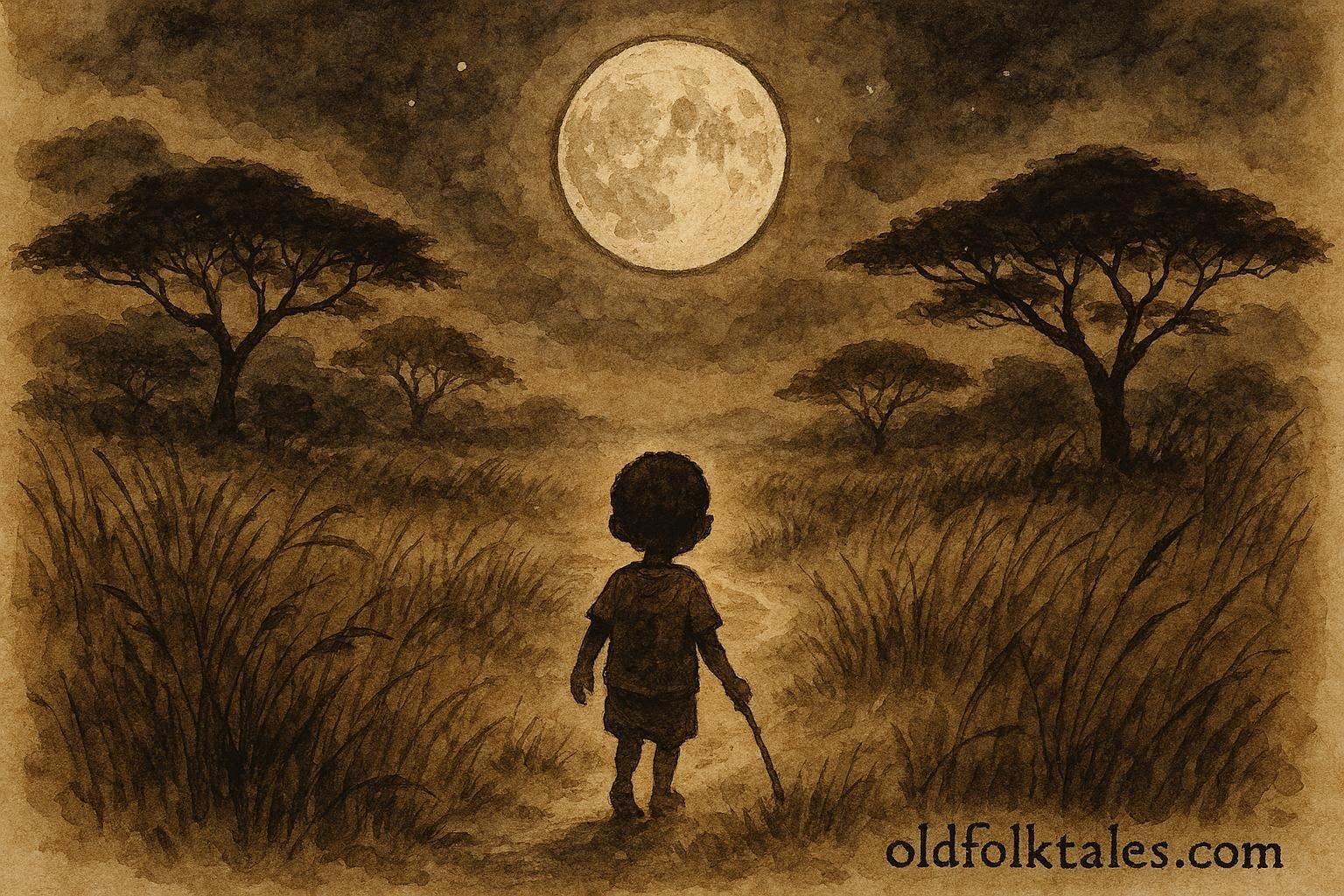
Then, above the vast sky, something appeared.
The moon.
Large, calm, and steady.
It rose slowly, casting soft light across the land.
To the child, it did not feel distant.
It felt present.
Almost aware.
In Dinka understanding, the moon is not only light in the sky, it is a guiding presence, connected to the movement of life below.
The child looked up.
And waited.
The First Signs of Guidance
As the child began to walk cautiously, unsure of direction, the moonlight shifted across the landscape.
It illuminated paths that had been hidden in darkness.
It revealed the outline of trees, the bend of familiar terrain, the direction of wind moving through grass.
The child paused.
It felt as if the world was becoming visible again, not all at once, but step by step.
The moon did not speak.
But its presence felt intentional.
Listening to the Sky
The child remembered something the elders had often said:
“Do not rush where you cannot see. Watch what the night reveals.”
So, the child slowed down.
Instead of running in fear, they began to observe.
When the moonlight brightened one path more than another, the child followed it.
When shadows grew uneven, the child stopped and waited.
It was not force that guided the way.
It was attention.
The Quiet Protection of Nature
As the child moved through the night, the land itself seemed less frightening.
The wind no longer felt unknown.
The rustling grass no longer sounded threatening.
Even the silence became easier to carry.
The moon remained steady above, as if accompanying every step.
In that quiet journey, the child began to understand something deeper:
Nature does not always announce its help.
Sometimes, it simply becomes visible when needed.
A Return to Familiar Ground
After what felt like a long journey through shadow and light, the child began to recognize familiar shapes in the distance.
A familiar tree.
A known path.
The outline of the homestead slowly emerged from the darkness.
The child’s steps quickened, but not in panic, this time, in relief.
Soon, voices could be heard.
The glow of firelight appeared.
Home was near.
The Final Stretch
As the child reached the edge of the homestead, the moon remained overhead.
Still bright.
Still steady.
It had not moved closer.
But it had made the path visible.
The child stepped into the safety of the village, where elders and family waited, unaware of how far the journey had gone.
Only the sky had witnessed the entire return.
After the Journey
That night, the child sat quietly near the fire.
No scolding was needed.
The experience itself had spoken clearly.
The elders, when told what had happened, nodded slowly.
They did not speak of punishment.
They spoke of understanding.
“You were guided,” they said, “because you did not resist being guided.”
The child listened.
And remembered.
Don’t stop yet! See our complete East African folktales collection
Moral Lesson
Guidance is always present in the natural and spiritual world, but it must be observed and respected. Listening, patience, and awareness can prevent harm and lead one safely home.
Knowledge Check
1. What is “The Moon and the Lost Child” about?
It is a Dinka folktale about a child who gets lost at night and is guided home by the moon.
2. What does the moon represent in the story?
The moon represents spiritual guidance, protection, and natural wisdom in Dinka cosmology.
3. Why did the child become lost?
The child wandered too far from home during exploration and lost track of time.
4. How did the child find the way back?
The child followed moonlight and natural signs that revealed safe paths home.
5. What theme is central to the folktale?
The story emphasizes listening, obedience, and respect for natural guidance.
6. What lesson does this African folktale teach?
It teaches that nature provides direction and wisdom, and awareness can lead to safety.
Source: African folktale, South Sudan.
Adapted from Dinka cosmological oral traditions preserved through oral transmission and later recorded in Sudanese folklore studies (late 20th century, c. 1980s).
Cultural Origin: Dinka people, South Sudan