In the lush green landscapes of Central and Eastern Uganda, where fertile soil supports wide banana plantations and village life moves with the rhythm of farming seasons, stories have long been used to explain human behavior through animals.
Among the Baganda and Basoga communities, the hare often appears as a clever figure, quick-thinking, sharp-minded, and always alert.
Want more? Read more West African folktales now
But intelligence in these stories is not always praised.
When it is used without morality, it leads to downfall.
This is the story of a greedy hare and a banana garden that taught a village about justice.
A Hidden Garden in the Forest Edge
There was once a large banana plantation hidden near the edge of a village.
The garden was well cared for, and its owner depended on it for livelihood.
The banana trees grew tall and heavy with fruit, attracting attention from both people and animals in the surrounding area.
Because of this, the owner and villagers often guarded it carefully.
But no matter how much they tried, something strange began to happen.
The First Theft
One morning, the owner noticed that several bunches of bananas were missing.
At first, he thought it was a mistake.
Perhaps animals had wandered in.
Perhaps wind had caused damage.
But the pattern continued.
Night after night, bananas disappeared.
No footprints.
No clear signs.
Only loss.
The Clever Thief Revealed
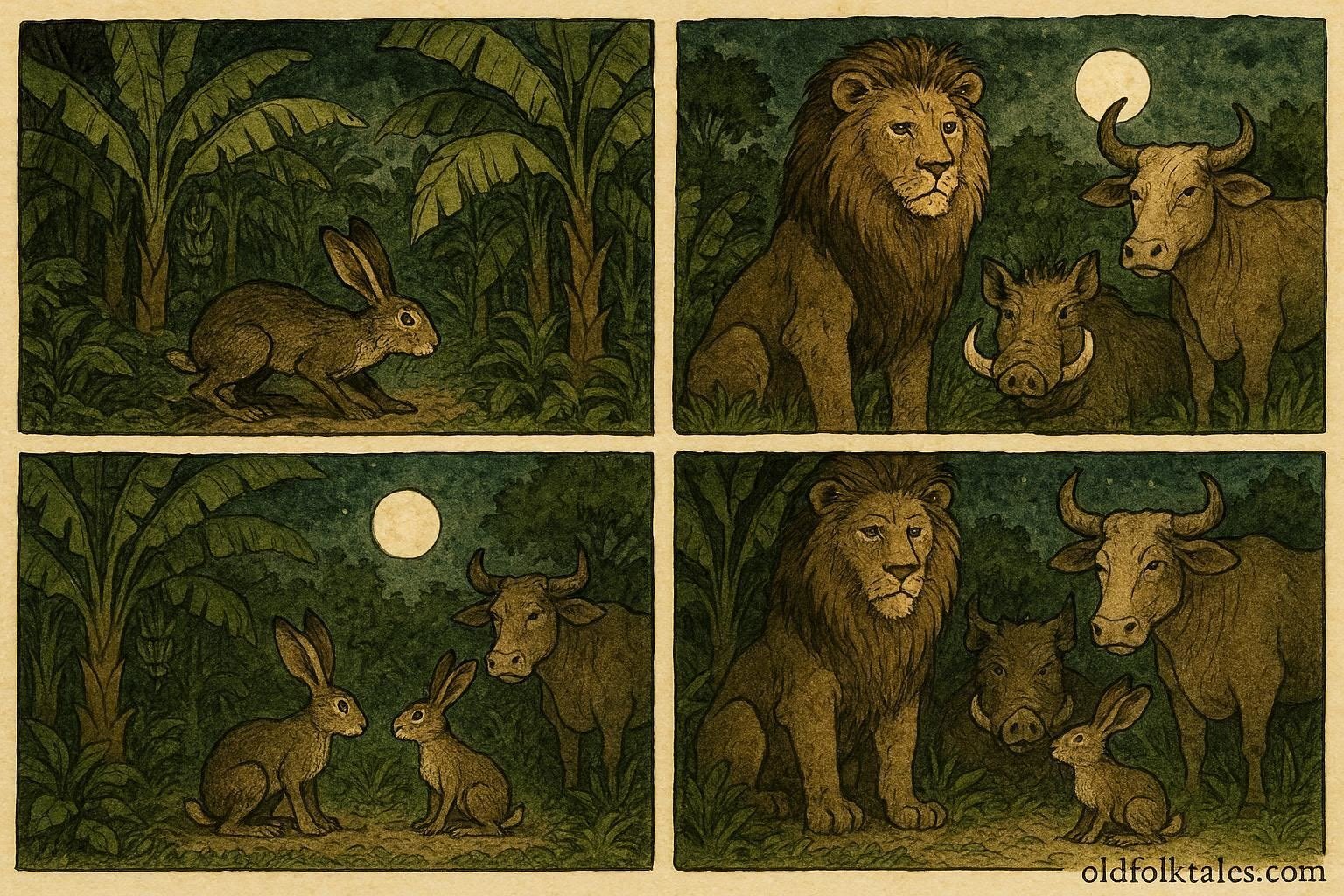
Deep in the forest nearby lived a hare.
Small.
Fast.
And known for his intelligence.
He had discovered the banana garden by chance one evening.
And once he tasted the fruit, he could not stop.
Instead of taking only what he needed, he began returning every night.
Carefully.
Quietly.
Always avoiding detection.
But the hare knew something important:
He could not continue alone forever.
So, he decided to use others.
The Hare’s Trick
One evening, the hare approached a group of animals near the forest edge.
“Have you heard?” he asked.
“There are strange movements near the banana garden at night. Something dangerous may be stealing from it.”
The animals became alarmed.
“What should we do?” they asked.
The hare sighed.
“We must guard it,” he said wisely. “Take turns watching through the night.”
The animals agreed.
They trusted him.
After all, he seemed concerned.
But the hare had no intention of stopping.
A Perfect Plan, Or So It Seemed
As the animals began guarding the garden at night, the hare adjusted his strategy.
He observed their shifts.
He noted their sleeping patterns.
And when he saw gaps in attention, he continued his secret visits.
The guards were present.
But not always alert.
And so, the bananas kept disappearing.
The hare believed he had outsmarted everyone.
But greed has a way of creating blind spots.
The First Suspicion
One of the animals began noticing something odd.
Even with guards present, the same type of damage continued.
And yet, no stranger was ever caught.
“How is this possible?” they asked.
The guards began to question one another.
But no one suspected the hare.
He was, after all, the one who suggested the guarding system in the first place.
And that made him appear trustworthy.
Carelessness Begins
As the hare grew more confident, he became less careful.
He began visiting the garden at riskier times.
He ate more than he could carry.
He no longer checked his surroundings thoroughly.
And in doing so, he left small signs behind.
Fallen banana peels.
Disturbed soil.
Broken stems.
Signs that someone sharp-eyed could eventually notice.
The Truth Emerges
One night, the animals decided to tighten their watch.
They changed their guarding positions.
They remained quieter and more alert.
And this time, they noticed movement.
Not from outsiders.
But from within.
The hare had returned again.
But this time, he was seen.
The Exposure
The animals confronted him.
At first, the hare tried to deny everything.
He spoke quickly.
He attempted to confuse the situation.
But the evidence was clear.
Too many inconsistencies.
Too many signs pointing in one direction.
And finally, his own overconfidence betrayed him.
The truth could no longer be hidden.
The Consequence of Greed
The animals were disappointed.
Not only because the bananas had been stolen.
But because trust had been broken.
The hare had not only eaten the fruit.
He had manipulated the community meant to protect it.
And so, consequences followed.
He was no longer trusted to be near the garden.
And the system he had created to protect his theft collapsed entirely.
Restoring Balance
With the hare exposed, the animals returned to honest cooperation.
They continued guarding the garden, but now with awareness and unity.
The banana plantation, once disrupted, gradually returned to stability.
And the owner finally understood what had been happening.
Not through force.
But through truth revealed by observation.
The Hare’s Lesson
The hare did not disappear.
He remained in the forest.
But his reputation changed.
Animals became more cautious around him.
And though he was still clever, his cleverness was no longer admired in the same way.
Because intelligence without responsibility loses its value.
And deception always leaves traces.
Looking for more? Explore the magic of East African folktales here
Moral Lesson
Cleverness used for selfish gain leads to exposure and loss of trust. True intelligence is guided by responsibility and respect for community.
Knowledge Check
- What is “The Greedy Hare and the Banana Garden” about?
It is an East African folktale about a hare who steals bananas and is eventually exposed for his greed. - Where does the story come from?
From Baganda and Basoga oral storytelling traditions in Uganda. - How did the hare trick the other animals?
He convinced them to guard the garden while he secretly continued stealing from it. - What caused the hare to be discovered?
His greed led to carelessness, leaving evidence of his theft behind. - What theme does the story highlight?
It emphasizes greed versus morality and intelligence versus responsibility. - What lesson does this African folktale teach?
It teaches that selfishness destroys trust and that intelligence must be guided by ethics.
Source: African folktale, Uganda.
Adapted from Baganda and Basoga oral storytelling traditions recorded in East African folklore anthologies and colonial-era ethnographic field notes (1950s–1970s).
Cultural Origin: Central and Eastern Uganda (Luganda oral traditions)