In the fertile heart of central Uganda, within the traditions of the Baganda people, stories about children and the natural world often carry deeper meanings than they first appear.
They are not just tales of curiosity.
Fascinated by this tale? Discover more North African folktales
They are lessons about responsibility.
About restraint.
And about the delicate boundary between human life and the world of animals.
This is the story of a boy who gained the ability to understand animal language, and the price that came with it.
A Curious Life in the Village
There was once a young boy who lived in a village surrounded by forests, wetlands, and open fields.
He was curious by nature.
Always watching.
Always listening.
While other children played, he often wandered near the edges of the forest, fascinated by the sounds of birds, insects, and distant animal calls.
He often wondered what they meant.
What stories they carried.
What warnings they might be giving.
But to him, they were only sounds, until one day everything changed.
The Wounded Bird
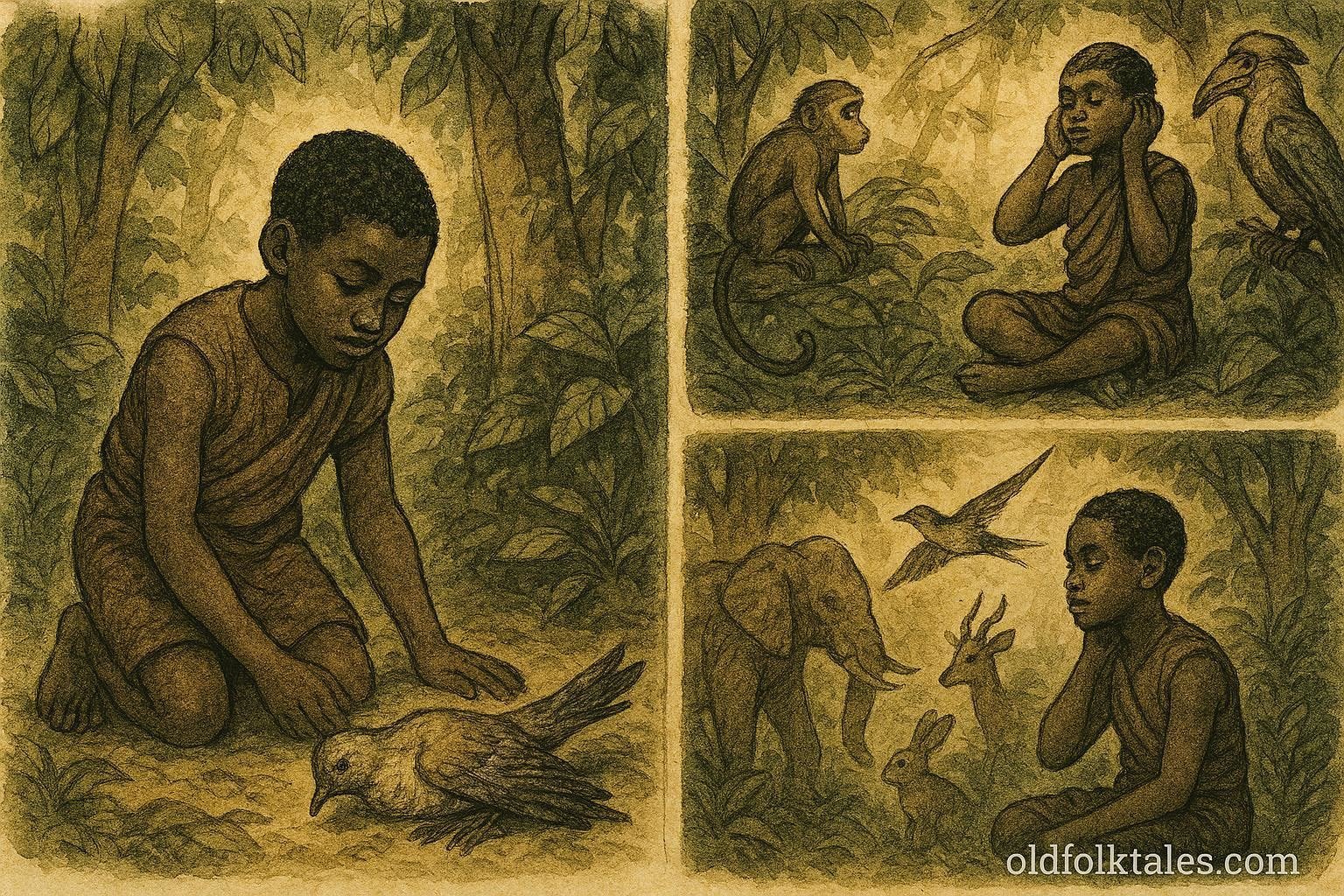
One morning, while walking near a clearing, the boy found a small bird lying on the ground.
Its wing was injured.
It could not fly.
Most people would have passed it by.
But the boy stopped.
He gently lifted the bird and cared for it, bringing it water and sheltering it from the sun.
He did not expect anything in return.
He simply could not ignore its suffering.
Days passed.
And slowly, the bird began to heal.
A Gift Unseen
On the day the bird finally regained strength, it did not fly away immediately.
Instead, it looked at the boy carefully.
And then, something unusual happened.
The boy began to understand its sounds.
Not just patterns.
But meaning.
The chirping was no longer noise.
It became language.
The rustling of leaves nearby carried intention.
The calls of distant animals formed sentences in his mind.
The forest had begun to speak to him, and he could understand it.
The Secret of the Forest
At first, the boy was overwhelmed.
He heard warnings from birds about approaching danger.
He learned where animals gathered water during drought.
He understood when predators moved near the village.
Slowly, he began to realize that the forest held constant communication, a network of life that humans rarely noticed.
And now, he was part of it.
But alongside the gift came a rule.
One the bird made very clear before it left.
The Sacred Warning
“You may hear us,” the bird said.
“But you must never tell how you came to understand us.”
“If you reveal the source of your gift, you will lose it forever.”
The boy listened carefully.
He nodded.
And the bird flew away into the sky.
From that moment on, the forest spoke to him clearly.
But the secret remained heavy in his heart.
The Boy Warns His Village
One day, the animals began speaking of danger.
Large movements in the forest.
Strange silence in certain areas.
Signs that something harmful was approaching the village.
The boy listened.
And he became afraid.
Without revealing how he knew, he warned the elders.
At first, they were skeptical.
But when the danger eventually appeared, just as he had described, they began to trust him.
A Growing Responsibility
As time passed, the boy continued to help his village.
He warned them of floods before rivers overflowed.
He alerted them when dangerous animals came too close.
He helped farmers understand when to plant and when to wait.
The village began to depend on his guidance.
But with each success, the weight of secrecy grew heavier.
Because no one knew how he knew.
And he could never tell them.
The Temptation to Speak
One evening, during a village gathering, people began praising him openly.
They called him wise.
Blessed.
Even chosen.
The boy felt proud, but also uncomfortable.
Someone asked him directly:
“How do you know these things?”
The question lingered in the air.
For a moment, he almost answered.
But he remembered the bird’s warning.
So, he remained silent.
The Moment of Risk
Later, a disagreement arose in the village about whether to move livestock to another area.
The boy knew the answer from what he had heard in the forest.
But the elders demanded explanation.
“How do you know this?” they insisted again.
The pressure grew.
People wanted a reason.
A source.
Something they could understand.
The boy stood at a crossroads.
To explain would mean losing his gift.
To stay silent might cost the village safety.
Choosing Silence
After a long pause, the boy spoke carefully.
“I cannot explain,” he said.
“But I ask you to trust what I have learned.”
Some were frustrated.
Others were uncertain.
But eventually, they followed his guidance.
And later, they discovered he was right again.
Still, the question of his knowledge remained unanswered.
The Burden of the Gift
As the boy grew older, his role became more important.
But so did the burden of secrecy.
He lived between two worlds.
One where he understood everything spoken by animals.
And another where he could not explain how.
He learned that knowledge without explanation can be powerful, but also isolating.
The Rule Remains Unbroken
The boy never revealed the origin of his ability.
Not even once.
He remembered the bird’s warning every time he was tempted to speak.
And because he kept the secret, the forest continued to speak to him.
The gift remained.
But only because he respected its boundary.
Looking for more? Explore the magic of East African folktales here
Moral Lesson
True wisdom requires responsibility and restraint. Sacred knowledge is sustained not only by receiving it, but by respecting its conditions and limitations.
Knowledge Check
- What is “The Boy Who Understood Animal Language” about?
It is a Baganda folktale about a boy who gains the ability to understand animals after saving a wounded bird. - Where does the story come from?
From central Uganda, within Baganda oral storytelling traditions. - How did the boy gain his ability?
He saved a wounded bird, which later gave him the ability to understand animal language. - What rule was attached to his gift?
He must never reveal how he gained the ability, or he would lose it. - What theme does the story emphasize?
Responsibility, sacred knowledge, and trust between humans and nature. - What lesson does this African folktale teach?
It teaches that wisdom comes with responsibility, and sacred knowledge must be respected to be preserved.
Source: African folktale, Uganda.
Adapted from Baganda oral tradition recorded in East African folktale anthologies and anthropological fieldwork on children’s initiation stories (1940s–1970s).
Cultural Origin: Baganda oral tradition (Central Uganda)