In the misty highlands of southwestern Uganda, where steep hills rise into clouds and valleys disappear into fog, the Bafumbira and Bakiga communities have long told stories about places that exist between the physical and the spiritual world.
In these traditions, mountains are not just landforms.
Want more? Read more West African folktales now
They are living thresholds.
Gateways.
And sometimes, homes of unseen spirits who test the character of those who seek them.
This is the story of an invisible path that appears only to those whose hearts are free from greed.
The Discovery of the Sacred Mountain
Long ago, villagers began speaking of a distant mountain hidden deep within the highlands.
It was said that spirits lived there, beings who could grant blessings, healing, and guidance to those who reached them.
But the mountain was not easy to find.
In fact, some believed it could not be found at all.
Only reached.
Only revealed.
And only under certain conditions.
Still, curiosity spread through the villages.
And eventually, a group of villagers decided to search for it.
The Beginning of the Journey
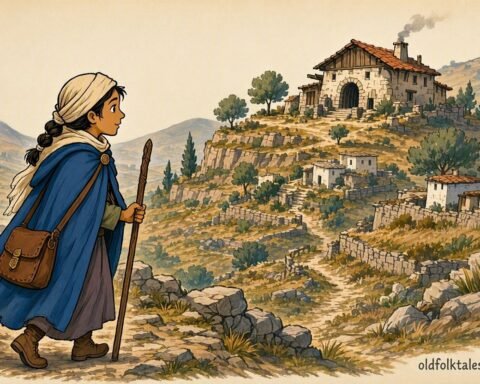
The villagers set out together early in the morning.
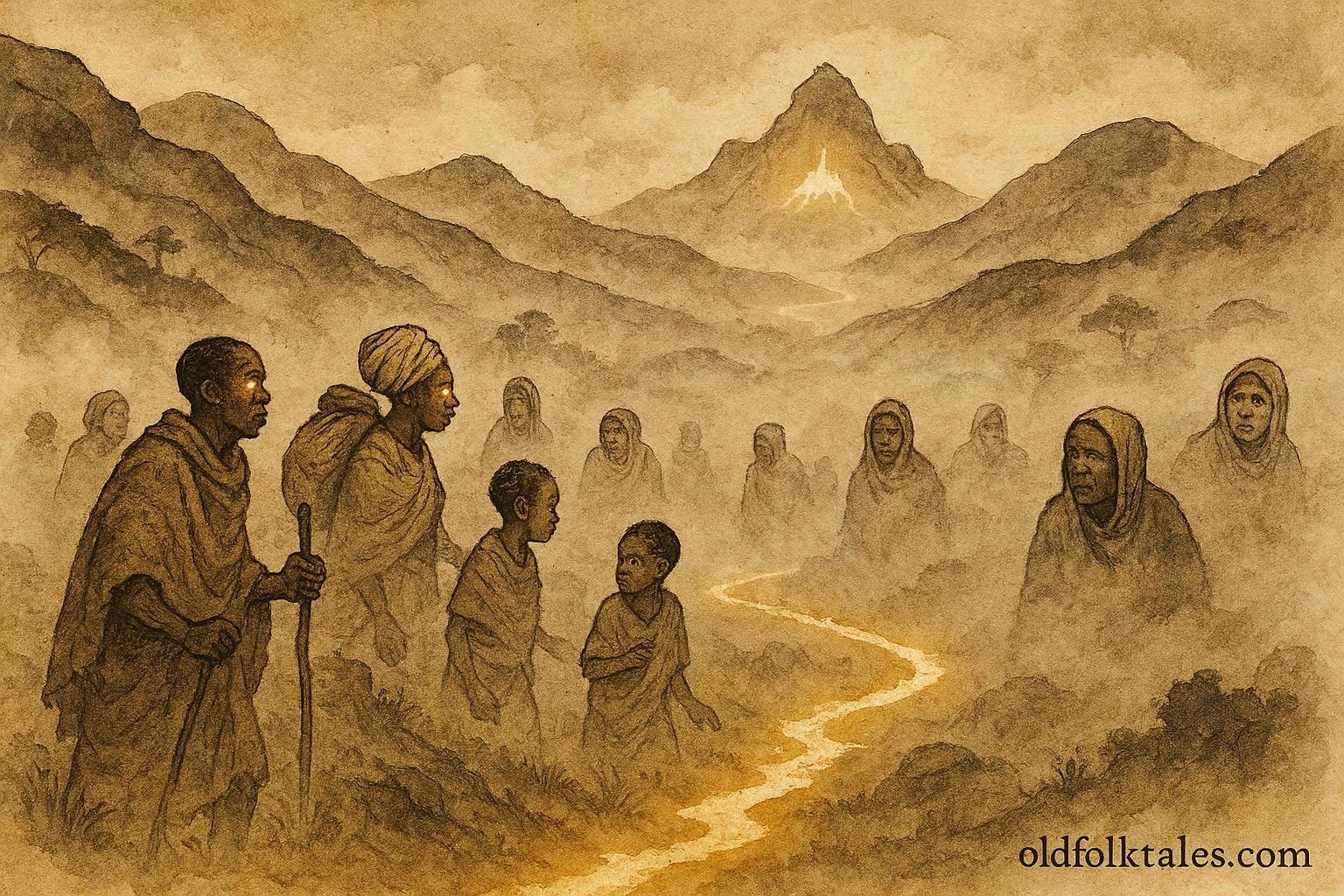
They walked through thick forests, climbed rocky slopes, and crossed mist-covered valleys.
At first, the path was visible and familiar.
But as they went deeper into the highlands, the trail became unclear.
Some insisted they could still see it.
Others disagreed.
And slowly, confusion began to divide them.
The journey that began as unity started to reflect something deeper within each traveler.
The Vanishing Path
By midday, the visible path disappeared completely.
There was only wilderness ahead.
No clear direction.
No markings.
No certainty.
Some villagers became anxious.
Others became frustrated.
A few began to argue about where to go next.
And then something unusual happened.
Some claimed they could still see a faint path ahead, while others saw nothing at all.
The First Separation
As the group continued, they gradually split.
Those who were calm, patient, and humble seemed to follow a faint, steady direction that others could not perceive.
But those who were impatient or focused only on reward began to lose their way.
They insisted the path must be somewhere else.
They searched in circles.
They argued more loudly.
And in doing so, they became more confused.
The Invisible Test
It became clear that the journey was not simply about reaching the mountain.
It was also about how each person walked it.
The forest seemed to respond differently to each traveler.
For some, the way forward felt clear and natural.
For others, the same landscape felt shifting and uncertain.
And slowly, a truth began to emerge among those still moving forward:
The path was not visible to everyone.
It revealed itself only to certain hearts.
The Role of Humility
Those who continued to see the path shared something in common.
They were not rushing.
They were not demanding answers.
They were not focused on what they would gain at the end.
Instead, they walked quietly.
They listened.
They observed the land carefully.
And they accepted uncertainty without fear.
Because of this, the invisible path remained visible to them.
The Lost Among the Greedy
Meanwhile, those who were driven by impatience and desire found themselves increasingly lost.
They began to see contradictions in the terrain.
One direction seemed right, then suddenly wrong.
Landmarks disappeared.
Familiar signs no longer made sense.
The more they insisted on control, the more the forest seemed to resist them.
Eventually, many gave up the journey altogether, unable to understand how others continued while they could not.
Arrival at the Spirit Mountain
Those who remained on the invisible path eventually reached a great mountain.
It was unlike any other place.
Silent.
Still.
Yet filled with a presence that could not be described easily.
At its base, they felt a deep calm settle over them.
And they understood that they had arrived not through force, but through alignment with something greater than themselves.
The Spirits of the Mountain
At the mountain, they were said to encounter unseen spirits.
These beings did not appear in physical form.
Instead, they were felt in the wind, the silence, and the surrounding air.
The spirits did not speak loudly.
They responded gently to those who had arrived with humility.
Blessings were not given as rewards for effort alone.
But as reflections of inner character.
The Blessings Given
The villagers who reached the mountain were said to receive different forms of blessings.
Some returned with healing wisdom.
Others with guidance for their communities.
Some gained clarity in decision-making.
But all of them returned changed.
Not because the mountain altered them directly.
But because the journey had revealed what already existed within them.
The Return and the Lesson
When the travelers returned to their villages, they shared what they had experienced.
They explained that the path to the spirit mountain was not fixed.
It could not be forced.
It appeared only to those who approached it with humility and truth.
Those who tried to pursue it with greed or impatience had lost it entirely.
And so, the story became a lesson passed through generations.
What the Elders Teach
Among the Bafumbira and Bakiga elders, this tale is often told to remind people that not all journeys are physical.
Some are spiritual.
Some are moral.
And some are both.
They say that the invisible path still exists today, not on the land, but within people.
And it is only visible to those who walk through life with honesty and humility.
Continue your journey: Read more East African folktales
Moral Lesson
True guidance is not forced or demanded, it is revealed through humility, patience, and inner clarity. Greed and impatience cloud perception, while truth opens the way forward.
Knowledge Check
- What is “The Invisible Path to the Spirit Mountain” about?
It is a Bafumbira and Bakiga folktale about a hidden spiritual mountain that can only be reached through an invisible path seen by the humble. - Where does the story come from?
From southwestern Uganda, within Bafumbira and Bakiga highland oral traditions. - Who can see the invisible path?
Only those who are honest, humble, and patient can see it clearly. - What happens to greedy travelers?
They become confused and lose their way, unable to perceive the path. - What theme does the story emphasize?
Humility, spiritual testing, and moral clarity. - What lesson does this African folktale teach?
It teaches that inner character determines one’s ability to find truth and guidance in life.
Source: African folktale, Uganda.
Adapted from Bafumbira and Bakiga oral spiritual narratives documented in Ugandan highland folklore studies (1960s–1990s).
Cultural Origin: Southwestern Uganda (Bafumbira and Bakiga traditions)