In the savannah landscapes of western Uganda, where grasslands stretch wide and wildlife moves in ancient patterns, animals in traditional storytelling are more than creatures of the wild.
They are reflections of society.
Click here to explore more Central African folktales
Power.
Justice.
And the consequences of leadership.
Among the Bunyoro and Toro oral traditions, the lion is often seen as the unquestioned ruler of the animal kingdom, strong, dominant, and feared.
But strength alone does not always guarantee fairness.
This is the story of a young antelope who dared to challenge that order.
A Kingdom Under the Lion
In the great forest and savannah, the lion ruled as king.
His word was law.
His strength ensured obedience.
And his hunting rules determined how all animals lived.
But over time, the smaller animals began to feel the weight of his authority.
Hunting was no longer balanced.
The weak suffered most.
And fairness slowly disappeared beneath fear.
The Growing Discontent
Among the animals, a young antelope began to notice the imbalance.
He was not the strongest.
Nor the loudest.
But he was observant.
He saw how decisions were made without consultation.
He saw how outcomes always favored the powerful.
And he began to question why leadership should depend only on strength.
Others whispered similar thoughts, but none spoke openly.
Except him.
The Bold Challenge
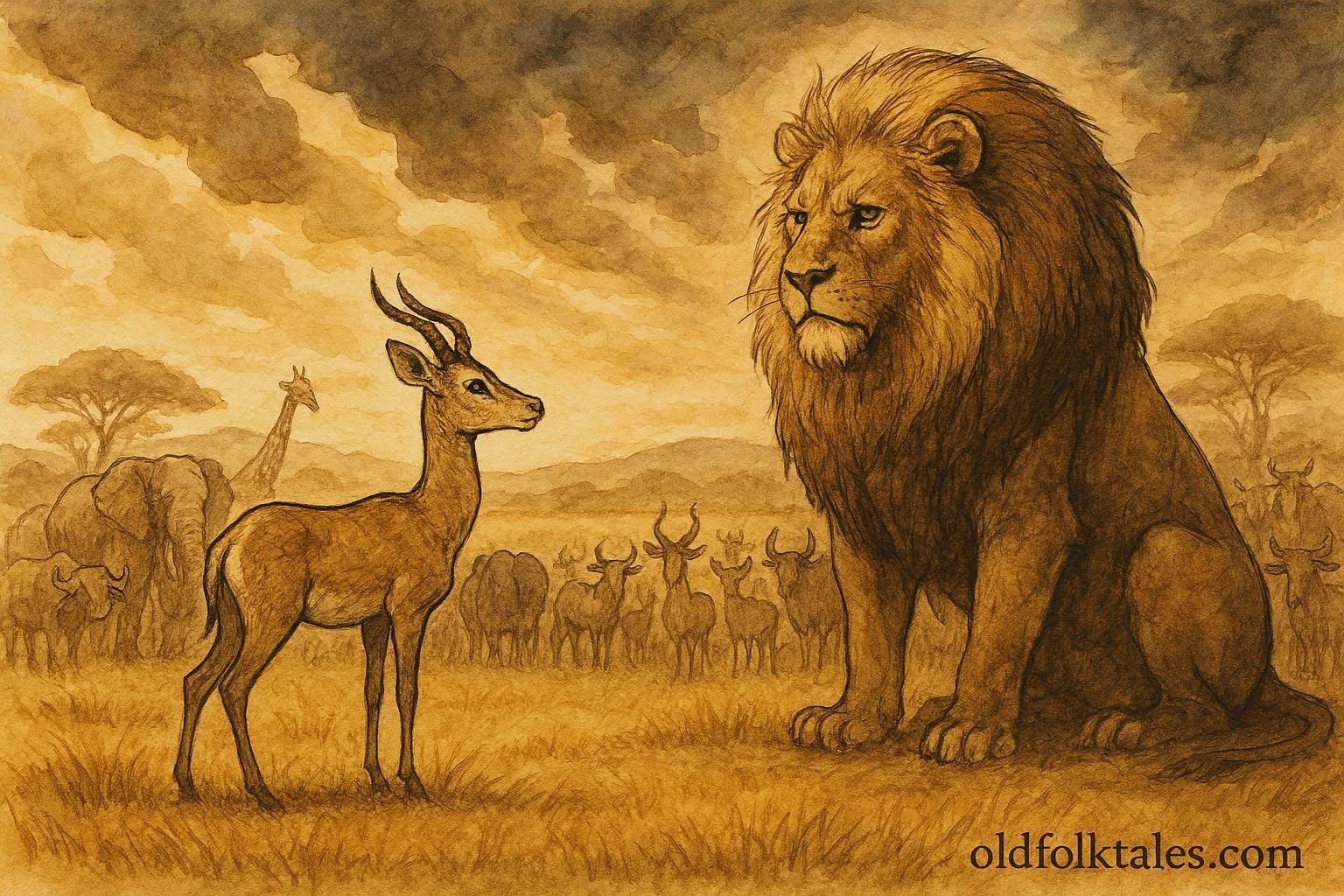
One day, the antelope stepped forward during a gathering of animals.
The lion king watched him closely.
The air grew tense.
“I challenge the way justice is decided,” the antelope said calmly.
A murmur spread through the crowd.
The lion narrowed his eyes.
“And what do you propose?” he asked.
The antelope replied:
“Let us decide through wisdom, not strength.”
Silence followed.
Such a challenge had never been made openly before.
The Lion’s Condition
The lion, amused and curious, agreed, but with a condition.
“If you lose,” he said, “you will accept that strength is the only law.”
The antelope nodded.
“And if I win,” he replied, “then justice must be decided by wisdom, not force.”
The agreement was made.
The forest gathered to witness the contest.
The Contest of Wisdom
The lion prepared to prove his dominance through strength.
But the antelope had chosen a different path.
He asked questions instead of fighting.
He presented puzzles instead of resistance.
He observed patterns instead of reacting impulsively.
The lion, powerful but less patient, struggled with the unfamiliar challenge.
Each question revealed more than it concealed.
And each answer required reflection, not force.
The Turning Point
The final challenge was simple.
The antelope asked:
“What is stronger than power, but cannot be seen or held?”
The lion paused.
He considered strength.
He considered fear.
He considered dominance.
But none of these fit.
The forest watched in silence.
The answer was not something that could be taken by force.
It required understanding.
The Lion’s Defeat in Wisdom
After a long silence, the lion admitted:
“I do not know.”
The antelope answered gently:
“Wisdom.”
A quiet realization spread through the gathering.
The contest had not been about defeating the lion.
It had been about redefining what leadership meant.
And in that moment, strength alone was no longer enough to justify rule.
A New Beginning for the Forest
The lion did not reject the outcome.
Instead, he acknowledged it.
From that day, decisions in the forest were no longer made by force alone.
Wisdom councils were formed.
Different animals were allowed to speak.
And leadership began to shift from dominance to balance.
The forest changed, not through rebellion, but through understanding.
The Antelope’s Role
The antelope did not become king.
He did not seek power.
Instead, he became a voice of counsel.
A reminder that courage is not only physical.
But intellectual.
And that change often begins with those willing to question what others accept.
Legacy of the Challenge
Among the animals, the story of the antelope spread widely.
It was told to young ones as a lesson.
That fear does not define leadership.
And that wisdom, even in the smallest voice, can reshape the strongest systems.
The lion remained king.
But his rule was no longer absolute.
And that made all the difference.
Don’t stop yet! See our complete East African folktales collection
Moral Lesson
True leadership is not based on strength alone, but on wisdom, fairness, and the ability to listen. Courage and intelligence can reshape unjust systems.
Knowledge Check
- What is “The Antelope Who Challenged the Lion King” about?
It is a Bunyoro and Toro folktale about an antelope who challenges a lion king using wisdom instead of strength. - Where does the story come from?
From Western Uganda, specifically Bunyoro and Toro oral storytelling traditions. - How did the antelope defeat the lion?
By using intelligence and logical thinking rather than physical strength. - What change happened after the contest?
Leadership decisions began to include wisdom and fairness, not just strength. - What theme is central to the story?
Justice, courage, and wisdom as a form of power. - What lesson does this African folktale teach?
It teaches that intelligence and fairness are stronger foundations for leadership than force.
Source: African folktale, Uganda.
Adapted from Bunyoro and Toro oral storytelling traditions recorded in East African animal fable collections and colonial-era narrative studies (1950s–1970s).
Cultural Origin: Western Uganda (Bunyoro and Toro traditions)