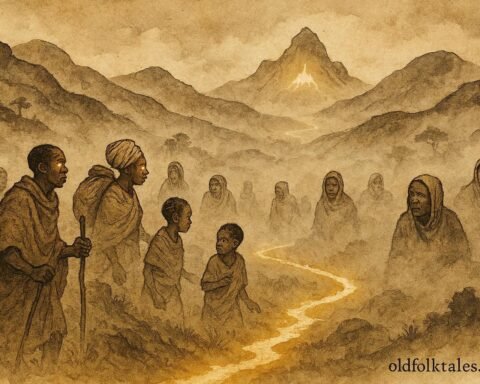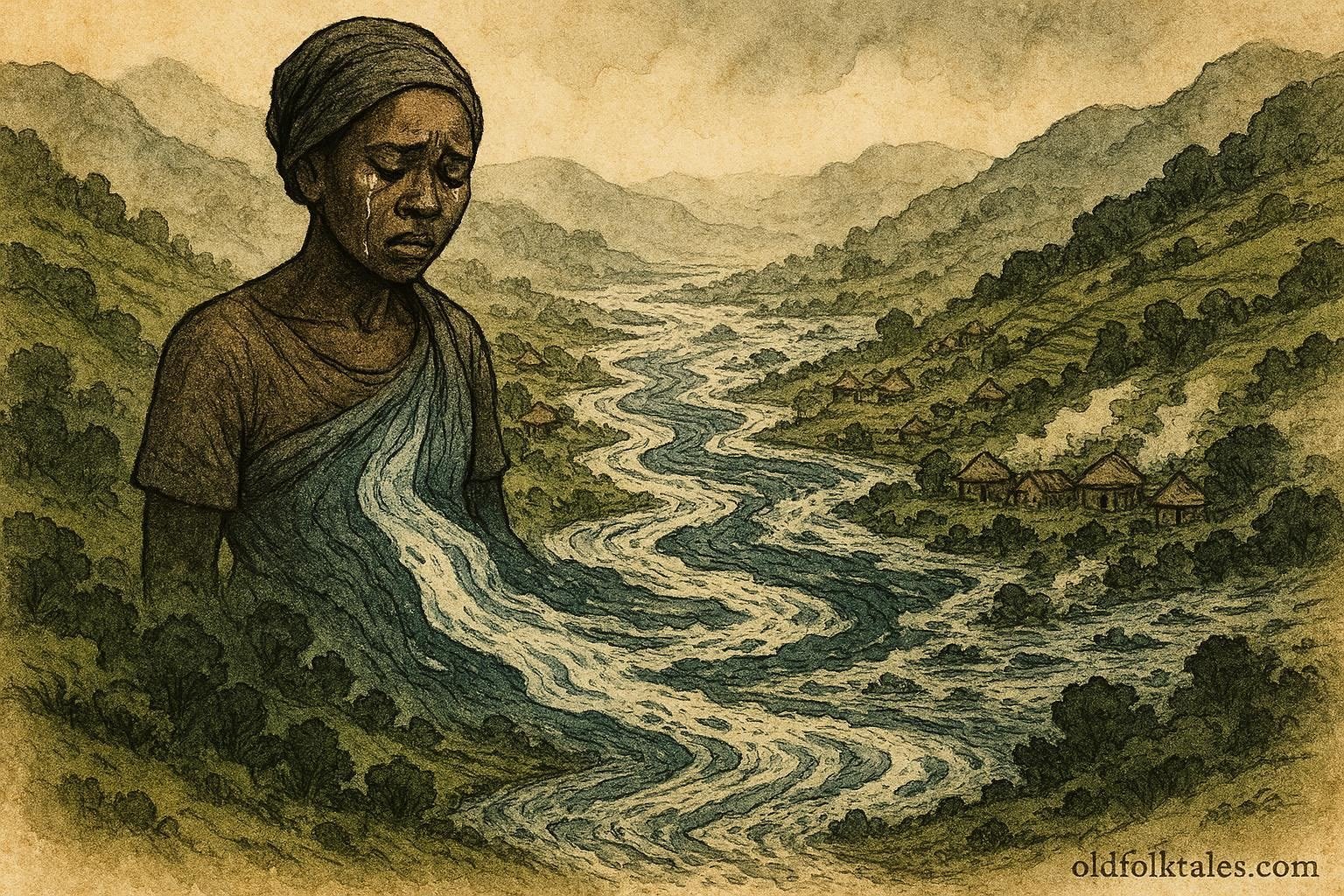
In the highlands of southwestern Uganda, where rolling green hills meet mist-covered valleys and rivers cut quietly through the land, stories have long been used to explain not only events, but emotions too deep for ordinary language.
Among the Ankole and Kigezi communities, nature is not separate from human life.
Want more? Read more West African folktales now
It listens.
It remembers.
And in some stories, it even responds to injustice.
This is the tale of a woman falsely accused, and how her sorrow became something larger than herself.
A Life Interrupted by Accusation
There was once a woman known in her village for her quiet nature.
She lived simply.
She worked honestly.
And she tried to avoid conflict whenever possible.
But one day, she was accused of wrongdoing she did not commit.
The accusation spread quickly through the village.
Whispers became certainty.
And certainty became judgment.
Even those who once trusted her began to doubt her.
She tried to speak in her defense.
But her words were drowned out by fear and assumption.
The Flight into the Wilderness
Unable to clear her name, and overwhelmed by shame she did not deserve, the woman fled into the wilderness.
She walked far from the village.
Beyond fields.
Beyond homes.
Beyond paths that others used.
Only the wind followed her.
And the land stretched endlessly before her.
As she walked, her sorrow deepened, not because she was guilty, but because she was not believed.
And injustice, when unchallenged, becomes a heavy burden.
The Moment of Transformation
After many days of wandering, the woman reached a quiet valley surrounded by hills.
There, she stopped.
Exhausted.
Heartbroken.
And silent.
She looked at the land around her and felt something shift within her, not physically, but deeply.
Her grief, her pain, and her unanswered truth began to merge with the landscape itself.
The ground beneath her softened.
The air grew still.
And slowly, something impossible began to happen.
Becoming the River
From where she stood, water began to flow.
Not from a visible source.
But from the place where sorrow met silence.
Her form dissolved into movement.
And the woman became a river.
A living current flowing through the valley.
What had once been a single life now became a continuous presence in the land.
The river moved gently at first, winding through stones and soil, carving its path with quiet persistence.
And as it flowed, it carried something invisible but powerful:
The memory of injustice.
A River That Gave Life
Villages nearby soon discovered the new river.
Its waters were clear.
Fresh.
Life-giving.
People came to drink.
To farm.
To build their lives around it.
They did not know its origin.
Only that it sustained them.
And for a time, it seemed like only blessing remained.
But the river had not forgotten what it was born from.
When Injustice Was Spoken
Something unusual began to happen.
Whenever false accusations or harsh injustices were spoken near the river, its waters reacted.
The flow would rise suddenly.
Banks would overflow.
Fields would flood.
Not in destruction alone, but in warning.
As if the river was responding to the words spoken near it.
Those who noticed began to understand a pattern.
The river did not punish randomly.
It responded to injustice.
The Village Learns to Listen
At first, people feared the floods.
They did not understand their meaning.
But over time, elders began to observe carefully.
They noticed that when truth was spoken, the river remained calm.
When dishonesty or unfair judgment was made, the waters became restless.
Slowly, understanding grew.
The river was not merely water.
It was memory in motion.
A reminder that injustice leaves traces in the world.
The Hidden Truth of the River
The origin of the river was never spoken aloud in the village.
But some elders believed they understood.
They said that the river carried the spirit of someone wronged.
Someone who had not been heard in life.
And now spoke through water instead of words.
Whether or not all understood its origin, everyone learned to respect it.
Not out of fear.
But out of awareness.
A New Relationship with Justice
Over time, the river became part of how the village understood fairness.
Disputes were approached with more care.
Judgments were made more slowly.
People learned that words carry weight, not only socially, but spiritually.
And the river remained.
Flowing steadily when truth was present.
Rising when injustice returned.
Always reminding the land that balance must be maintained.
The Woman Remembered in Water
Though no one in the village ever saw the woman again, her presence remained.
Not in form.
But in flow.
She became part of the landscape that fed life, sustained crops, and shaped valleys.
And in moments of injustice, her memory rose to the surface, not as revenge, but as correction.
A reminder that truth, once silenced, does not disappear.
It transforms.
Looking for more? Explore the magic of East African folktales here
Moral Lesson
Injustice does not vanish when ignored, it transforms and returns in other forms. Truth and fairness must be upheld, or imbalance will reflect back into the world.
Knowledge Check
- What is “The Woman Who Turned into a River” about?
It is a Kigezi and Ankole folktale about a falsely accused woman who transforms into a river after fleeing injustice. - Where does the story come from?
From southwestern Uganda, specifically Ankole and Kigezi highland oral traditions. - Why did the woman transform into a river?
Her sorrow and injustice became intertwined with the land, causing her transformation. - What happens when injustice is spoken near the river?
The river floods or becomes disturbed, symbolizing response to wrongdoing. - What theme does the story highlight?
Injustice, transformation, emotional and spiritual connection to nature. - What lesson does this African folktale teach?
It teaches that injustice leaves lasting consequences and truth eventually manifests, even through nature.
Source: African folktale, Uganda.
Adapted from Kigezi and Ankole oral traditions preserved in Ugandan myth archives and regional folklore recordings (1960s–1980s).
Cultural Origin: Southwestern Uganda (Ankole and Kigezi highlands)