In the riverlands of South Sudan, where water shapes life as much as land does, rivers are not simply bodies of flowing water.
They are living forces.
Want to dive deeper? Read more North African folktales today
They feed cattle, sustain fishing, and carry the memory of seasons long past. Among the Dinka people, who depend deeply on both land and water, rivers are treated with respect, as spaces where the visible and invisible worlds meet.
This is the story of a fisherman, a river spirit, and a promise that was not meant to be forgotten.
A Life by the River
There was once a fisherman who lived near a wide, slow-moving river.
Each day, he would rise early, carry his net, and walk to the water’s edge. The river provided enough for him and his family. Some days were abundant, others less so, but he always took only what he needed.
At first, he understood the river as a gift.
But over time, familiarity softened his respect.
And slowly, that respect began to fade.
The First Warning
One season, the river’s flow became stronger than usual.
Fish were plentiful.
The fisherman caught more than he had ever seen before.
At first, he was grateful.
But as days passed, he began to take more than necessary.
He no longer thanked the river.
He no longer observed the quiet customs his elders had taught him.
One evening, as he cast his net once more than usual, the water beneath him stirred.
Not from wind.
Not from fish.
But from something deeper.
A voice rose from the river.
“You take without respect,” it said.
The fisherman froze.
The River Spirit Appears
The water shifted.
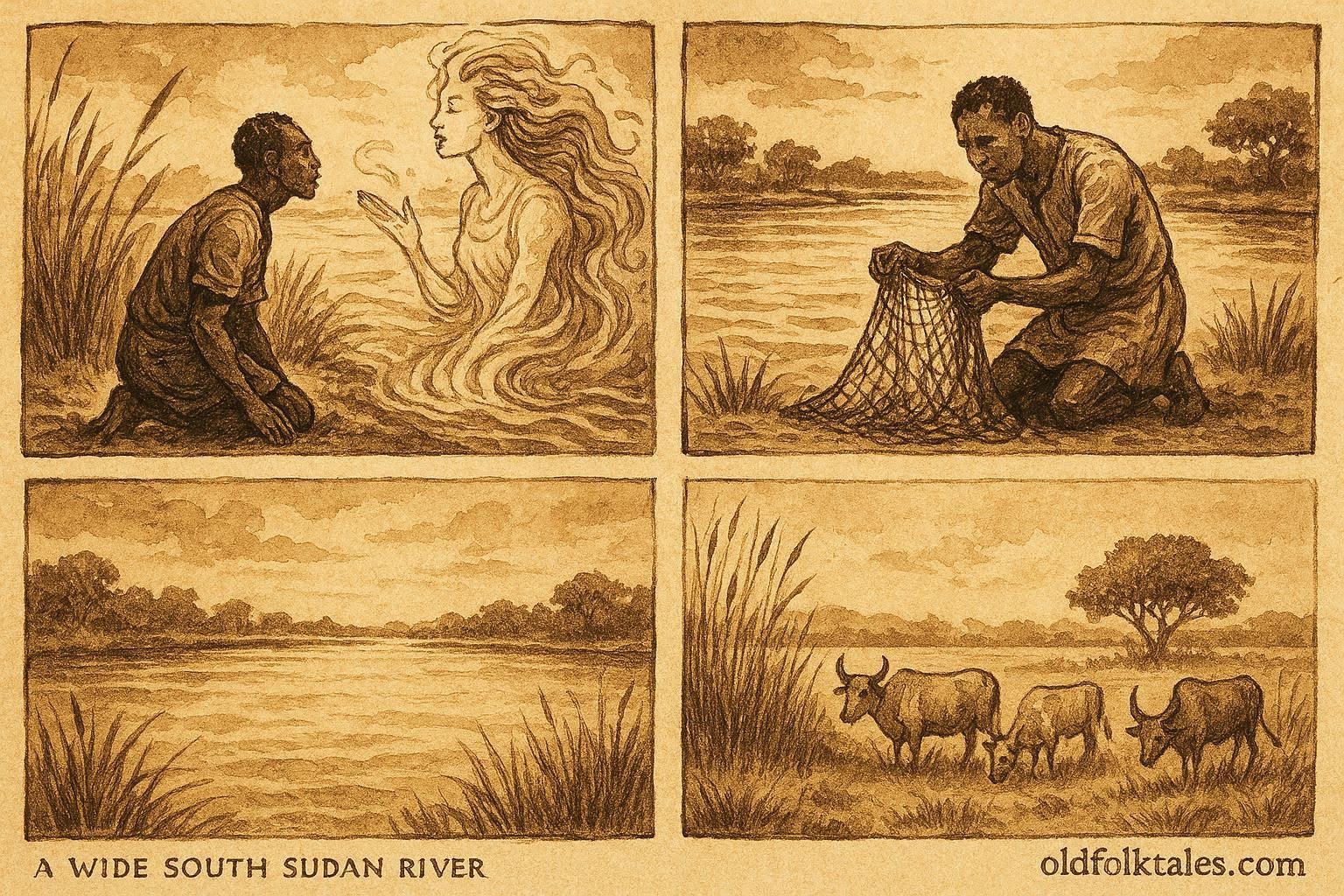
And from its surface emerged a presence, not fully human, not fully water, but something in between.
The river spirit had revealed itself.
The fisherman stepped back, frightened.
“I did not mean harm,” he said quickly.
The spirit remained calm.
“You have taken more than you need,” it said. “And you have forgotten the balance.”
The fisherman lowered his head.
“I will change,” he promised. “I will only take what is needed. I will respect the river.”
The spirit studied him for a long moment.
Then it spoke softly.
“Then live by your promise.”
And the water became still again.
A Time of Abundance
For a while, the fisherman kept his word.
He took only what was necessary.
He thanked the river before leaving each day.
And in return, the river remained generous.
His life became stable again.
His family was fed.
The water flowed peacefully.
But time has a way of testing promises.
The Return of Greed
As seasons changed, the fisherman began to forget the fear he once felt.
He remembered the abundance more than the warning.
One day, tempted by easy success, he cast his net deeper and wider than before.
“I will take just a little more,” he told himself.
But “a little more” soon became more than enough.
And then more than needed.
He stopped thanking the river.
He stopped remembering the promise.
And the river, silently, noticed.
The Withdrawal of the River
At first, nothing changed.
The fisherman believed he had escaped consequence.
But slowly, the river’s generosity began to fade.
Fish became scarce.
His nets returned lighter each day.
The water felt different, less welcoming, less giving.
Still, he continued.
Still, he ignored the signs.
Until one morning, when he cast his net and found nothing at all.
Not a single fish.
The river had become silent in its own way.
The Fisherman’s Realization
Days passed.
Then weeks.
The fisherman’s family struggled.
He returned to the river again and again, but the water no longer responded as it once had.
One evening, as he sat by the riverbank in silence, he understood.
The river had not abandoned him suddenly.
It had simply responded to his actions.
He had broken what he had promised.
And the river remembered.
Seeking Forgiveness
Humbled, the fisherman knelt at the river’s edge.
“I understand now,” he said quietly. “I forgot what I promised. I took more than I needed. I disrespected the balance.”
The water shifted gently.
Not violently.
Not angrily.
But as if listening.
“I will change,” he said again. “Not for reward, but for respect.”
The river remained still for a long moment.
Then, slowly, life returned to its flow.
Restoring Balance
In the days that followed, the fisherman changed his ways.
He took only what was needed.
He spoke words of gratitude before each catch.
He treated the river not as a resource to be used endlessly, but as a partner in survival.
And over time, the river responded again.
Not immediately.
Not generously beyond measure.
But steadily.
Balanced.
As it had always intended.
Continue your journey: Read more East African folktales
Moral Lesson
Nature responds to human behavior. Broken promises and disrespect disrupt balance, but humility and responsibility can restore harmony between people and the environment.
Knowledge Check
- What is “The River Spirit and the Fisherman’s Promise” about?
It is a Dinka folktale about a fisherman who breaks his promise to respect the river and faces consequences. - What does the river spirit represent?
It represents nature’s living force and the spiritual connection between humans and the environment. - Why did the fisherman lose his catch?
Because he broke his promise and overfished, disrupting the balance of the river. - What caused the river to become silent?
The fisherman’s repeated disrespect and greed caused the river to withdraw its generosity. - How was balance restored?
The fisherman returned to humility, respected the river, and honored his promise again. - What lesson does this African folktale teach?
It teaches that nature must be respected and that actions toward the environment have consequences.
Source: African folktale, South Sudan.
Adapted from Dinka oral environmental wisdom narratives collected in Sudanese ethnographic research (mid–late 20th century).
Cultural Origin: Dinka people, South Sudan