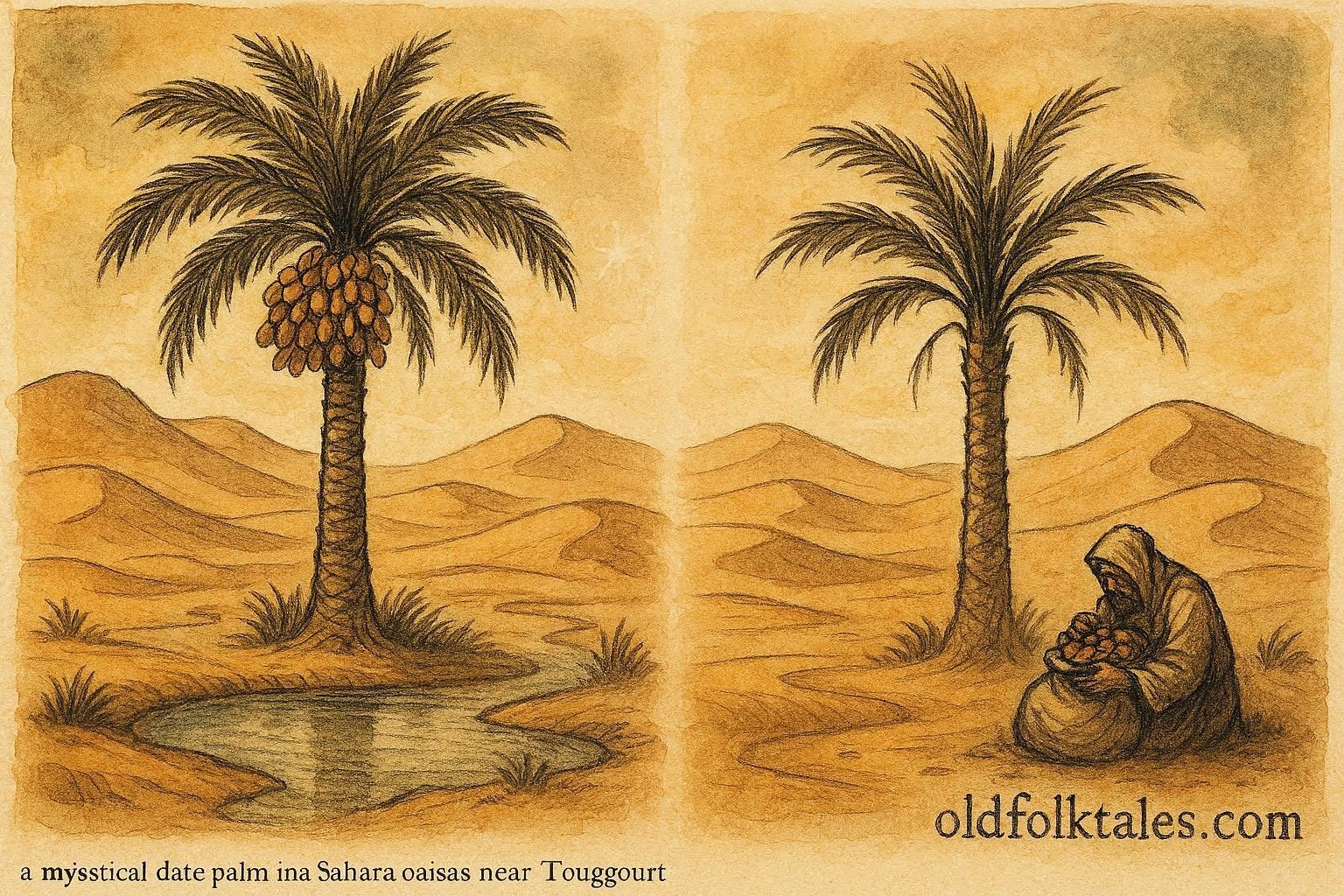
In the deep Sahara of Algeria, where life gathers around rare pockets of water and the horizon stretches endlessly in gold and heat, oases are more than resting places.
They are lifelines.
Click here to explore more Central African folktales
In regions like Touggourt and Ghardaïa, where communities have survived for centuries by reading the desert’s rhythms, the oasis is seen as a sacred gift, something protected, respected, and never taken for granted.
Among these communities, there is an old story told beside palm groves and evening fires.
A story of a date palm unlike any other.
A Tree That Should Not Exist
There was once an oasis hidden between dunes and rocky desert paths.
At its center stood a date palm.
But this was not an ordinary palm.
It was said to be enchanted.
It bore fruit endlessly.
Not seasonally.
Not occasionally.
But constantly, so long as it was treated with kindness.
Travelers who arrived tired and hungry often found its branches heavy with ripe dates.
And those who shared what they took with gratitude were always welcomed again.
The oasis became known quietly among desert travelers as a place of blessing.
The First Rule of the Oasis
The people of the region understood something important:
The palm did not belong to one person.
It belonged to balance.
Those who took only what they needed were always satisfied.
Those who gave thanks, whether through words, respect, or helping others, found the tree generous.
But there was an unspoken truth that everyone knew:
The oasis responded to character.
Not demand.
The Arrival of the Trader
One day, a trader passed through the desert and reached the oasis.
He had traveled far, carrying goods and ambition, but little patience for tradition.
When he saw the palm tree heavy with fruit, his eyes widened.
“This tree,” he said, “could make me rich.”
Unlike the others, he did not pause to observe the customs of the place.
He did not greet the oasis.
He did not offer respect.
He simply began to take.
The First Signs of Change
At first, the trader was pleased.
The dates were abundant.
He filled his sacks quickly.
But when others arrived and shared the oasis respectfully, they noticed something strange.
The tree seemed less generous in his presence.
Branches that were once full appeared less abundant when he approached.
Still, he did not stop.
He only increased what he took.
Greed Takes Root
The trader decided to stay longer.
He guarded the tree as if it belonged to him.
He began selling the dates in nearby markets, speaking proudly of his discovery.
“I have found a tree that never runs dry,” he boasted.
But he did not share.
He did not thank.
He did not observe the quiet respect others gave to the oasis.
And slowly, the tree responded.
The Enchanted Palm Withdraws
One morning, the trader woke early and rushed to the palm.
But the branches were empty.
No ripe fruit hung where abundance once had been.
He waited.
He checked again.
Still nothing.
Confused and angry, he demanded answers from the villagers.
But they only said:
“The tree gives to those who understand it.”
He did not understand.
So, he waited again.
And still, the tree remained silent.
The Oasis Speaks Without Words
Days passed.
The trader tried everything he knew.
He watered the roots excessively.
He guarded the tree aggressively.
He even tried to force harvest from unripe branches.
But nothing worked.
The oasis had shifted.
The land itself felt different.
Less welcoming.
More distant.
It was as if the environment had withdrawn from him completely.
A Quiet Explanation
An elder from the oasis finally spoke to him.
Not with anger.
But with calm certainty.
“This palm does not respond to force,” the elder said.
“It responds to balance.”
The trader frowned.
“What balance?”
The elder pointed to the tree.
“It gives when it is respected. It rests when it is abused.”
The trader tried to argue.
But for the first time, he had nothing to say that did not sound like justification.
The Moment of Realization
That night, the trader sat alone near the empty palm.
The desert wind moved softly across the sand.
No fruit fell.
No abundance returned.
Only silence remained.
And in that silence, something changed in him.
He remembered what it felt like when he first arrived, how freely the tree had given before he demanded too much.
He finally understood:
The tree had not failed him.
He had failed the tree.
The Act of Correction
The next morning, the trader returned, but differently.
He did not take anything.
He cleaned the area around the tree.
He helped repair irrigation channels.
He shared water with travelers passing through.
He offered what he had instead of demanding what he wanted.
And he waited.
Without expectation.
The Return of the Fruit
Days later, small clusters of dates began to appear again.
Not immediately abundant.
But present.
Alive.
The tree had not been lost.
Only withdrawn.
And now, slowly, it responded once more to changed behavior.
The trader did not rush to harvest.
He watched.
He learned.
And for the first time, he understood the oasis not as a resource, but as a relationship.
Restored Balance
As time passed, the oasis returned to its rhythm.
Travelers came and went.
Some took with gratitude.
Others gave in small ways.
And the tree remained generous, but not reckless.
It gave in balance.
Not excess.
Not absence.
But harmony.
The trader stayed for a while longer.
And then, when he finally left, he did so differently than when he arrived.
Fascinated by this tale? Discover more North African folktales
Moral Lesson
Nature responds to human behavior. Greed disrupts balance, while kindness and respect restore harmony and abundance in both people and the environment.
Knowledge Check
- What is “The Enchanted Date Palm of the Oasis” about?
It is a Saharan Algerian folktale about a magical palm tree that rewards kindness and withdraws fruit from greed. - Where does the story take place?
In Saharan oasis communities of Touggourt and Ghardaïa in Algeria. - Why did the date palm stop producing fruit?
Because a greedy trader exploited it and failed to respect the balance of the oasis. - How was the tree’s abundance restored?
Through acts of respect, sharing, and the trader correcting his behavior. - What theme does the story emphasize?
Kindness versus greed and harmony with nature. - What lesson does this Algerian folktale teach?
It teaches that nature responds to respect and balance, not exploitation or force.
Source: African folktale, Algeria.
Adapted from Saharan oral folklore documented in early French ethnographic desert expeditions (1905–1940).
Cultural Origin: Saharan Algerian oasis communities (Touggourt and Ghardaïa regions)