In the rugged mountain regions of Kabylie in northern Algeria, where olive trees cling to rocky slopes and villages rest between valleys and stone ridges, life has always been shaped by memory.
Memory of land.
Don’t stop yet! See our complete East African folktales collection
Memory of ancestors.
And memory of what is spoken, and what is not.
Among Kabyle oral traditions, animals are sometimes more than companions. They are witnesses. And in rare stories, they become messengers of truth.
This is the story of a lonely boy, a mysterious goat, and a secret buried beneath family history.
A Quiet Life in the Mountains
There was once a young boy who lived in a small mountain village.
His family was poor, and life was not easy.
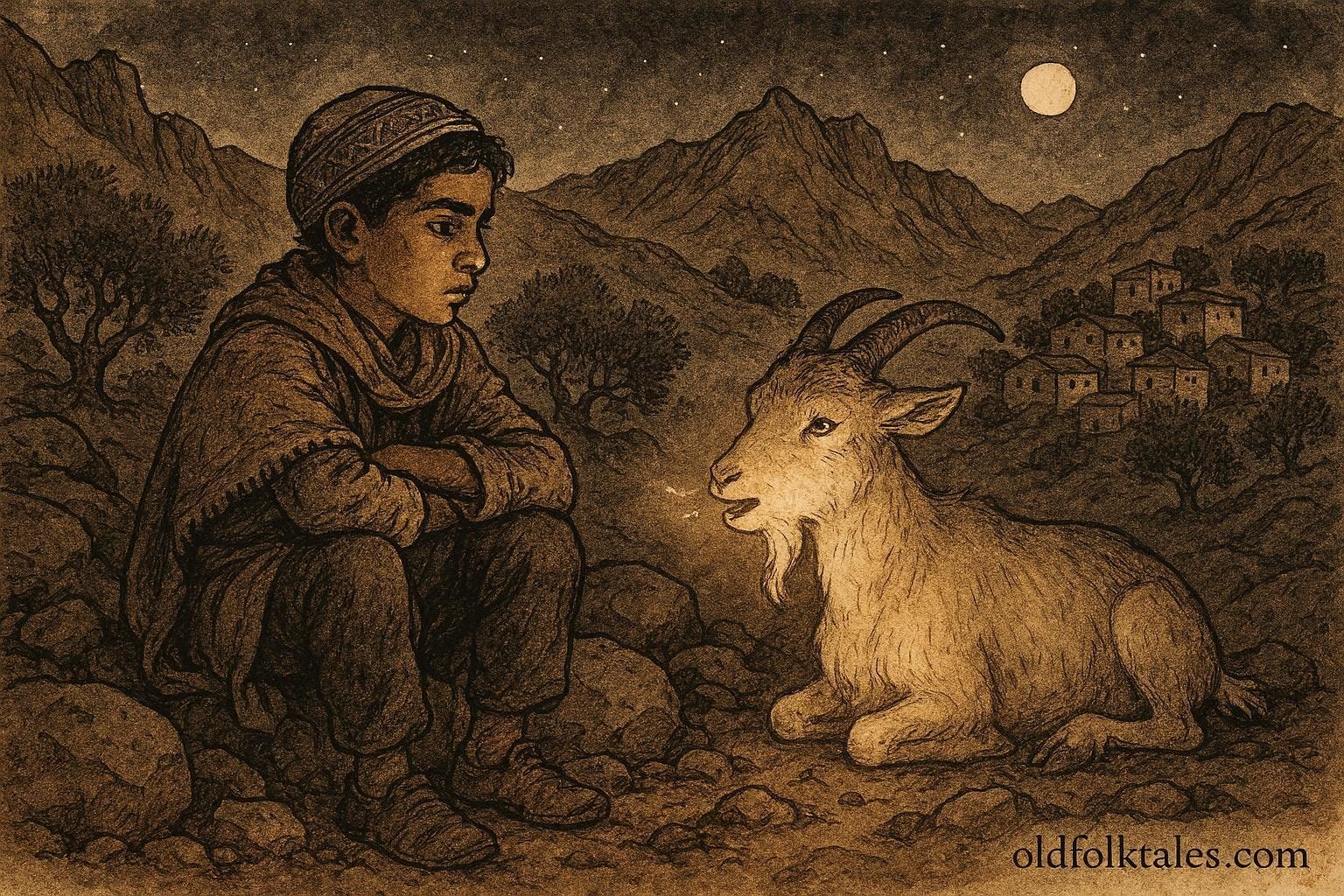
He spent most of his days tending a small group of animals near the edge of the village, where the wind moved freely and the stones carried the warmth of the sun.
The boy was quiet by nature.
Not because he had nothing to say, but because there was often no one to listen.
His only true companion was a single goat his family owned.
A simple animal.
Or so it seemed.
The First Night of Speech
One night, as the village settled into silence, the boy noticed something strange.
He had fallen asleep near the goat’s shelter, exhausted from the day’s work.
But in the middle of the night, he woke to a voice.
Soft.
Clear.
Human-like.
“Are you awake?” the voice asked.
The boy froze.
He turned slowly toward the goat.
It was watching him.
But goats do not speak.
And yet, the voice came again.
“Do not be afraid,” it said.
The boy did not run.
He could not.
Something about the voice felt familiar, as if it had always been there, waiting to be heard.
A Secret Revealed in Silence
Night after night, the voice returned.
The goat spoke only when the world was quiet.
Only when no one else could hear.
At first, it spoke of simple things, paths in the mountains, weather, the movement of animals across valleys.
But over time, its words changed.
It began speaking of the boy’s family.
Of land that had once belonged to them.
Of disputes that had been buried, not resolved.
The boy listened carefully, unsure whether he was dreaming or being guided.
But he remembered everything.
The Hidden Land
One evening, the goat spoke more directly than ever before.
“Your family’s land was not lost by fate,” it said.
The boy sat upright.
“What do you mean?” he asked.
The goat’s eyes remained steady.
“It was taken during a time of confusion,” it said. “And the truth was never spoken aloud.”
The boy felt a strange weight in his chest.
His family had always believed they lost their land through misfortune.
But now, something else was being suggested.
Something deliberate.
The Boy’s Doubt
The next day, the boy hesitated to speak of what he had heard.
Who would believe him?
A talking goat?
A hidden injustice revealed in the night?
Still, he could not ignore the feeling growing inside him.
He began asking small questions in the village.
Carefully.
Quietly.
At first, no one responded clearly.
Some avoided the topic.
Others changed the subject.
But silence itself became a kind of answer.
The Goat’s Guidance
That night, the goat spoke again.
“You are close,” it said.
The boy asked, “Close to what?”
“To the truth that was buried,” the goat replied.
It then told him where to look, old boundary markers, forgotten paths, stones that had been moved long ago.
The boy began to walk those paths during the day.
Observing.
Remembering.
Connecting what the goat had said with what he could see.
And slowly, the past began to take shape.
The Evidence of the Mountains
In the mountains, nothing disappears completely.
It only becomes hidden.
The boy found signs that matched the goat’s words.
Old markers that suggested different boundaries.
Elder villagers who remembered fragments of past agreements.
Whispers of disputes that had never been resolved properly.
Piece by piece, the truth began to form, not as a sudden revelation, but as a pattern that had always been there.
Waiting to be understood.
The Village Confrontation
Eventually, the boy spoke.
Not with anger.
But with clarity.
He shared what he had learned.
At first, there was resistance.
But the details he presented could not be easily dismissed.
The village elders gathered.
Old memories were revisited.
Old claims were re-examined.
And slowly, what had been hidden began to surface.
The boy did not speak alone.
He was guided by what he had seen.
And what he had been told in the silence of night.
Restoration of What Was Lost
After long discussion and reflection, the truth was acknowledged.
The boy’s family had indeed been wronged.
The land was restored to them, not as a gift, but as recognition of what had been taken unfairly.
It was not a dramatic victory.
It was a correction.
A return to balance.
And through it, the village understood something important:
Truth does not vanish.
It waits.
The Goat’s Final Silence
After the matter was resolved, the goat stopped speaking.
One night, the boy waited.
But there was no voice.
Only the usual quiet of the mountains.
He called softly.
No answer came.
The goat remained beside him, as it always had.
But the speech was gone.
As if its purpose had been fulfilled.
A Different Kind of Understanding
The boy never told others about the goat’s voice again.
Some truths, he learned, are not meant to be displayed.
Only understood.
He continued to care for the goat.
And he continued to live in the village with a deeper awareness of what lies beneath silence.
Not everything visible is complete.
And not everything silent is empty.
Want to dive deeper? Read more North African folktales today
Moral Lesson
Truth can emerge from unexpected places, and justice often requires patience and careful observation. Hidden history eventually surfaces when listened to with honesty and courage.
Knowledge Check
- What is “The Boy and the Talking Goat” about?
It is a Kabyle folktale about a boy who befriends a talking goat that reveals a hidden family land injustice. - Where does the story take place?
In the Kabylie mountain regions of northern Algeria. - What secret does the goat reveal?
It reveals that the boy’s family land was taken unfairly in the past. - How does the boy discover the truth?
Through the goat’s guidance and his own observations of old village boundaries and memories. - What theme is central to the story?
Hidden truth, ancestral justice, and revelation through unexpected companionship. - What lesson does this Algerian folktale teach?
It teaches that truth can emerge slowly and that justice requires listening, patience, and courage.
Source: African folktale, Algeria.
Adapted from Kabyle oral storytelling traditions preserved by local elders and later transcribed in 20th-century ethnographic studies (1920–1955).
Cultural Origin: Kabylie mountain regions of Algeria