Across the wide Somali plains, where the sun presses gently upon the land and life moves between scarcity and survival, people have always understood one truth: kindness is necessary, but it must walk hand in hand with wisdom.
This is the story of a man who chose kindness.
Want more? Read more West African folktales now
And of a snake who did not return it.
A Cry in the Grass
One afternoon, as the dry wind moved softly across the land, a man walked along a narrow path between patches of tall grass. He had traveled far that day, his steps steady, his thoughts quiet.
Then he heard it.
A faint sound, urgent, strained.
He paused.
The sound came again.
It was not the wind.
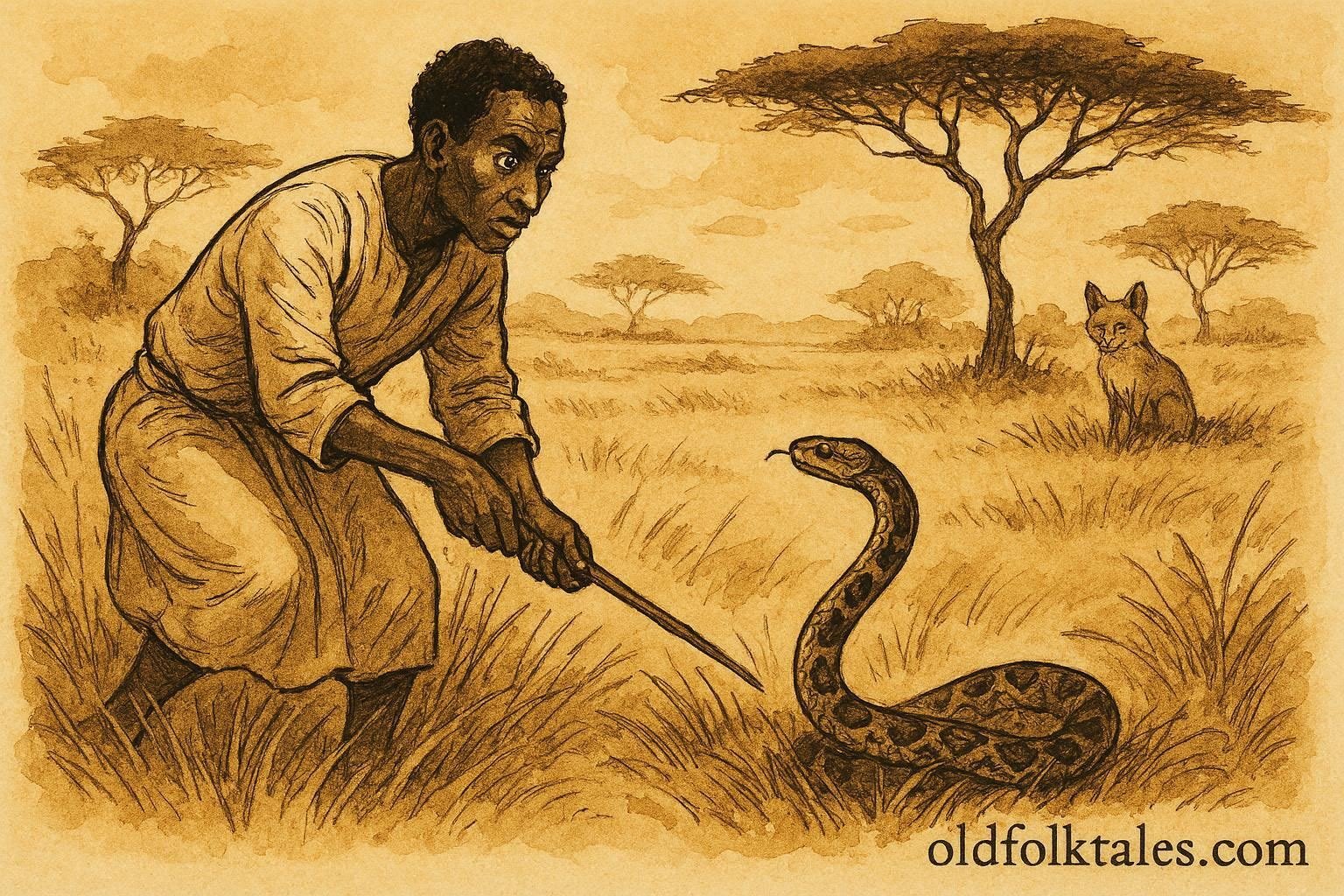
Carefully, he stepped off the path and followed the noise into the grass. There, coiled tightly near a patch of scorched earth, he found a snake.
It was trapped.
The ground around it had been disturbed, and something had pinned part of its body. It struggled, its movements weak but desperate.
The man stood still.
He knew what a snake was capable of.
He knew the danger.
But he also saw its condition.
A Choice of Kindness
The snake lifted its head slightly, its eyes fixed on the man.
“Help me,” it seemed to say, not in words, but in its struggle.
The man hesitated.
He could walk away.
He could leave it to its fate.
But something within him would not allow that.
Carefully, cautiously, he moved closer. Using a long stick, he loosened what held the snake in place. With patience and care, he worked until the snake was free.
It lay still for a moment.
Then it moved.
Slowly at first, then more steadily.
The man stepped back, giving it space.
“You are free now,” he said quietly.
A Sudden Turn
For a brief moment, there was silence.
Then the snake lifted itself higher.
Its body coiled.
Its head angled toward the man.
And its posture changed.
The man felt it immediately.
This was no longer a creature in distress.
This was a creature prepared to strike.
He froze.
“I helped you,” he said.
The snake did not retreat.
“I was in danger,” it seemed to answer through its stance. “Now I am not.”
The man’s heart tightened.
“And now,” he said slowly, “you would harm me?”
The snake remained poised.
Its answer was clear.
Seeking Justice
The man stepped back carefully.
“Wait,” he said. “If this is how it will be, let us not decide it alone.”
The snake did not move.
“There are others,” the man continued. “Let us ask them what is right.”
The snake lowered slightly, not in trust, but in curiosity.
“Very well,” its silence seemed to agree.
And so, they set out together.
The First Judgment
They came upon another animal along the way.
The man explained what had happened, how he had found the snake in danger, how he had freed it, and how it now turned against him.
“What is just?” he asked.
The animal listened carefully.
Then it spoke.
“Kindness is often forgotten,” it said. “Many give help, and many receive it, but not all remember.”
The man listened closely.
The snake remained still.
“Then is it right,” the man asked, “for the snake to harm me?”
The animal did not answer directly.
It simply said, “This is the way of the world.”
The man felt no relief.
The Second Judgment
They continued.
Soon, they met another animal.
Again, the man told his story.
Again, he asked for judgment.
The second animal listened, then replied, “Those who are helped do not always return kindness. Sometimes, they act only in their own interest.”
The man’s shoulders lowered slightly.
“And is that justice?” he asked.
The animal did not say yes.
It did not say no.
It simply looked away.
Doubt and Desperation
The man began to feel the weight of his situation.
He had acted with compassion.
Yet the world did not seem ready to defend him.
The snake, meanwhile, waited patiently.
Its intent had not changed.
The Final Judgment
At last, they came upon another creature, one known not for strength, but for sharp thinking.
The man spoke again, carefully, clearly, explaining everything from beginning to end.
The creature listened without interruption.
Then it tilted its head.
“I do not understand,” it said.
The man frowned slightly.
“What do you mean?”
“How was the snake trapped?” the creature asked.
The man gestured toward the ground behind them.
“It was pinned and could not move.”
The creature nodded slowly.
“And how did you free it?”
The man demonstrated, showing the position, the movement, the careful steps he had taken.
The creature stepped closer.
“I would like to see it exactly as it was,” it said.
The snake hesitated.
But curiosity, and perhaps pride, held it in place.
The Turning Point
“Show me,” the creature said again.
Reluctantly, the snake moved back into position, recreating the way it had been trapped.
The man followed, guiding the demonstration.
For a moment, everything returned to how it had been before.
The snake, constrained.
The man, standing nearby.
The creature observed closely.
Then, without warning, it spoke:
“Now,” it said, “step back.”
The man did.
The creature turned to the snake.
“You wished to harm the one who helped you,” it said. “But now you are as you were, dependent, vulnerable.”
The snake struggled.
It realized too late what had happened.
Justice Restored
The creature looked at the man.
“You have seen enough,” it said.
The man nodded slowly.
The lesson was clear.
Kindness without caution had placed him in danger.
But wisdom, guided by patience, had brought him out of it.
He did not move closer to the snake again.
He did not repeat his earlier action.
Instead, he stepped away.
The snake remained where it was.
Its fate now returned to the same uncertainty from which it had been freed.
After the Judgment
The man continued on his journey.
He did not forget what had happened.
Nor did he abandon kindness.
But he carried something new with him, discernment.
And the story spread, as such stories always do.
Not to discourage kindness.
But to remind those who listen:
Kindness must be guided by wisdom.
Continue your journey: Read more East African folktales
Moral Lesson
Kindness without wisdom can lead to danger. True goodness requires both compassion and careful judgment.
Knowledge Check
- What is “The Ungrateful Snake” about?
It is a Somali folktale about a man who rescues a snake, only for the snake to turn against him. - Why did the snake try to harm the man?
The snake acted out of instinct and ingratitude, showing no appreciation for being saved. - How did the man seek justice?
He asked other animals to judge the situation and determine what was right. - What role did the final animal play?
It used intelligence to reveal the truth and restore fairness by recreating the situation. - What theme is central to the story?
The story highlights the importance of combining kindness with wisdom. - What lesson does this Somali folktale teach?
It teaches that not everyone repays kindness, so one must act with both compassion and caution.
Source: African folktale, Somalia.
Adapted from oral poetry and Somali folklore traditions (1964).
Cultural Origin: Somali pastoral communities