In the open Somali landscapes, where the horizon stretches endlessly and the sky feels close enough to touch, the wind is never just air in motion. It is presence.
It moves across the plains, shaping sand, bending grass, and carrying stories from one place to another. To those who live close to nature, the wind is not something to be ignored, it is something to be respected.
Want to dive deeper? Read more North African folktales today
This is the story of a boy who forgot that truth.
A Boy with a Stubborn Heart
There was once a boy who lived in a small rural settlement surrounded by wide fields and scattered trees. He was strong for his age, quick to speak, and even quicker to challenge anything he believed he could overcome.
He did not like being told what he could or could not do.
Especially when it came to nature.
When elders spoke of the wind with respect, the boy laughed. When they said it could change direction without warning, he smiled as if they were speaking of something imaginary.
In his mind, strength meant control.
And he believed he was strong enough.
The First Challenge
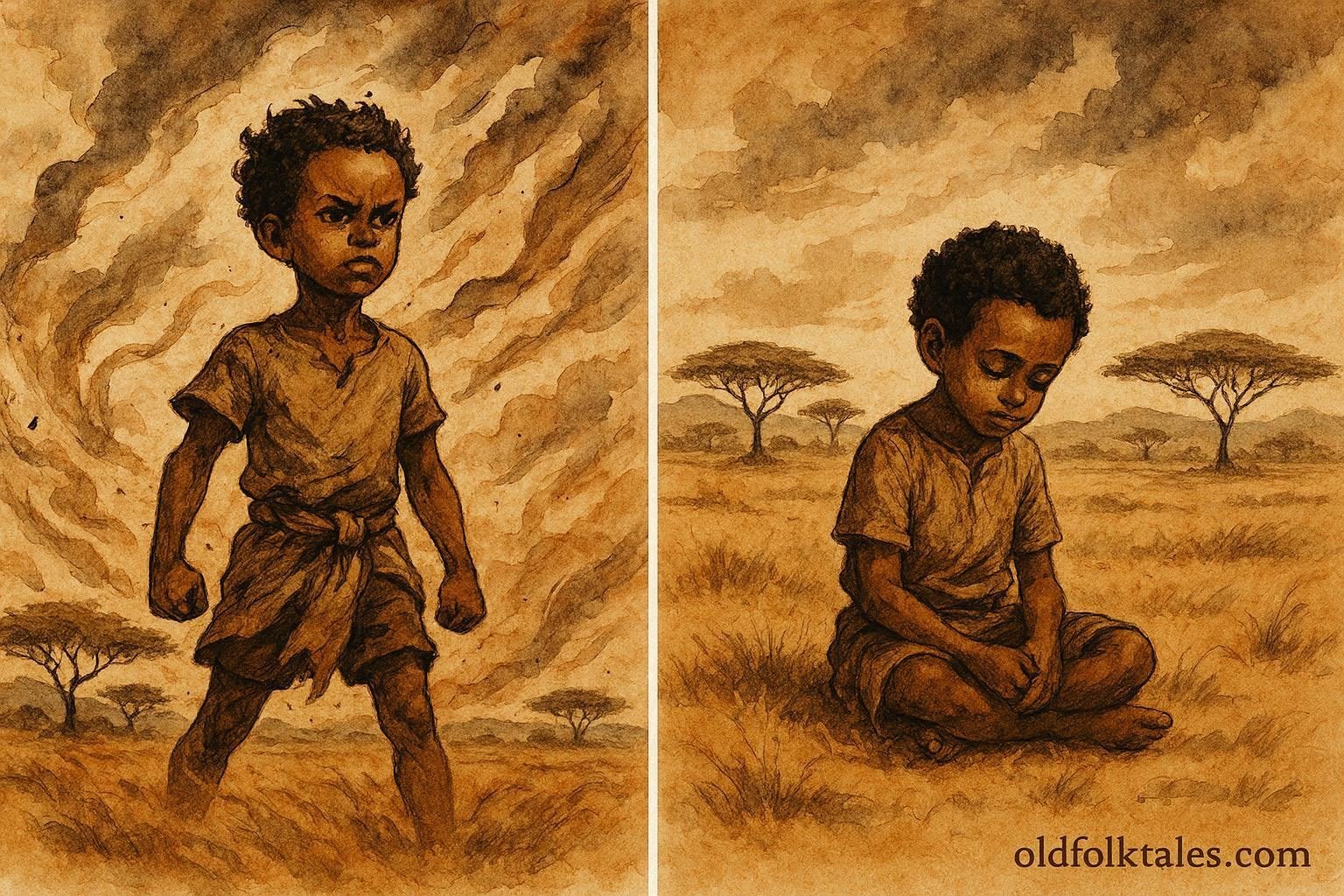
One afternoon, while walking across an open stretch of land, the boy felt the wind pick up.
It was not unusual. The wind often came and went, brushing across the earth like an unseen hand.
But this time, the boy stopped.
He faced it directly.
“I am not afraid of you,” he said aloud.
The wind did not respond in words.
It simply moved.
Stronger now.
The boy narrowed his eyes.
“You think you are powerful,” he said. “But I can stand against you.”
He lifted his arms slightly, as if preparing for a contest.
The wind swirled around him.
Dust rose from the ground.
Grass bent in waves.
Still, he did not move.
The Wind Responds
At first, it seemed like a game.
The boy stood firm while the wind pushed against him. He tightened his stance, determined not to step back.
“I will not move,” he declared.
But the wind was not listening in the way he thought.
It was not responding to him.
It was simply becoming itself.
Stronger gusts arrived without warning. The air shifted in unpredictable patterns. The ground beneath him became harder to stand on as dust and debris filled the space around him.
Still, the boy refused to yield.
His pride held him in place longer than his strength could support.
The Consequences Begin
The wind changed again.
This time, it was sharper.
The boy stumbled slightly, catching himself quickly. His confidence wavered, but he refused to admit it.
“This is nothing,” he muttered.
But now he was speaking more to himself than to the wind.
The storm around him was no longer gentle.
It pushed harder, forcing him to shield his eyes, to bend his body just to remain upright.
Still, he resisted.
But resistance without understanding has limits.
And the wind does not recognize pride.
The Moment of Humbling
A strong gust swept across the land.
Stronger than before.
The boy lost his footing.
He fell to the ground, the force of the wind pressing against him as dust filled the air around his face. For a moment, he could see nothing clearly.
Only movement.
Only power.
He struggled to stand, but the wind was no longer something he could argue with.
It was something he had to acknowledge.
Lying there, partially shielded by the earth, he realized something he had not understood before.
The wind had never been competing with him.
It had simply been moving.
Silence After the Storm
As quickly as it had intensified, the wind began to ease.
The dust settled slowly.
The air cleared.
The boy remained on the ground for a moment longer, breathing heavily, his body tired from the struggle.
Around him, the land looked unchanged, but he was not.
He slowly pushed himself upright.
This time, he did not speak.
He looked around, not with defiance, but with awareness.
The wind continued to move gently across the plains, as it always had.
But now, it no longer felt like something to challenge.
The Return Home
The boy walked back slowly toward his home.
His steps were quieter than before.
When he arrived, he did not boast of strength or victory. He did not speak of controlling the wind or standing against it.
Instead, he sat down and remained silent for a long time.
When the elders saw him, they did not ask many questions.
They already understood.
Experience had spoken more clearly than words could.
A New Understanding
From that day forward, the boy no longer treated nature as something to be conquered.
He watched the wind instead of challenging it.
He listened when elders spoke of the land.
And slowly, something shifted within him.
Not fear.
Not weakness.
But understanding.
He began to see that strength was not always about resisting.
Sometimes, it was about knowing when to yield.
Don’t stop yet! See our complete East African folktales collection
Moral Lesson
Pride blinds judgment, but humility brings wisdom. Nature’s power is not meant to be challenged, but respected and understood.
Knowledge Check
- What is “The Boy Who Challenged the Wind” about?
It is a Somali folktale about a stubborn boy who tries to challenge the wind and learns humility. - Why did the boy challenge the wind?
He believed his strength and pride could allow him to control or resist natural forces. - What happened when the boy faced the wind?
He was overpowered by stronger gusts and forced to realize he could not control nature. - What theme is central to the story?
The story highlights respect for nature and the dangers of pride. - How did the boy change after the experience?
He became more humble and respectful toward nature and the wisdom of elders. - What lesson does this Somali folktale teach?
It teaches that pride leads to downfall, while humility leads to growth and understanding.
Source: African folktale, Somalia.
Adapted from A Tree Is Beautiful: Somali Folktales (2006).
Cultural Origin: Somali environmental and oral storytelling traditions