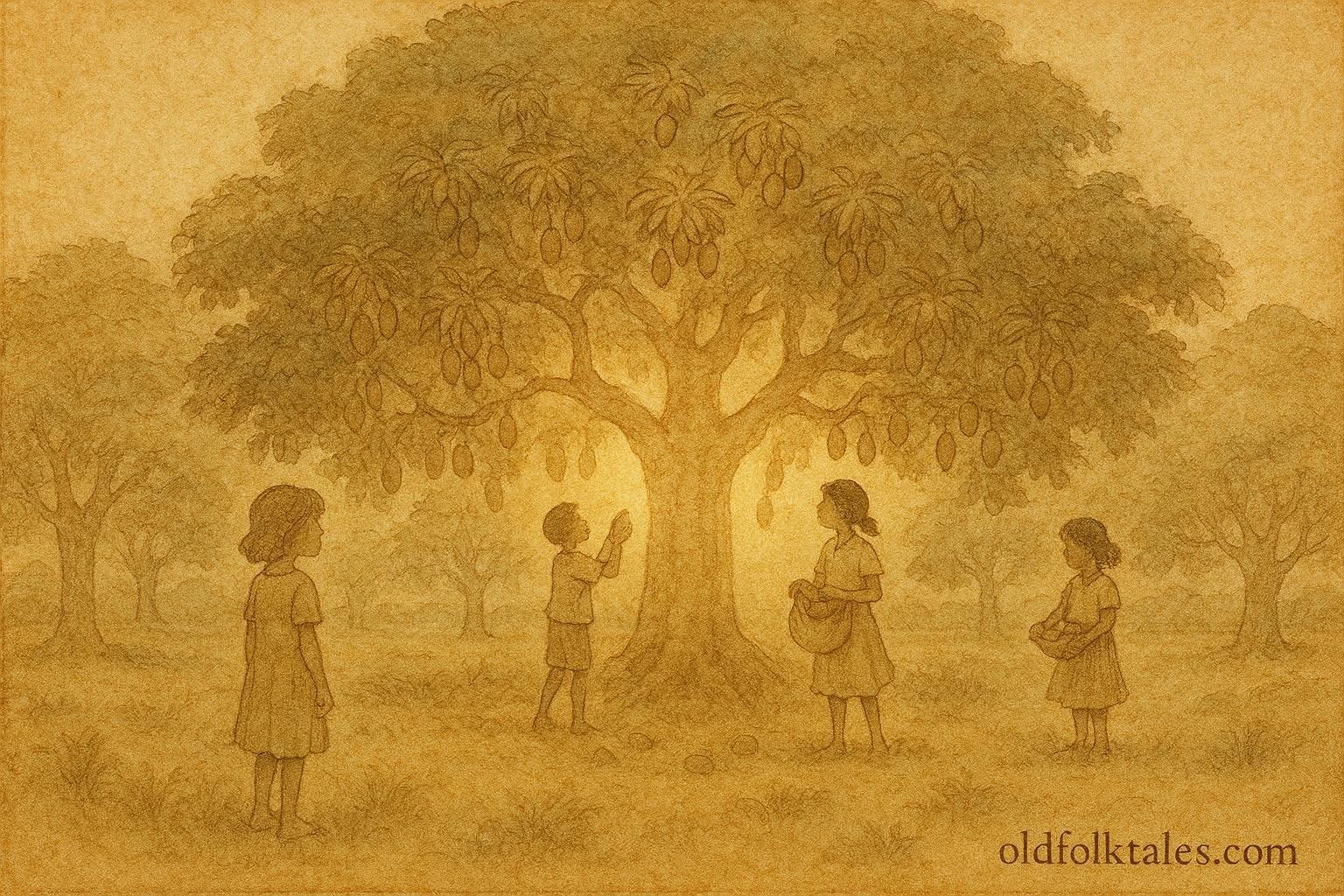
In a quiet village somewhere in the rural heart of Seychelles, where life moved with the rhythm of planting seasons and harvest rains, there stood an old mango orchard. Among all the trees that grew there, one mango tree was spoken of differently. It was older than most, with thick roots that spread deep into the soil and branches that stretched wide as if holding memory in every leaf.
To the villagers, especially the elders, the orchard was not just land for fruit. It was part of life itself. Children grew up running between the trees, learning early which branches were safe to climb and which fruits were ready to be picked. The mango season was always a time of joy, laughter, and shared work, where families gathered under the shade to collect nature’s sweetness.
Click here to explore more Central African folktales
But among all these trees, one was treated with special care.
It was said that this particular mango tree “remembered.”
No one could explain it fully, but the belief had lived in the village for generations. The elders would say that the tree noticed how people treated it. Those who approached it with respect—who did not break its branches carelessly or throw stones at its trunk, were rewarded when the season came. Their fruits were sweeter, fuller, and easier to gather.
But those who showed cruelty or carelessness toward it often found something different waiting for them. The same branches that once seemed full would appear empty. The fruits they expected would be fewer, or sometimes not there at all.
The children grew up hearing this not as a warning of fear, but as a lesson of behavior.
In the village, children played often in the orchard. They would climb trees, sit on low branches, and compete to see who could find the ripest mango first. Laughter would echo through the grove as they tossed fruit between themselves or rested in the shade during the heat of the day.
But even in their play, they were taught respect.
The elders reminded them that the orchard was alive in its own way. It provided food, shade, and comfort. It was not to be harmed without reason. Especially the oldest mango tree, which stood slightly apart from the others, was treated almost like an elder of the land.
One of the children, growing up in this village, often listened closely to these stories. Like many others, he played beneath the trees, climbed their branches, and waited eagerly for the mango season. But unlike some of the others, he sometimes forgot the quiet rules of respect. In moments of excitement, he would pull at branches too strongly or shake fruit down before it was ready.
The elders noticed such actions, and they would speak gently, reminding him that the orchard was not just for taking, but for sharing and care.
Still, the story of the “tree that remembers” stayed in his mind more than anything else.
As seasons passed, the orchard changed in its own natural rhythm. Some years were rich with fruit, others less so, as nature itself shifted between abundance and rest. But villagers insisted that there was something more than weather or soil at work in the way the special mango tree behaved.
They would point to patterns.
Those who treated the tree kindly, helping to clear fallen leaves, avoiding damage to its trunk, and taking only what they needed, seemed to always find enough fruit when harvest came. Their baskets were full, and their sharing in the village was easy and joyful.
But those who were rough or careless sometimes returned with disappointment. The tree, they would say, had “turned away” from them.
The belief became part of how the village understood responsibility. Not through punishment alone, but through relationship. The tree was not seen as a silent object, but as something that responded to human action in its own quiet way.
Over time, the children grew older, and the orchard remained. New generations came to play beneath its branches, hearing the same lessons repeated. The mango tree stood as it always had, silent, rooted, and watching seasons pass.
To outsiders, the idea of a tree remembering might have sounded like imagination. But in the village, it was understood differently. Memory, they believed, did not only belong to people. It could live in the land, in the soil, in the growing things that depended on human care to survive.
The orchard became a place where behavior and nature were deeply connected. A reminder that every action, no matter how small, carried consequences that returned in time.
Even as the years went on, the story of the mango tree did not fade. It remained part of how children were raised, part of how respect was taught without force, and part of how the community understood balance with nature.
The tree continued to stand, its branches still stretching wide over the orchard, still offering fruit each season. And those who approached it with kindness continued to find what they needed beneath its shade.
In this way, the mango tree became more than just a tree.
It became a living lesson.
A quiet presence reminding the village that nature remembers not in words, but in results.
And so the orchard remained, not just as land filled with fruit, but as a place where respect was learned, practiced, and quietly returned by the world around it.
Continue your journey: Read more East African folktales
Moral Lesson
This folktale teaches that nature responds to how it is treated. Respect, care, and responsibility toward the environment lead to balance and reward, while neglect or harm brings consequences.
Knowledge Check
- What is special about the mango tree in the folktale?
It is believed to “remember” how people treat it and responds through its fruiting. - How are respectful children rewarded in the story?
They receive sweeter and more abundant mangoes during harvest season. - What happens to those who damage the tree?
They find fewer or no fruits when harvest time comes. - What does the mango tree symbolize in Seychellois folklore?
It symbolizes memory, nature’s response to human actions, and moral consequence. - Where does the story originate from?
It comes from Seychelles rural Creole storytelling traditions. - What lesson does the community teach through this tale?
That respect for nature leads to balance, while disrespect results in loss or lack.
Source: Seychellois rural folklore preserved through Creole household storytelling traditions, recorded in the 1997 Rural Oral Folklore Archive Collection.
Cultural Origin: Seychelles (Creole agrarian folklore), shaped by island farming traditions and African animist influences that view trees, land, and nature as living entities with memory and moral presence.