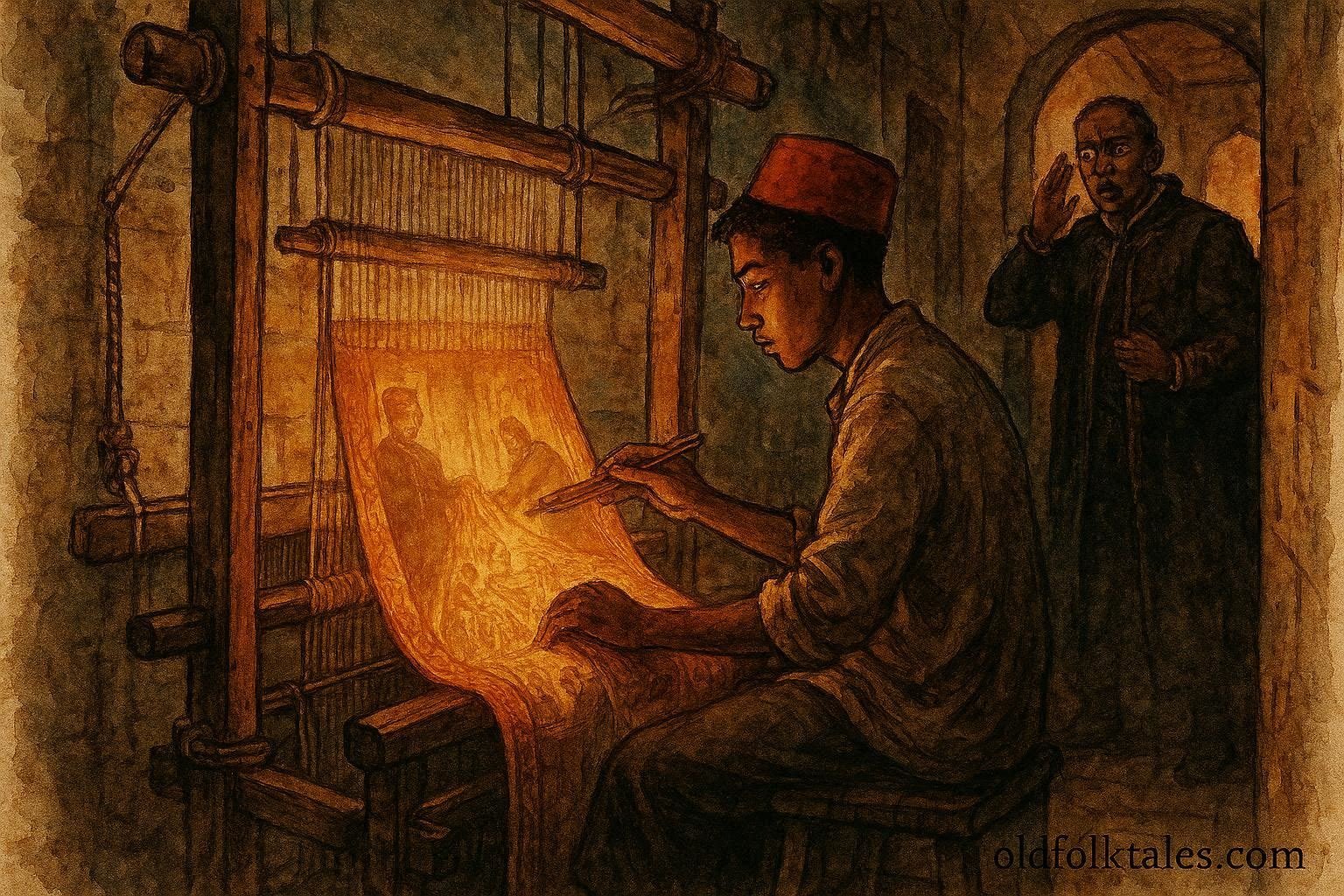
In the ancient city of Fez, where winding alleys twist like threads through stone walls and the air carries the scent of dye, leather, and spice, craftsmanship is not merely work, it is heritage.
Within this city lived a young weaver’s daughter.
Don’t stop yet! See our complete East African folktales collection
She was raised among fabrics, patterns, and the steady rhythm of the loom. Her mother had been a respected weaver, known for producing cloth that was not only beautiful but precise, as though each thread had purpose beyond appearance.
When her mother passed away, the girl inherited little in possessions, but she received one thing of great value.
A loom.
It was old, carved from dark wood worn smooth by years of use. Many said it was just a tool shaped by time and skill. But her mother had always treated it differently, speaking to it softly, as though it understood her.
The girl did not yet know why.
The Inheritance of Silence and Thread
After her mother’s passing, the household grew quiet.
The loom stood in its place, waiting.
At first, the girl did not touch it. Grief has a way of making even familiar objects feel distant. But necessity has its own urgency.
One morning, she sat before the loom and placed her hands on its frame.
It felt warm.
Not like wood left in the sun, but warm, as though it remembered touch.
She began to weave.
The motion was familiar. Thread passed through thread. Patterns formed slowly, carefully.
Then something unexpected happened.
The loom made a sound.
Not a creak.
Not a groan.
A voice.
The First Words of the Loom
The girl froze.
Her hands stopped mid-motion.
“Do not fear,” the loom said softly.
She stepped back immediately, her heart pounding.
“I am not here to harm you,” the voice continued. “I am here because you have inherited more than wood and thread.”
The girl looked around the room, as if someone might be hiding nearby.
But she was alone.
“What are you?” she whispered.
“I am what your mother taught me to become,” the loom replied.
The girl did not understand.
But slowly, carefully, she returned to the loom.
And resumed weaving.
The Truth in the Fabric
As she worked, the loom guided her.
It did not move on its own, but it spoke as she wove, offering suggestions, correcting tension, shifting patterns slightly when needed.
And with every finished piece, something strange appeared.
The fabric did not only show color and design.
It revealed images.
Scenes.
Truths.
At first, the girl thought it was imagination.
But the images were too precise.
Too specific.
A stolen exchange in a hidden room.
A lie spoken in public and contradicted in private.
A hidden act of cruelty behind a noble face.
The cloth was not just woven.
It was revealing.
The Nobleman’s Request
Word of the girl’s extraordinary skill spread quietly through Fez.
Eventually, it reached a powerful nobleman.
He arrived at her home with attendants, dressed in fine garments, his presence filling the room with authority.
“I hear you weave unlike any other,” he said.
The girl lowered her gaze respectfully.
“I weave as I was taught,” she replied.
The nobleman smiled faintly.
“I require a robe,” he said. “One worthy of my status. A garment that will display my honor in court.”
He placed a generous sum of gold before her.
“And I expect perfection,” he added.
The girl hesitated only briefly.
Then she agreed.
The Loom’s Warning
That night, she sat before the loom.
As she prepared the threads, the loom spoke.
“This garment will reveal more than you intend,” it said.
The girl paused.
“What do you mean?” she asked quietly.
“The one who commissions it,” the loom replied, “carries truth he does not wish to be seen.”
The girl’s hands tightened slightly on the thread.
“I cannot refuse him,” she said. “He is powerful.”
“The truth does not care for power,” the loom replied.
Silence followed.
Then the girl continued weaving.
The Robe That Spoke Without Words
Days passed.
The robe grew in form, rich, detailed, and flawless in appearance.
But as it neared completion, the loom began to reveal more clearly what it had been showing in fragments.
The fabric displayed scenes of corruption.
Hidden exchanges.
Misused authority.
Acts of injustice carried out behind closed doors.
The nobleman’s image, woven into the cloth, was no longer neutral.
It was exposed.
Not through accusation.
But through reflection.
The truth had become visible.
Fear in the Workshop
When the girl saw the final pattern, she stepped back in shock.
She understood immediately what would happen if the nobleman saw it.
He would not accept it.
He would not question it.
He would punish it.
She considered destroying the robe.
Or hiding it.
But the loom spoke again.
“Truth cannot be buried in thread,” it said. “Only delayed.”
The girl sat in silence for a long time.
Fear pressed against her thoughts.
But beneath it, something steadier began to form.
Resolve.
The Moment of Presentation
The day of delivery arrived.
The nobleman returned with attendants.
He expected admiration.
He expected obedience.
The girl brought out the robe.
It shimmered under the light, beautifully crafted, flawless in appearance.
The nobleman extended his arms as it was placed upon him.
At first, he smiled.
But then he saw it.
The images.
The truth woven into the fabric.
His expression changed.
Slowly.
Sharply.
The attendants shifted uneasily.
Whispers began.
The nobleman stepped back.
“What is this?” he demanded.
The girl lowered her head.
“I only wove what the loom showed,” she said.
The Exposure of Power
The nobleman tried to remove the robe, but the images remained visible.
His hidden actions were no longer hidden.
Not in words.
Not in accusation.
But in cloth.
The court would see it.
The city would see it.
Fez would see it.
And he understood this immediately.
His authority, carefully built on appearance, had been undermined by truth he could not control.
He turned toward the girl.
His voice was cold.
“You have made an enemy of me,” he said.
The room fell silent.
The girl did not step back.
But she did not challenge him either.
She simply stood beside the loom’s truth.
What the Loom Had Passed On
Before the nobleman could act, word of the robe began to spread.
Not because of the girl’s intention.
But because truth, once revealed, travels faster than fear can contain it.
People spoke.
Artisans listened.
Officials questioned.
And slowly, the nobleman’s influence began to weaken, not through force, but through exposure.
The girl did not celebrate.
She did not rejoice.
She simply continued weaving.
But now, she understood what her mother had left her.
It was not just a tool.
It was a responsibility.
Legacy of the Weaver’s Daughter
In time, the girl became known not for defiance, but for integrity.
She wove for many, but she never again feared what the loom might reveal.
Because she understood its purpose.
Not to destroy.
But to show.
The loom did not create truth.
It revealed what already existed beneath layers of appearance.
And in doing so, it protected those who might otherwise have remained unseen.
Explore the wisdom and wonder of North African folktales
Moral Lesson
Truth cannot be hidden forever, especially when courage allows it to be revealed. Integrity is stronger than authority, and legacy is not what we inherit in objects, but what we choose to do with them.
Knowledge Check
- What is the main lesson of “The Weaver’s Daughter and the Talking Loom of Fez”?
The story teaches that truth eventually emerges and integrity is more powerful than authority or fear. - What makes the loom special in the folktale?
The loom speaks and weaves fabrics that reveal hidden truths about the people and events connected to them. - Why was the nobleman afraid of the robe?
The robe exposed his hidden corruption and actions through woven imagery that could not be denied. - What role does the weaver’s daughter play in the story?
She is the guardian of truth, choosing integrity over fear despite the risks posed by powerful figures. - What does the loom symbolize?
The loom symbolizes inherited wisdom, truth, and the responsibility of craftsmanship to reveal reality. - What cultural values are reflected in this Moroccan folktale?
The story highlights honesty, artisanal heritage, courage, justice, and the moral responsibility of creators.
Source: African folktale, Morocco. Adapted from Moroccan artisan folklore documented in Craft Stories of Fez by Fatima Mernissi (1998).
Cultural Origin: Fez, Morocco